...ProgramPublic SpaceCreatives for Vienna – Making Spaces
Creatives for Vienna – Making Spaces

© Foto: Wirtschaftsagentur Wien
A cooperation with the Vienna Business Agency
At the Klima Biennale Wien 2026, the Vienna Business Agency is presenting ten projects that redesign and revitalise open spaces in Vienna. The winning projects emerged from the Creatives for Vienna – Making Spaces competition and were selected by a jury of experts from 132 submissions. They each received €15,000 in funding and support for implementation. The award winning concepts range from shading public spaces to neighbourhood participatory activities. They show how Vienna's creative industries are revitalising neighbourhoods and contributing to the quality of life in Vienna.
With Kühle Sache (COAT | conditions atmosphériques d’espaces), Licht für Vielfalt (Dusts Institute), Wiener Würstelstand (friendship.is), Die Anhaltestelle (Klara Jörg, Anna Krumpholz, Elisabeth Ableidinger, Marlene Lübke-Ahrens), Shade Commons (Konstantin Kim, Ekaterina Korchagina, Osvaldo Almendra), STRØM. (Placemaking Austria), Bruno (studiod*luxe), Die Stadt führt sich auf (Social Design Studio in Kooperation mit Burgtheater Wien), (W)hole in One (Tracing Spaces & Team), VIA TANKE (Via-Tanke-Kollektiv)
09.04. –
10.05.26
Artistic Perspectives
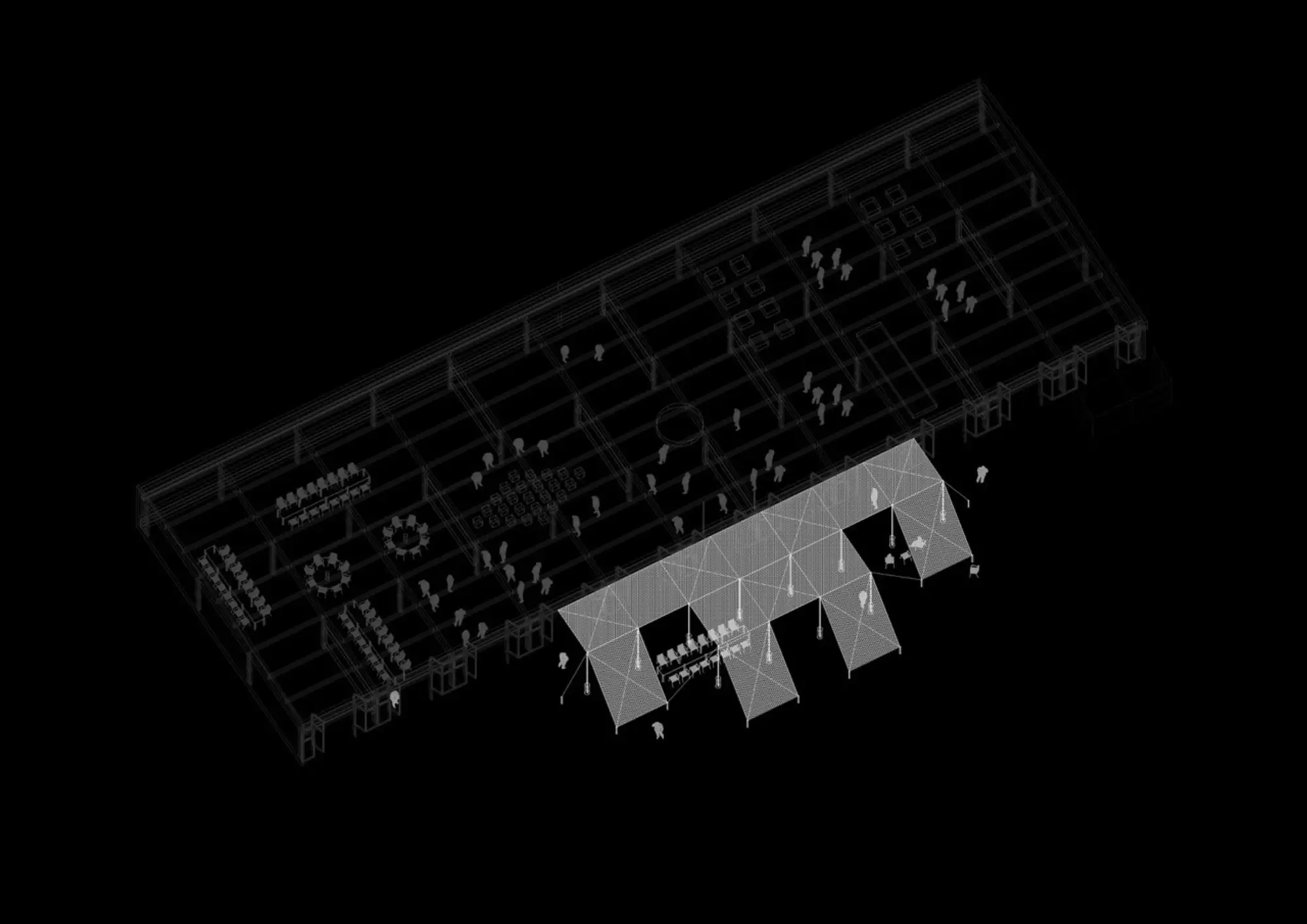
© Foto: Ekaterina Korchagina Konstantin Kim Osvaldo Almendra Axonometric
Shade Commons
How can cities adapt to climate change while making public spaces more inviting? Our answer: look beyond the city and into productive landscapes. Horticultural infrastructure, though vital to urban life, often goes unnoticed. By borrowing the industrial shade house’s typology and techniques, we propose a new public space strategy — one that shields against harsh sun while inviting activity.
This project is currently being built.
09.04.2026–10.05.2026 | always available
Shade Commons
Nordwestbahnstraße 16
1200 Wien
© Foto: ©studiodluxe
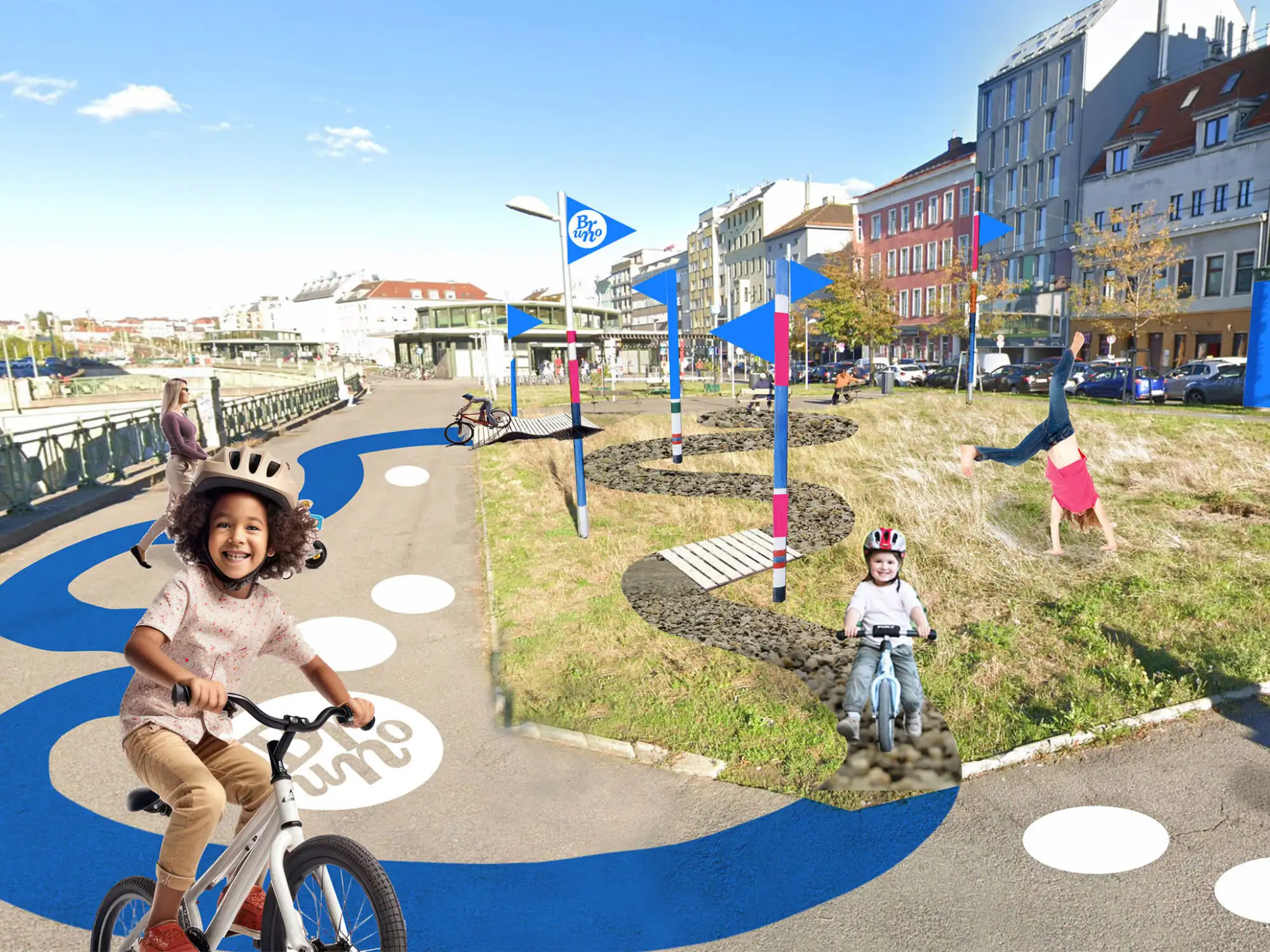
Bruno – ein Bewegungsparcours an der U4/U6
Bruno is open daily. The movement parcours builds on existing structures, boulders, and lawn areas, playfully enhancing them with colorful graphic markings and minimal interventions. Right next to the U4/U6 Längenfeldgasse station, a public open space invites you to rediscover, explore, and actively use it in new ways.
24.04.2026–10.05.2026 | always available
Bruno
Bruno-Pittermann-Platz
1120 Wien
© Foto: © Natalia Stundova
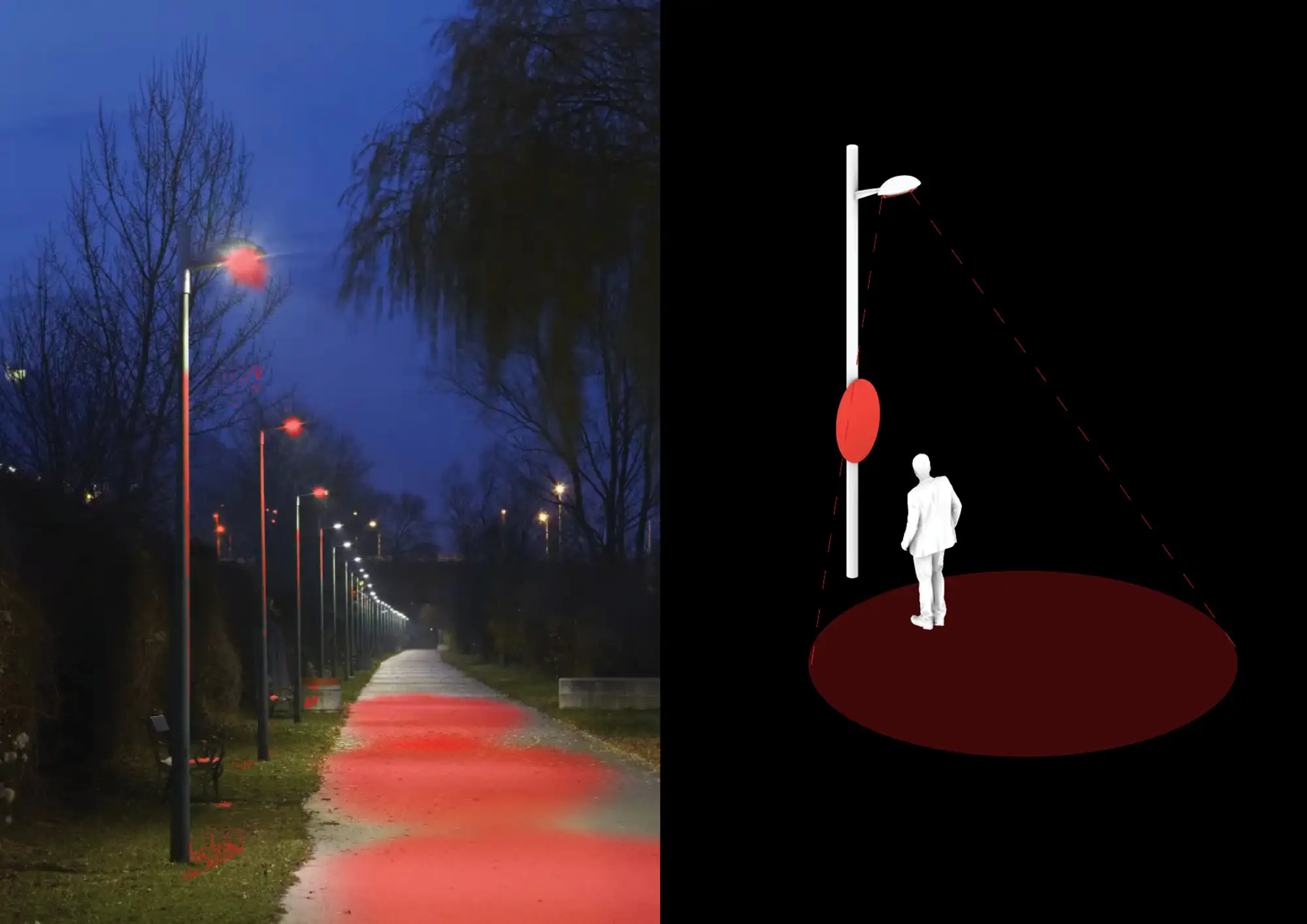
Light for Biodiversity
Light for Biodiversity is a temporary light-based intervention developed by Dusts Institute for the Klima Biennale Wien 2026. The project explores how artificial light shapes urban ecosystems and how small changes in lighting design can support nocturnal biodiversity. Today, most urban environments are permanently illuminated, contributing to the global phenomenon of light pollution. While artificial lighting plays an important role in public life, it can also disrupt the behaviour of many nocturnal species, particularly insects such as moths, which are strongly attracted to certain wavelengths of light. The intervention takes place in Juta-Steier-Park, where existing streetlights will be temporarily equipped with specially designed optical filters. These filters reduce the short wavelengths of light that are known to attract insects while maintaining sufficient illumination for people walking in the park. The installation demonstrates how subtle, reversible adjustments to existing lighting infrastructure can reduce ecological disturbance without changing the everyday use of public space. Alongside the installation, a series of evening workshops will invite visitors to experience the park after dark. Together with nocturnal insect specialist Mario Oswald and artistic researcher Adam Hudec, participants will observe and discuss nocturnal insects using the scientific method of light trapping. By making these often overlooked species visible, the project creates an opportunity to reflect on how cities can become shared habitats for both human and non-human life. Through artistic research and public engagement, Light for Biodiversity encourages a new awareness of the night as an ecological space within the city.
10.04.2026–10.05.2026 | always available
Licht für Vielfalt
Jutta-Steier-Park
Leyserstraße 4
1140 Wien
© Foto: Richard Pobaschnig / Tracing Spaces
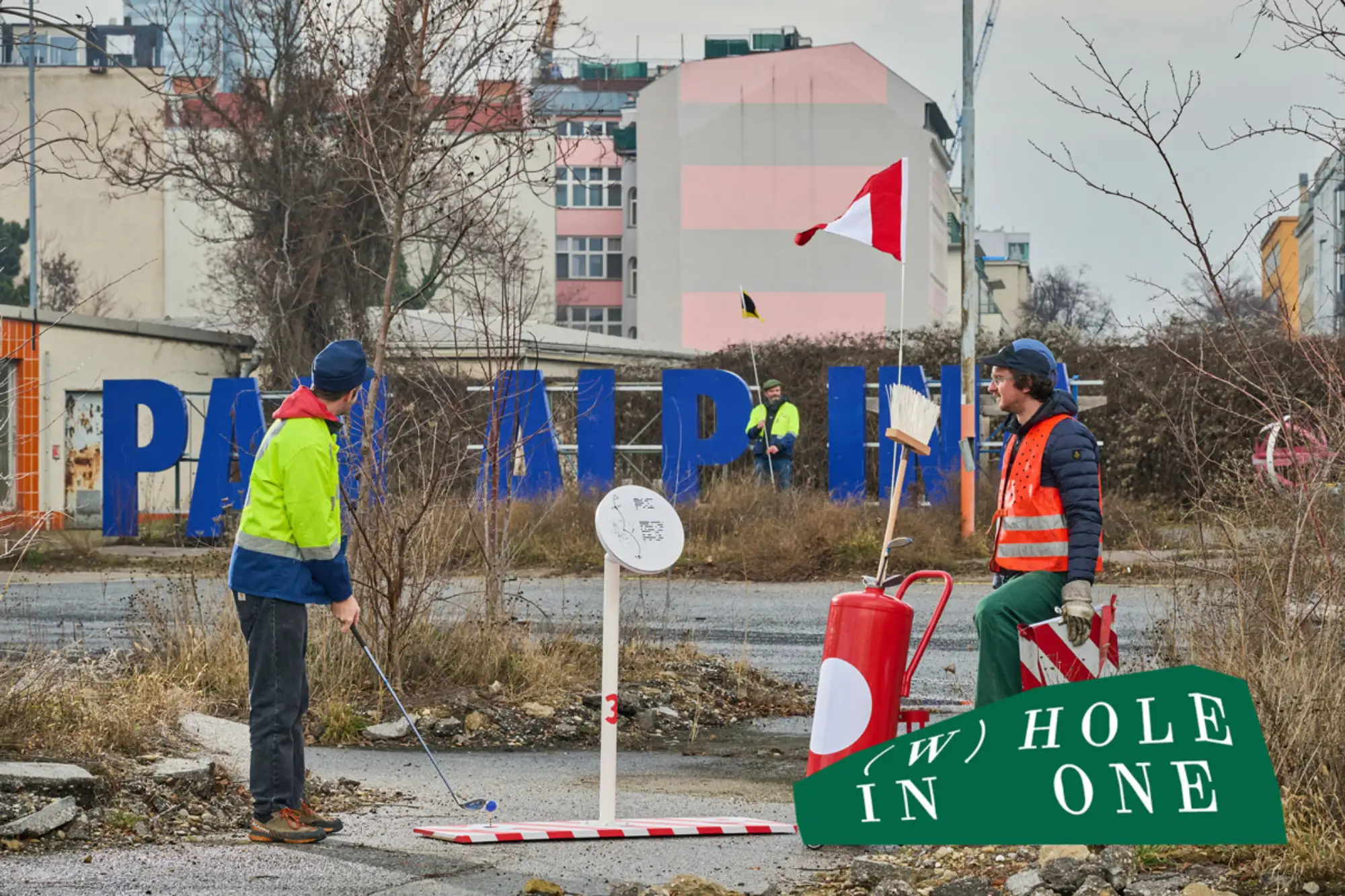
(W)Hole in One. Urban Cross Golf im Pocket Park Nordwest
A cross golf course featuring objects from the Museum Nordwestbahnhof collection is being set up on the wasteland of the disused Nordwestbahnhof railway station. An educational trail will be laid out between the tee stations and target areas, conveying the ecological and architectural potential of the site during its transformation into a new district in an accessible and playful way.
Open to all ages. No prior knowledge required. Balls and clubs available for a deposit. The Museum Nordwestbahnhof will be open at the same time. Registration recommended (office@tracingspaces.net).
Die Anzahl von Golf-Schlägern und Bällen und die Kapazitäten des Platzes sind begrenzt. Mehr Infos zu (W)hole in One unter https://tracingspaces.net/whole-in-one/
17.04.2026–30.05.2026 | Thursday 15:00–20:00, Friday 15:00–20:00, Saturday 15:00–20:00
(W)Hole in One
Nordwestbahnstraße 16
1200 Wien
© Foto: © Jan Gartner/PlaceMaking Austria
STRØM.
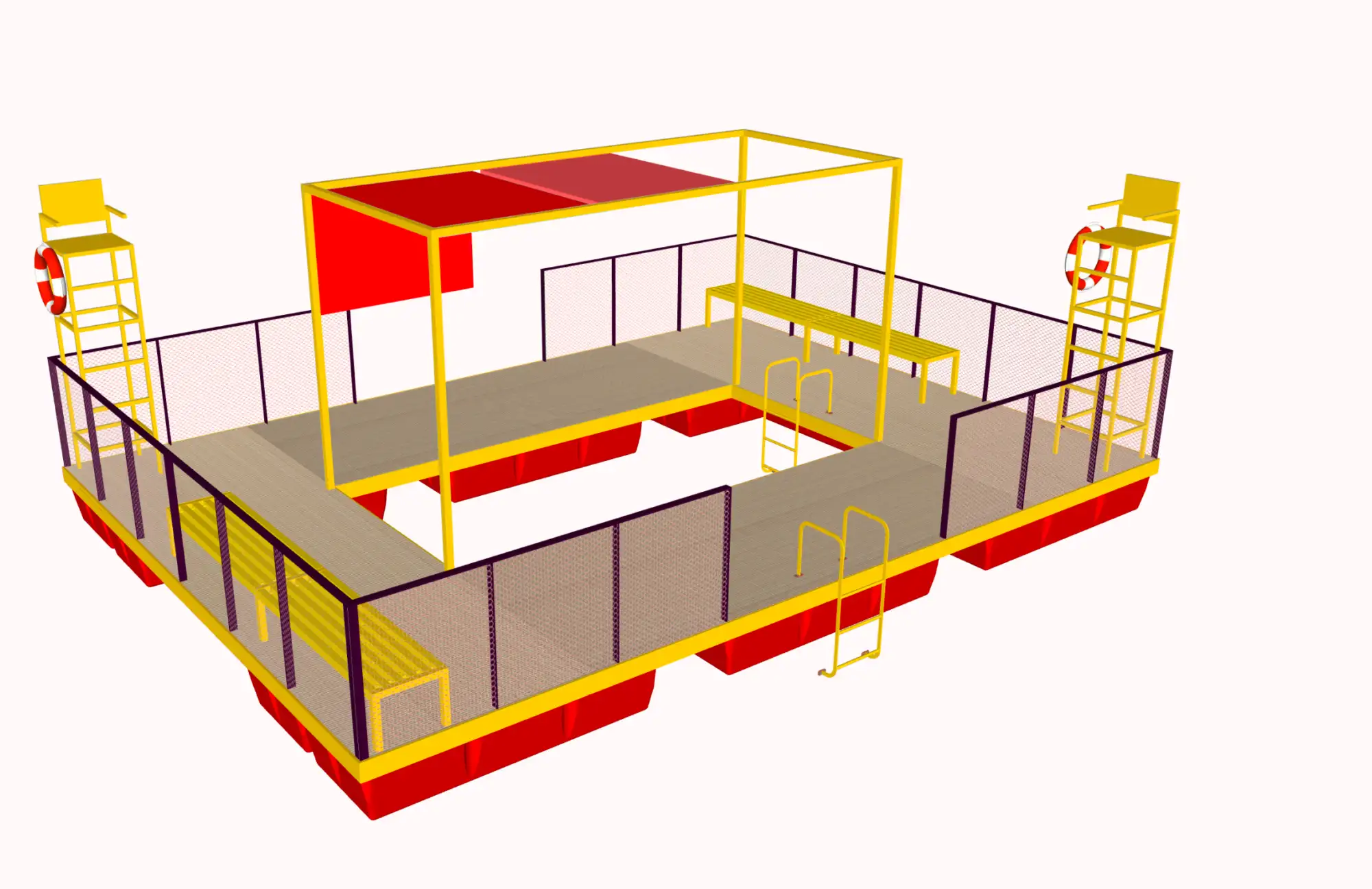
STRØM. - Baden im Kanal explores new ways of urban recreation and sustainable development along Vienna’s Danube Canal. The project demonstrates how water spaces can be made accessible and climate-responsive. Through participatory design and temporary infrastructure, it opens new perspectives on swimming and living with water in the city.
09.04.2026–10.05.2026
STRØM
Nordwestbahnstraße 16
1200 Wien
© Foto: © Lukas Kobel
VIA TANKE
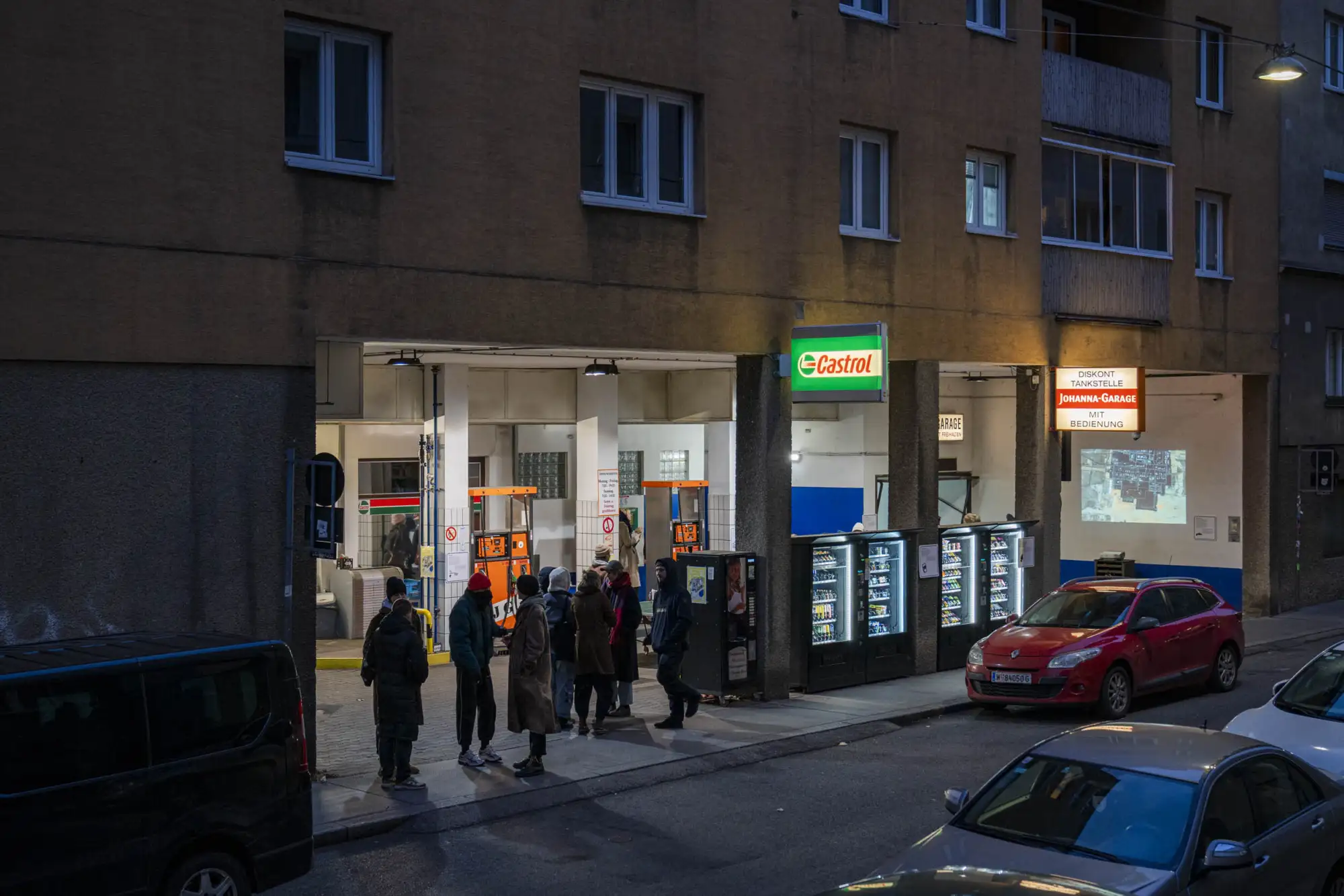
Playfully abandon fossil structures and dancing tango with gas pumps? Embedded inside an apartment block, the sheltered filling station shields from harsh weather. How to transform this semi-public zone into more than just a spot for auto fixes and petrol purchases? We dive into this idea, host a ping-pong competition, race in Mario Kart within the service bay and take apart the colossal Troll-A drilling rig together. Between 4.30 and 5.30 PM, curious people can dance by the pumps during a tango session by Bibi Jung (Bibi Jung Dance Studio): no experience needed, just grab comfy clothes. Bursting with rage over climate chaos and toxic politics? Belt it out and sing loud at our car wash karaoke. Wrapping up, we’ll present "Fahrteiler," our local rideshare scheme: a try-out to turn the pump site into a hub for shared journeys.
18.04.2026–10.05.2026
Via Tanke
Tankstelle Johanna-Garage
Johannagasse 28
1050 Wien
© Foto: © Marlene Luebke-Ahrens, Klara Jörg, Elisabeth Ableidinger, Anna Krumpholz
Die Anhaltestelle
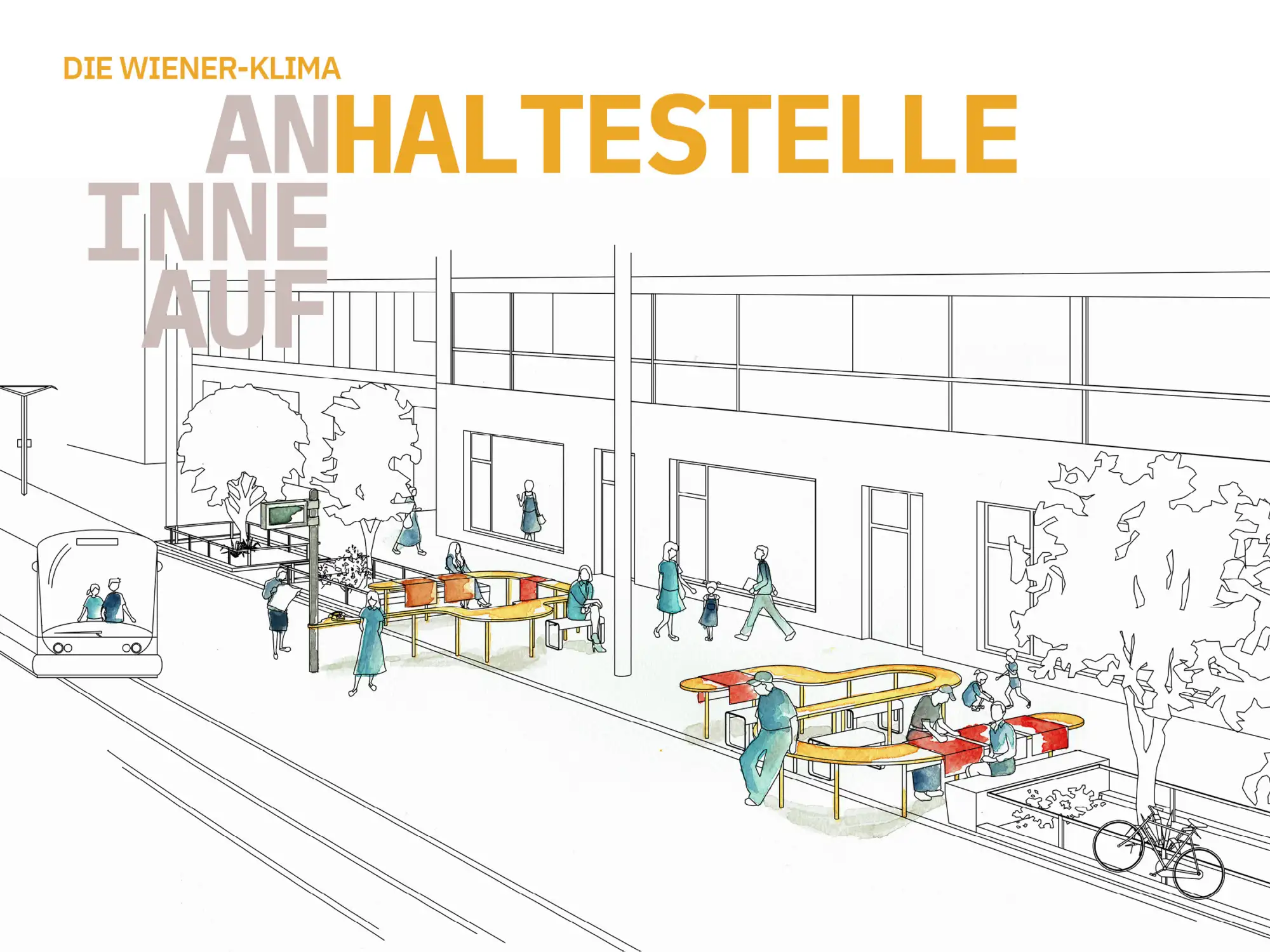
In Vienna, people from diverse social backgrounds, cultural contexts and life realities encounter one another every day. Yet despite this diversity, direct exchange in urban space remains rare – the pace of daily life and digital communication increasingly foster social isolation. The project Anhaltestelle uses tram stops as meeting points for dialogue in the city, encouraging small-scale encounters as a foundation for broader societal connection. Modular additions transform three stops along tram line O from places of waiting into places of pausing. The “Anhaltetisch” (Bruno-Marek-Allee) creates space for sitting together, eating, playing and talking. The “Anhaltebar” (Radetzkyplatz – access to the Climate Biennale) invites conversation while standing, while the circular “Anhaltebank” (Troststraße) encourages group exchange. In addition, the “Wiener Klimatücher” visualize the specific microclimate of each site, making everyday climate conditions both tangible and visible. Beyond these spatial interventions, the stops are activated throughout the Klimabiennale. A supporting programme addresses food, sharing and social interaction, creating opportunities for encounter. During the entire Biennale, the new infrastructures remain open to local actors. In this way, low-threshold spaces for meeting, dialogue and climate awareness emerge – in passing, without obligation, across the city.
09.04.2026–10.05.2026 | always available
Die Anhaltestelle (a)
Bruno-Marek-Allee
Haltestelle der Linie O
1020 Wien
© Foto: © COAT
Kühle Sache
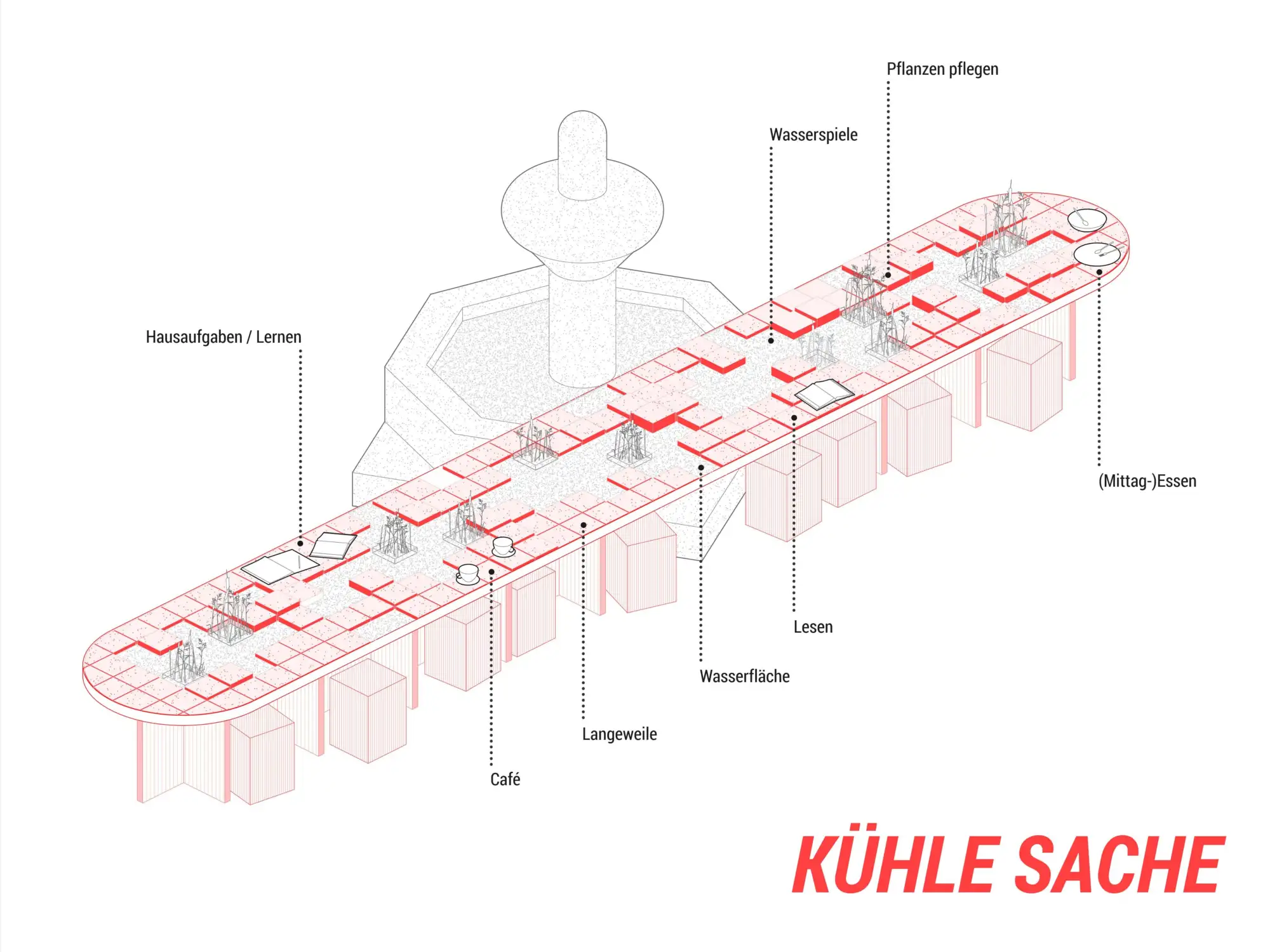
In view of the increasing overheating of Vienna during the summer months, as well as of urban spaces more generally, the temporary installation Kühle Sache (Cool Thing) proposes new ways of engaging with existing blue infrastructure at an inner-city heat hotspot. Its aim is to activate and amplify the potential of adiabatic cooling in the immediate surroundings. Specifically, the project focuses on the listed Tiertränkerbrunnen at Johanna-Dohnal-Platz in the 6th district of Mariahilf, expanding its existing cooling water surface from approximately 3.0 m² to about 11.8 m². The installation, consisting of a water-filled basin, is positioned at an angle above the fountain’s central basin. A jet of water from one of the lion-head spouts is directed into the installation’s basin, creating a generous cooling water surface. The water then flows back into the fountain via an overflow, fully integrating into the existing water circulation system. The Tiertränkerbrunnen comprises basins at three different heights: the lowest for dogs, the middle for horses, and the highest for birds. It represents the inclusive coexistence of diverse participants (including animal) in urban space. Inspired by this idea, the project adds another basin, bringing people closer once again to the cooling water surface. Tiles loosely placed within the water-filled basin form a tabletop surface which, together with chairs, serves as a temporary site for interaction and a variety of activities directly at the cool water’s edge, thereby activating the fountain as a communal gathering space.
10.04.2026–31.05.2026 | always available
Kühle Sache
Johanna-Dohnal-Platz
1060
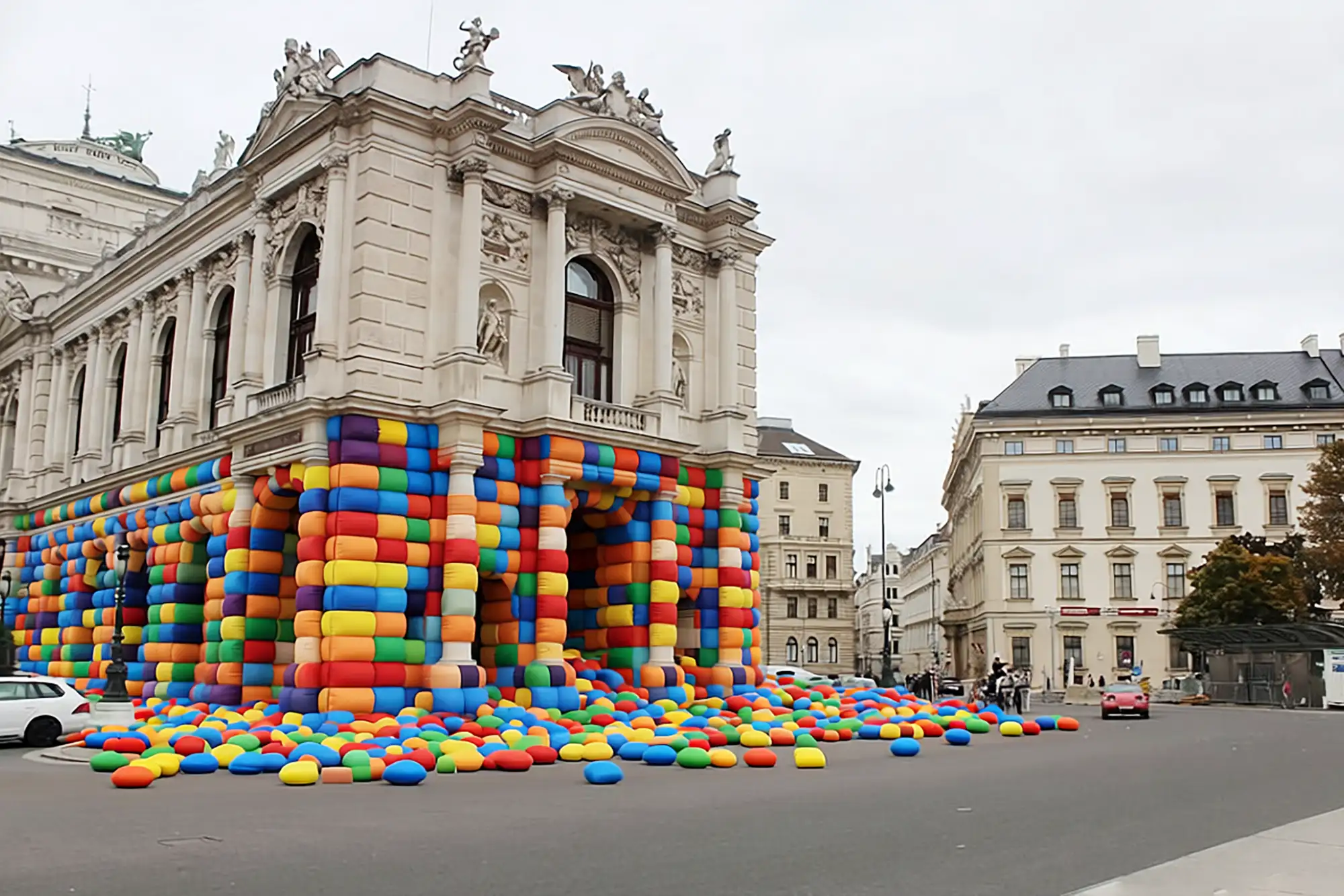
© Foto: © Martin Färber Stable Diffusion KI
Die Stadt führt sich auf
Nothing less than a comfortable spot in public space from which to observe the hustle and bustle of the city—a small opportunity to briefly step away from the fray amid the urban rush, all without any pressure to consume, yet sheltered from the heat or rain—is what this project aims to offer as “luxury for all.” Various stakeholders from the Burgtheater neighborhood, along with experts in working with fine fabrics, as well as initiatives that shake up urban spaces and use them playfully — seeing them as more than just serious and utilitarian — have come together for this experiment. Selected outdoor areas of the Burgtheater are being activated amidst the overly dense traffic and tested for broad use. The self-posed questions are: How quickly can urgently needed solutions be found to furnish urban space in a welcoming and inviting way? How little does it take to still create elegant offerings on the Ringstraße? What materials can the theater provide that can be transformed into design resources for the public? How can combined forces and gathered knowledge be sustainably applied? How does this project appeal to city dwellers who happen to pass by, even if only briefly? It offers a gentle respite from a reality that often feels too harsh, celebrating the freedoms that public spaces in a major city provide—as places for unexpected encounters and as spaces to commit oneself to a climate-just everyday life.
05.05.2026–08.05.2026
Die Stadt führt sich auf
Burgtheater Wien
Universitätsring 2
1010 Wien
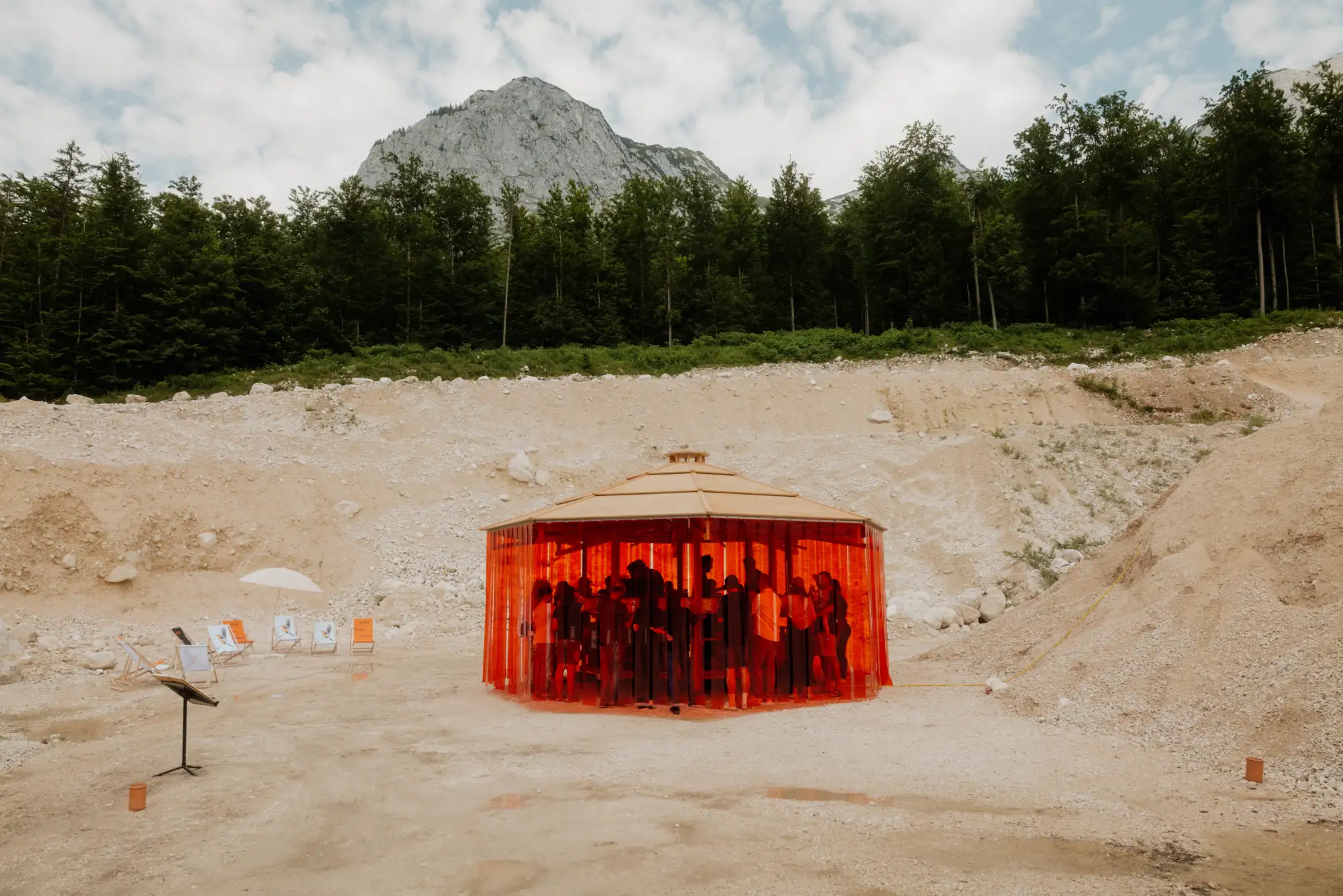
© Foto: ©Hannes Kläger
HOT BOX ON AIR | WIENER WÜRSTELSTAND – EINE VERSUCHSANORDNUNG
The Würstelstand as a social and cultural space of the future! The HOT BOX BUILDING becomes a laboratory at the Funkhaus: From April 24–25, it will pop up for 30 hours as a hybrid meeting place as well as a broadcasting station—an analog space for culinary interventions, workshops, and conversations, while simultaneously transmitting ON AIR.
The HOT BOX BUILDING was conceived as part of the European Capital of Culture Bad Ischl Salzkammergut 2024. The concept Wiener Würstelstand – Eine Versuchsanordnung was developed in collaboration with Clemens Bauder, friendship.is, and Letitia Lehner.
13.04.2026–14.04.2026 & 24.04.2026–25.04.2026
Wiener Würstelstand
Argentinierstraße 30B
1040 Wien