...ProgramPublic Space(No) Funny Games
(No) Funny Games
Curated by:
Hektor Peljak & Dorothea Trappel with Calle Libre, KÖR Wien, museum in progress, MuseumsQuartier Wien
© Foto: eSeL.at - Joanna Pianka
(No) Funny Games or How we learned to start caring and love the dystopia
In a world increasingly shaped by climate disasters, political upheaval, and social fragmentation, our most basic human needs — safety, care, connection — seem to be slipping away. What remains often feels cold, hostile, even cruel beyond comprehension.
(No) Funny Games, part of the Klima Biennale Wien, confronts this uncomfortable reality head-on. The exhibition plays with surface beauty and apparent lightness—only to unravel darker undercurrents that lie beneath. These sitespecific works in public space create seductive, idyllic impressions that turn out to be deceptive. What first appears charming or joyful gradually reveals itself as a mirror to the discomfort of our time.
Drawing on references like Funny Games and Dr. Strangelove, the exhibition engages in a double game of irony and sincerity. It uses aesthetic allure to draw us in, only to challenge our emotional defenses and confront us with our shared complicity. Joy becomes an act of resistance; wonder a way to stay alive in dystopia. But the question remains: What kinds of worlds are we creating to make the real one bearable—and at what cost?
(No) Funny Games not only questions the role of public art in times of crisis but also critiques how art is often instrumentalized in the context of climate discourse—without offering real solutions. These works break the fourth wall, inviting not passive consumption but emotional involvement and ethical reflection.
Activations Kaorle am Karlsplatz 2026
Art, cultural and educational institutions such as the Vienna State Opera, Karlskirche, the Vienna University of Technology, Wien Museum, the Secession, the Künstlerhaus Wien and other venues around Karlsplatz are participating in the activation of Margot Pilz's Kaorle am Karlsplatz 2026 with a diverse programme of events. Special tours, discussion formats and an educational programme will shed light on current issues relating to climate, cities and sustainability from artistic, spiritual and scientific perspectives. Musical performances and performative contributions put a spot on social aspects of the climate crisis and possible visions for the future. This creates a lively dialogue between art, the public and institutions, positioning Karlsplatz as a platform for climate awareness and transformation.
Programme Partners
HOPE Raumlabor @TU Wien I Kunst und Gestaltung
Karlskirche
Kunsthalle Wien
Künstlerhaus Vereinigung
NEST – Neue Staatsoper
Secession Vereinigung Bildender Künstler*innen Wien
Wien Museum
Wiener Staatsoper
The exhibition will be accompanied by a publication to be published by Verlag für moderne Kunst, Vienna.
Artists:
Margot Pilz, Pia Sirén, Zheng Mahler, Dominik Eulberg, Marcin Nowicki, Eva Seiler, Folke Köbberling, River Claure, FutureLeaks, NEVERCREW, Romuald Hazoumè
09.04. –
10.05.26
Artistic Perspectives
© Foto: eSeL.at - Joanna Pianka
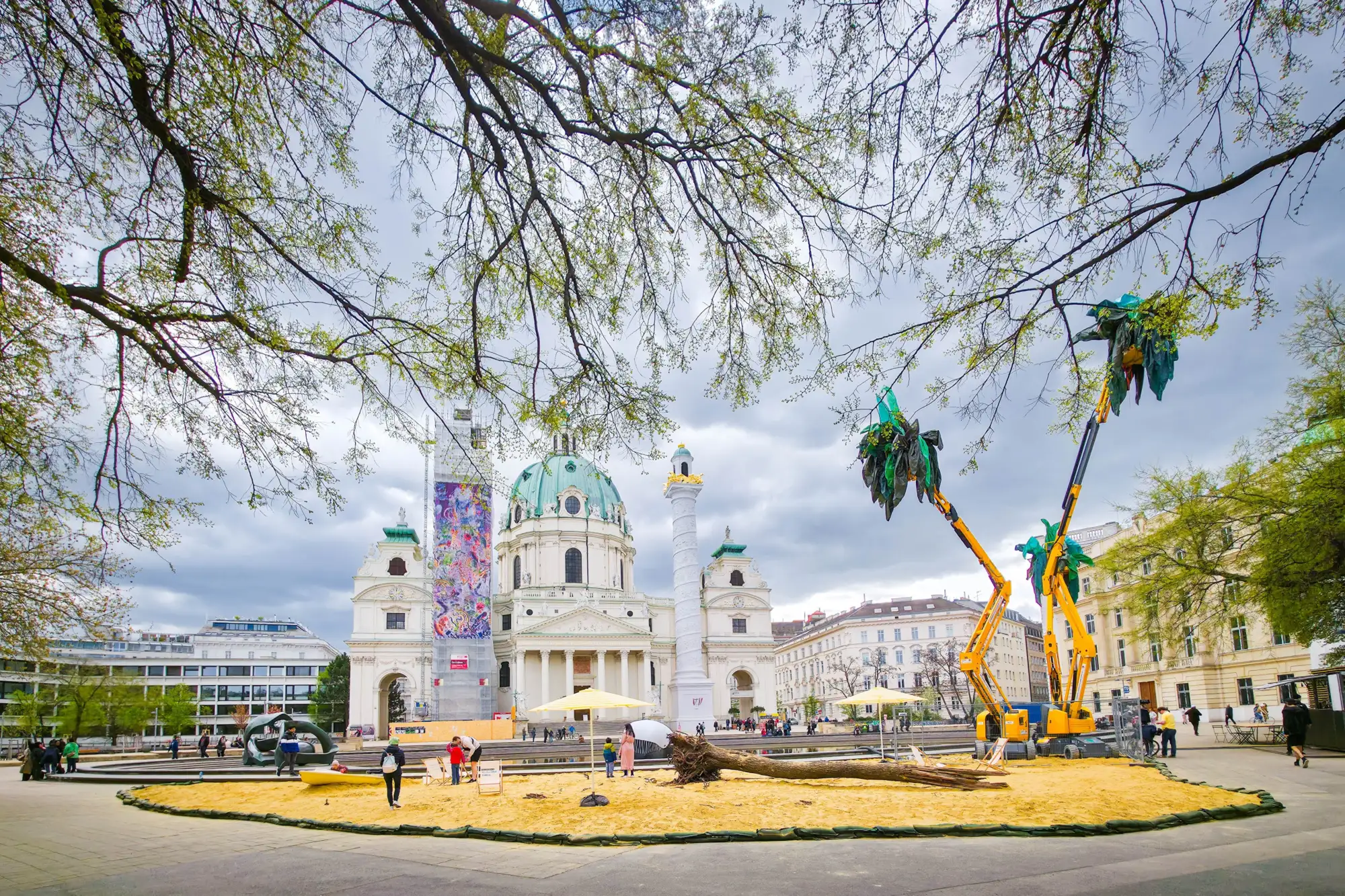
Margot Pilz. Kaorle am Karlsplatz 2026
Kaorle am Karlsplatz 2026 is a restaging of Margot Pilz’s groundbreaking work, contextualized in a contemporary setting. Back in 1982, as part of the Vienna Festival, Pilz transformed Karlsplatz into a consumer-free beach landscape complete with sand, palm trees, deckchairs, and parasols, staging the public space as a social sculpture. An inflatable whale and whale songs were an early reference to environmental destruction and species extinction. Forty-four years later, the installation returns as a critical commentary on the climate crisis. What once seemed like a utopian dream has become a dystopian reality: melting polar ice caps, rising sea levels, disappearing beaches and resource scarcity characterize the present. Kaorle am Karlsplatz 2026 combines escapist lightness with political acuity. The project questions responsibility, inaction, and the exploitation of nature, seeing itself as an open space between criticism, dialogue, and hope.
This project is realized with the kind support of Hengl Mineral GmbH and SSO Garten & Planung GmbH.
With activations by Karlskirche, Kunsthalle Wien, Künstlerhaus Vereinigung, NEST – Neue Staatsoper im Künstlerhaus, Wiener Staatsoper, HOPE Raumlabor @ TU Wien, Wien Museum, Vereinigung bildender Künstler*innen Wiener Secession u. a.
Kaorle am Karlsplatz
Karlsplatz
1040 Wien
© Foto: eSeL.at - Joanna Pianka
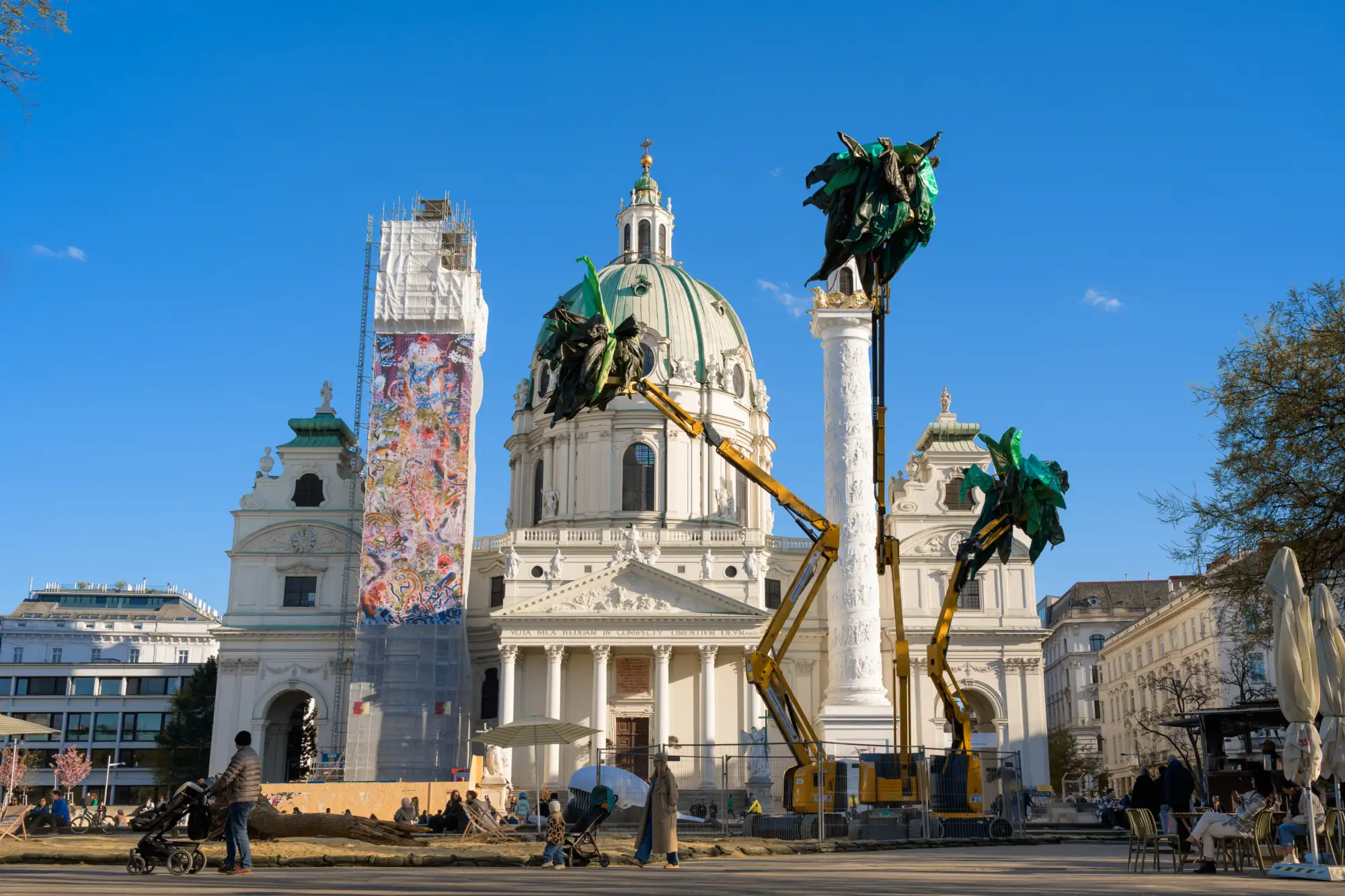
Pia Sirén. Karlsplatz Palmtrees
With Karlsplatz Palmtrees, Pia Sirén has created a temporary installation on Karlsplatz consisting of towering palm trees made from lifting platforms, aluminium tubes, and plastic tarpaulins. The work addresses issues of climate change, colonial-influenced images of longing, and the relationship between city and nature. The deliberately artificial construction refers to historical practices of appropriating exotic vegetation in the Global North. At the same time, the palm trees respond to the conditions of a densely populated urban space in which nature is increasingly planned, controlled, and simulated. Sirén views her palm trees not as permanent sculptures, but as spatial gestures—temporary interventions that shift tropical landscapes into an unexpected urban setting. The installation evokes a sense of ambivalence between longing and alienation, revealing how strongly ideas of nature are shaped by media images, memories, and imperial fantasies.
This project is being realized with the kind support of Wiener Stadtwerke.
Karlsplatz Palmtrees
Karlsplatz
1040 Wien
© Foto: eSeL.at - Joanna Pianka
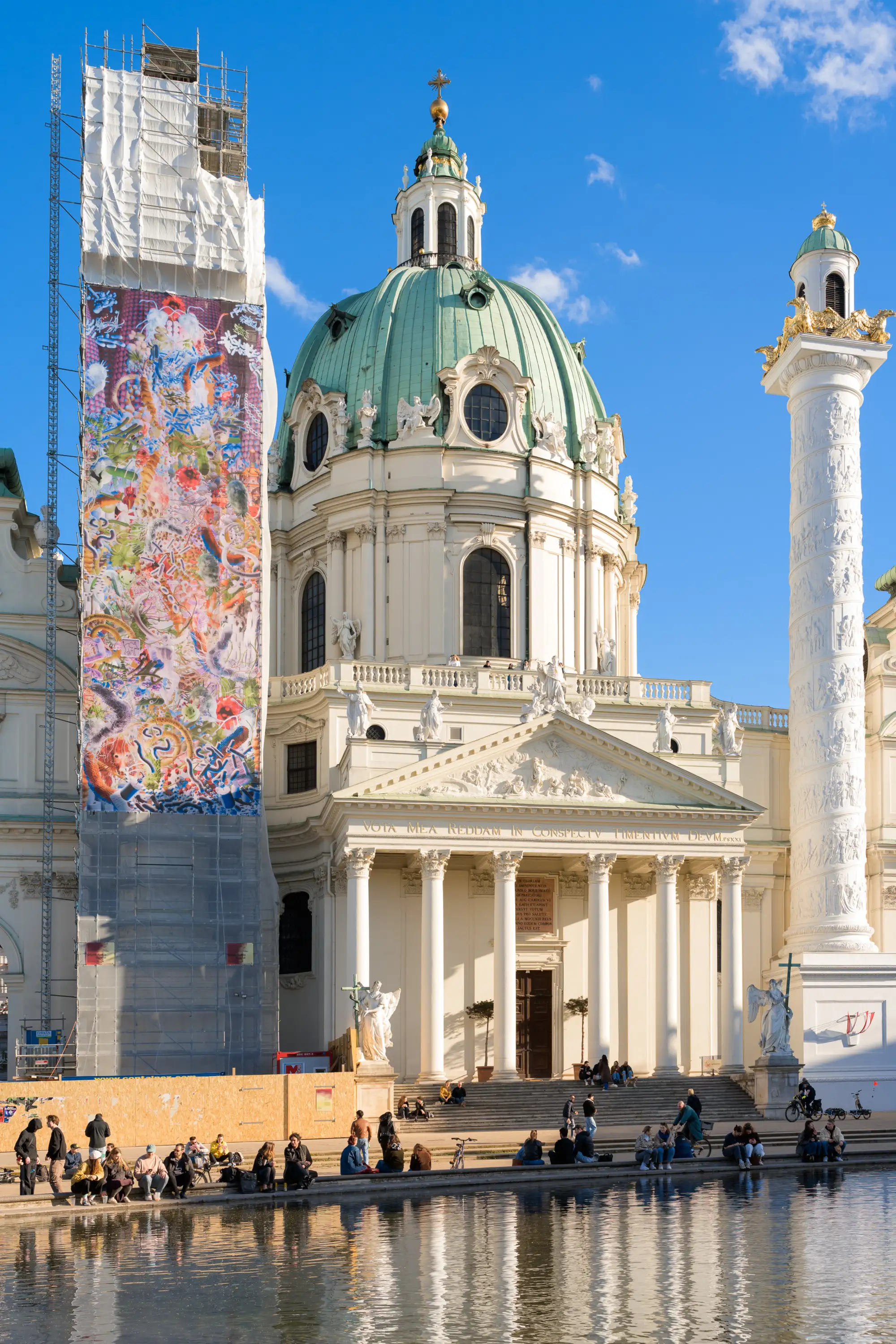
Zheng Mahler. Plague Columns
Since 2009, the artist duo Zheng Mahler has been taking an interdisciplinary approach to their work on the interactions between globalized trade flows, urban infrastructure, and the relationship between humans, nature, and technology. Their work Plague Columns, installed at St. Charles’s Church in Vienna, brings this research-based practice into a specific historical and spatial context. The project focuses on the eastern column of the church, which is covered during restoration work. Zheng Mahler has staged this as a temporary memorial to the Covid-19 pandemic. Built after the end of the Vienna plague epidemic in 1714, St. Charles’s Church stands for the history of epidemics, religious power, and the colonial representation of the Habsburgs. In their work, Zheng Mahler combine the European tradition of the plague column with totemic forms from Hong Kong, addressing anthropocentric worldviews and historical power relations in the process. In doing so, they raise questions about responsibility, memory, and the potential for healing in the relationship between humans and the environment.
This project is being realized with the kind support of Bank Austria.
Plague Columns
Karlskirche am Karlsplatz
1040 Wien
© Foto: Wiener Riesenrad / www.wienerriesenrad.com
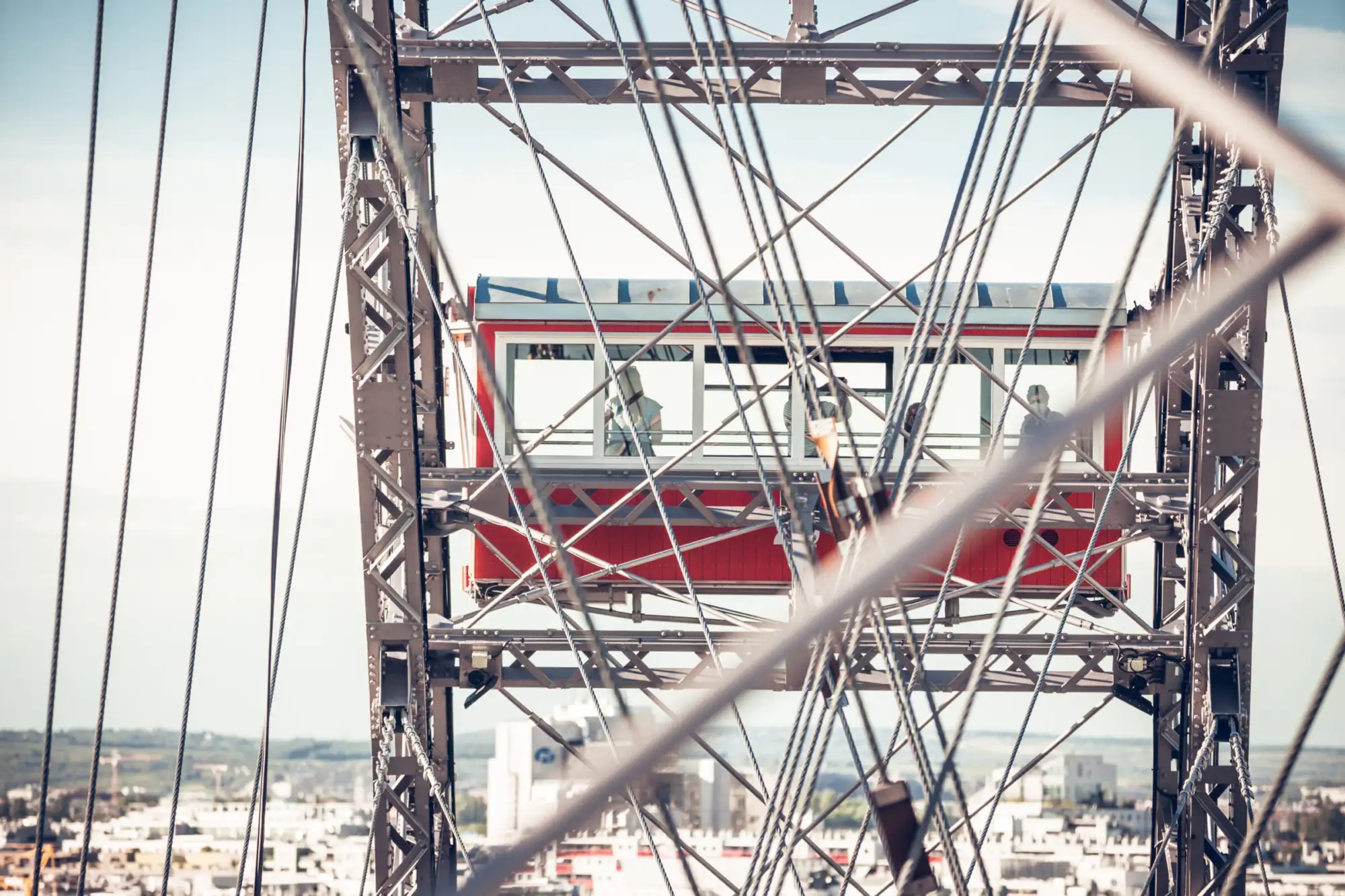
Dominik Eulberg & Marcin Nowicki - Ultrafauna
With Ultrafauna, Dominik Eulberg and Marcin Nowicki have created a sound installation in which bats become active producers of live music. In the Lobau (Donau-Auen National Park), ultrasonic calls from bats are recorded in their natural habitat using highly sensitive microphones, processed digitally in real time and translated into audible sounds. The resulting compositions are transmitted live to a waggon of the Vienna Giant Ferris Wheel for visitors to experience. The system is based on specially developed software that analyses the echolocation signals and interprets them musically via a digital audio environment. Ultrafauna combines ecological research and technology to offer insight into hidden worlds, making the presence of endangered species audible as a dynamic, location-based soundscape in urban space.
This project is realized with the kind support of the Vienna Giant Ferris Wheel and Donau Auen National Park.
Ultrafauna
Wiener Riesenrad
Gaudeegasse 1
1020 Wien
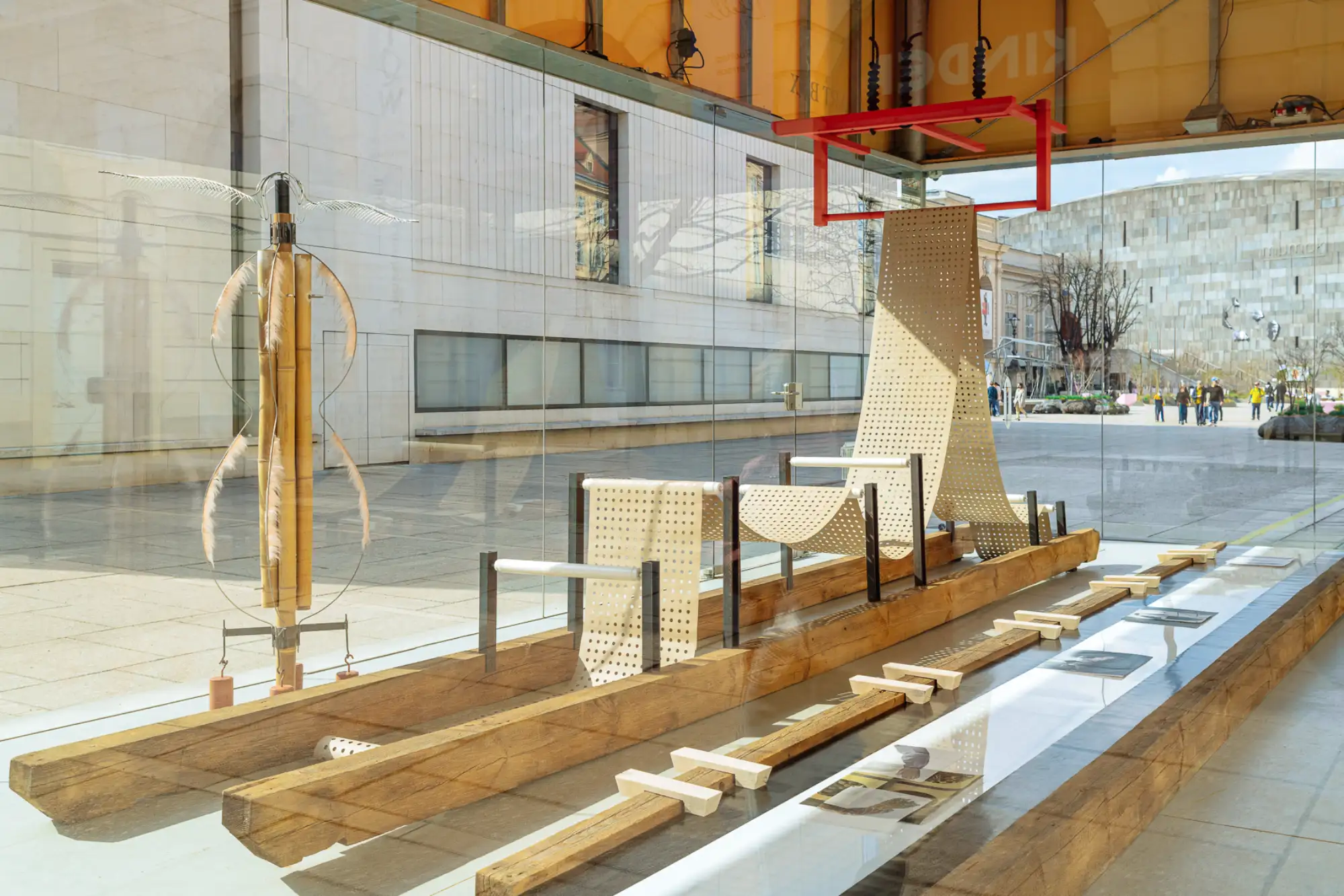
© Foto: Klaus Pichler
Eva Seiler. SPINSTERHOOD – The mulberry tree, the silkworm, the textile worker and the machine
At the heart of Eva Seiler’s installation, SPINSTERHOOD, lies the historical relationship between humans and silkworms. In the MQ Art Box, visitors encounter architectural elements reminiscent of attics, looms, and laboratories—spaces in which biological, human, and mechanical bodies are closely intertwined. The silkworm symbolizes working conditions, control, transformation, and the symbiotic relationship between humans and animals.
Vienna was a centre of silk production for centuries, with mulberry trees dominating the cityscape in the eighteenth century. Seiler addresses this local context, demonstrating the interdependence of mulberry trees, silkworms, spinners, and machines. SPINSTERHOOD thus addresses the production mania of industrialization, selective breeding, and the standardization of human labour, drawing parallels with today’s productivity logic. The title refers to spinsters and sisterhood, opening up a space for reflection on work, care, and coexistence. Without taking a moral stance, the work encourages us to imagine a fair and cooperative relationship between humans and animals.
A project of the MuseumsQuartier Wien in partnership with the Klima Biennale Wien 2026.
SPINSTERHOOD
MQ Art Box
MuseumsQuartier Wien
1070 Wien
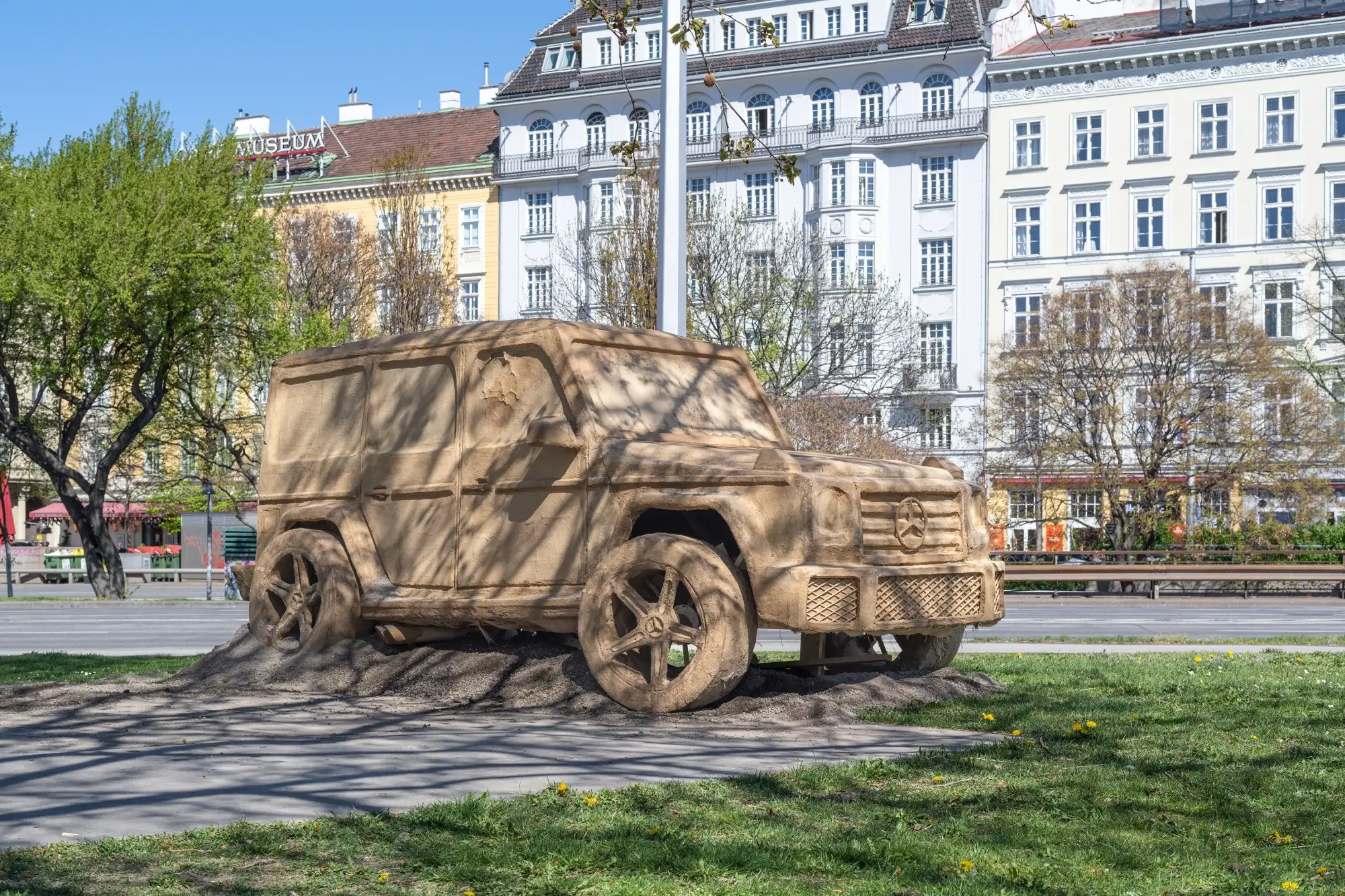
© Foto: Markus Krottendorfer, Bildrecht
Folke Köbberling. Maaaaash!
An off-road vehicle stands on a a piece of meadow right next to a busy traffic artery – muddy brown, as if it were completely covered in mud. It is an irritating yet familiar object in an urban space dominated by traffic.
Maaaaash! is a 1:1 replica of a luxury off-road SUV, which Folke Köbberling modelled directly from the original vehicle. The title of the work – Maaaaash! (to trample, crush, mix) – refers to the production of the material, a bio-based composite developed by the artist herself. Exposed to the elements, the sculpture slowly begins to rot and, unlike the original vehicle, provides space and nutrients for plants and microorganisms.
Folke Köbberling's artistically formulated social criticism is directed against the waste of resources, soil sealing and neoliberal profit-seeking. Maaaaash! is a scathing commentary, a poetic act of protest against the dominance of the automobile and the land consumption of status symbols.
Maaaaash! is a contribution of KÖR Wien (Public Art Vienna) to the Klima Biennale Wien 2026.
The project will be on display in public spaces until the end of July 2027.
Find more information on this project here.
Maaaaash!
Kunstplatz Karlsplatz
Rosa-Mayreder-Park
1040 Wien
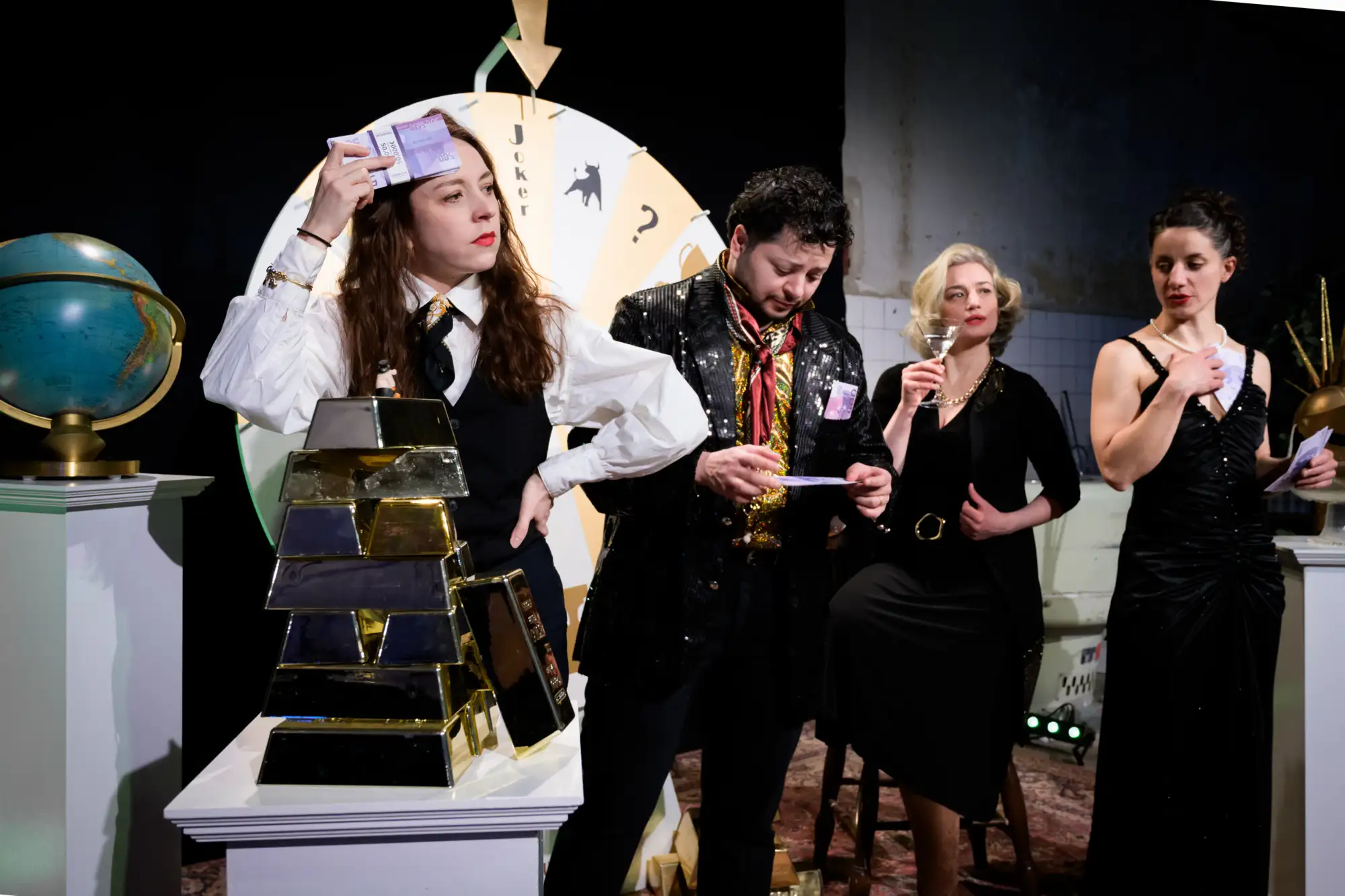
© Foto: eSeL.at / Joanna Pianka
FutureLeaks. The BIG Casino
The BIG Casino transforms an everyday place of consumption into a setting for existential decisions. At the heart of a shopping centre, a speculative casino of the future has opened, where the stakes are not money, but resources, privileges, and livelihoods. Climate becomes a currency, risk becomes a habit, and responsibility becomes an act of negotiation. Anna de Carlo’s immersive performance invites the audience to take part in the action. During the twenty-minute performance, boundaries dissolve between play and seriousness, fiction and reality. Mobility, security, and access to water are up for grabs—as is the question of who will win and who will lose. What is usually taken for granted proves fragile. With this performative parlour game, FutureLeaks condenses space, time, and decision-making into a physical experience, making power relations tangible and renegotiating scope for action.
23.04. & 24.04.2026: 12:30–16:20 (latest entrance at 16:00)
Break: 14:00-15:00
25.04.2026: 10:30–14:20 (latest entrance at 14:00)
Break: 12:30-13:30
The performances starts every 30 minutes.
The BIG Casino
Wien Mitte The Mall
Landstraßer Hauptstraße 1B
1030 Wien
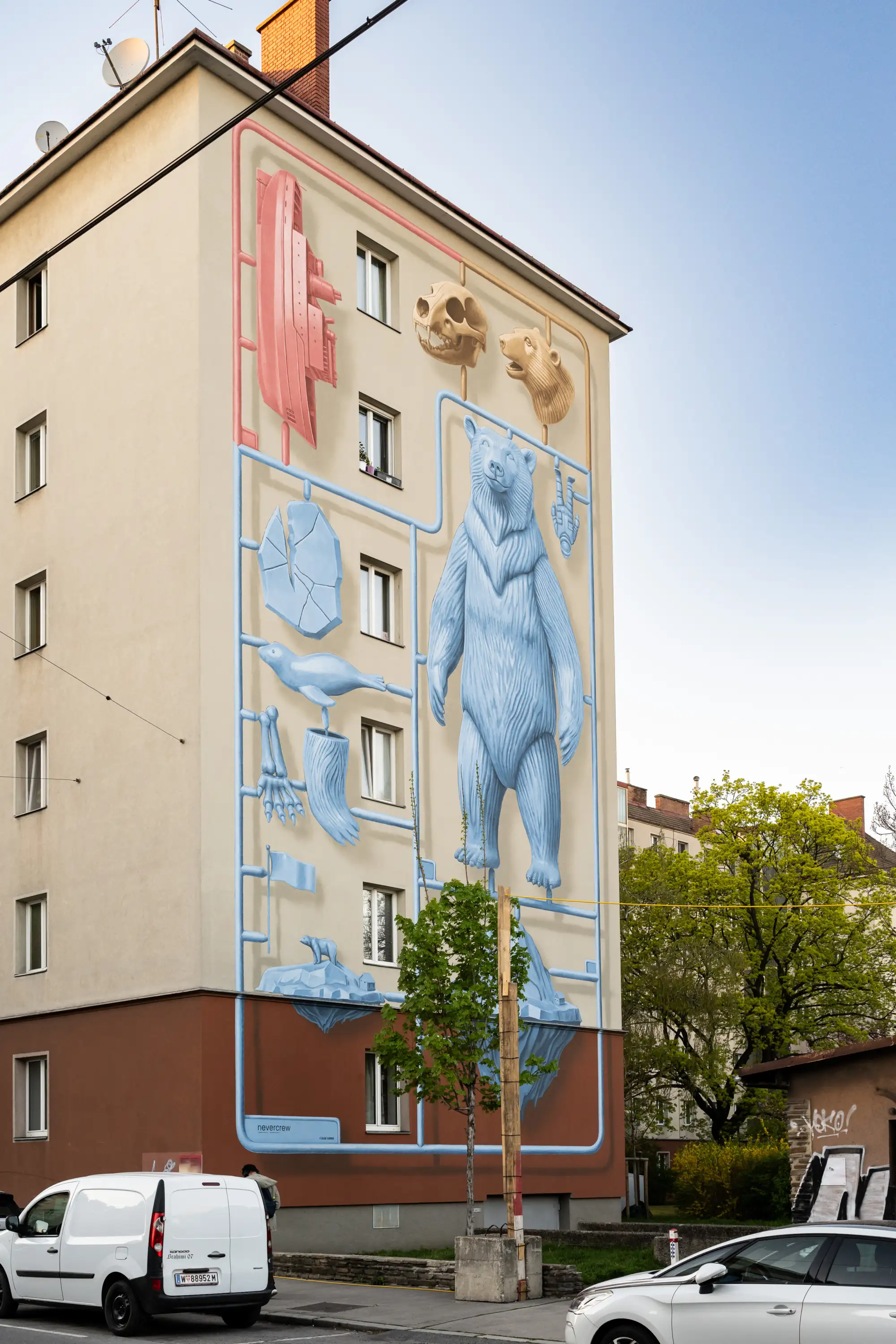
© Foto: eSeL.at - Joanna Pianka
NEVERCREW. Souvenir
Swiss artist duo NEVERCREW (Christian Rebecchi and Pablo Togni) are collaborating with the Calle Libre festival for street art to create a large-scale, site-specific mural on the facade of a building at Baumgasse 77 in Vienna’s 3rd district. The artists view public space as a central arena for social negotiation, positioning their work where it directly impacts everyday routines and patterns of perception. Against the backdrop of ecological crises, social inequalities, and political tensions, NEVERCREW employs a limited vocabulary of colour and form to create a monumental, surreal-dystopian visual language that initially appears accessible but reveals its critical nature upon closer inspection. Created in direct dialogue with the architecture, neighbourhood, and urban space, the wall work sees itself as a permanently accessible intervention that highlights issues related to responsibility, ecological interventions, and the consequences of human action.
This project is being developed in collaboration with and curated by Calle Libre.
Souvenir
Baumgasse 77 (Hauswand)
1030 Wien
© Foto: eSeL.at - Joanna Pianka
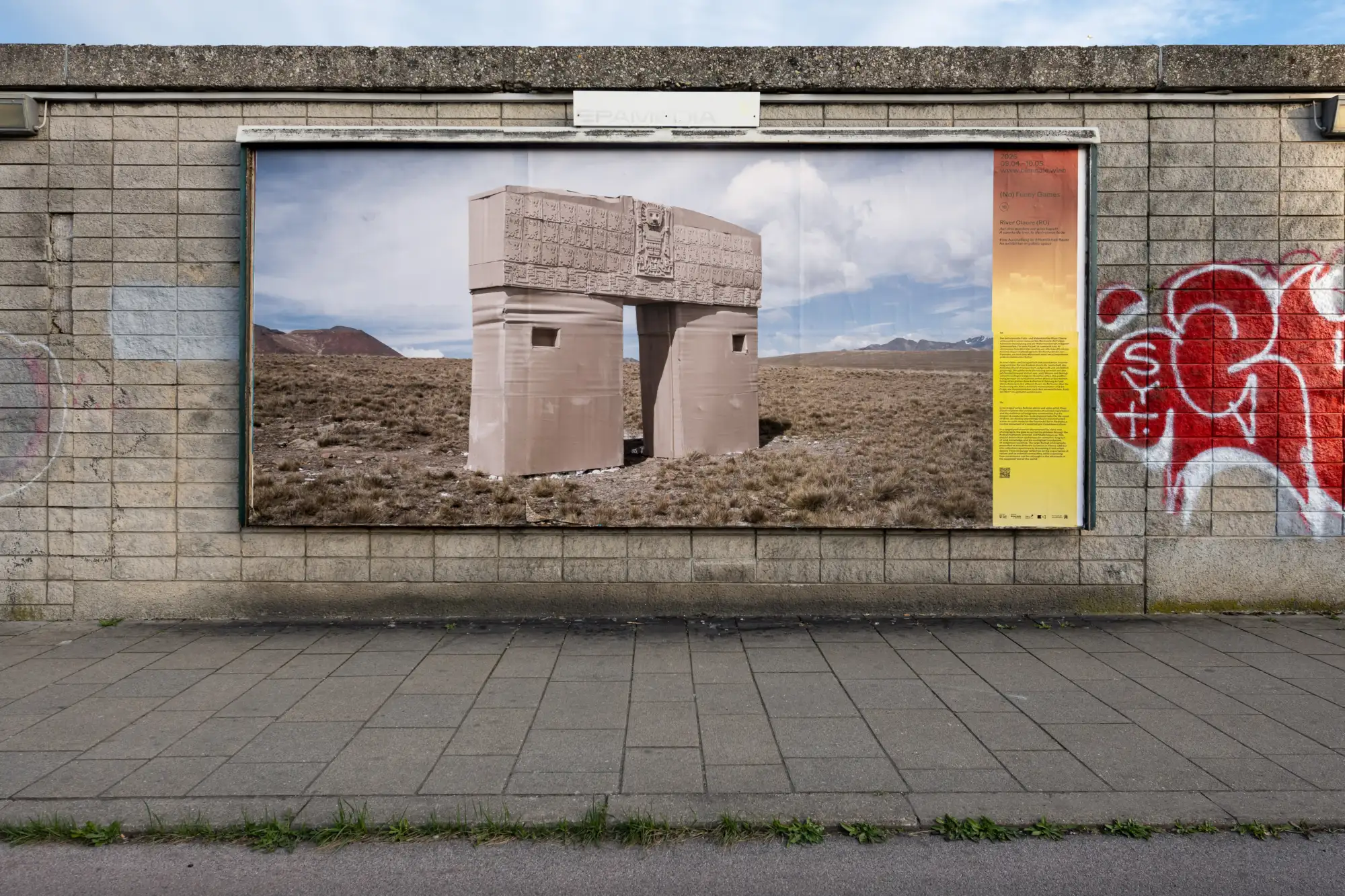
River Claure. A cuenta de tres, lo destruimos todo
In his staged series, Bolivian photo and video artist River Claure explores the consequences of colonial exploitation and the resilience of Indigenous communities. For his project A cuenta de tres, lo destruimos todo (On the count of three, we destroy everything), Claure reconstructed a true-to-scale model of the Puerta del Sol in Tiwanaku, a central monument of a vanished pre-Columbian culture.
In a staged performance documented by video and photographs, the gate is carried by children through the Andean highlands, erected, and finally blown up. This playful destruction symbolizes the centuries-long loss of land, knowledge, and the ecological foundations of Indigenous societies. The large-format photographs presented at nine different locations in Vienna address this collective experience by translating it into urban spaces. They encourage reflection on the exploitation of nature and on colonial continuities, while examining how coexistence can be rethought in the aftermath of the supposed ‘end of the world’.
This project is being realized with the kind support of NOVOart.
A cuenta de... (a)
A cuenta de tres, lo destruimos todo
Nordbahnstraße 51 (Hauswand)
1020 Wien
A cuenta de... (i)
A cuenta de tres, lo destruimos todo
Margaretenplatz
1050 Wien
A cuenta de... (b)
A cuenta de tres, lo destruimos todo
Hellwagstraße 1 (Plakatwand)
1200 Wien
A cuenta de... (c)
A cuenta de tres, lo destruimos todo
Radetzkyplatz (Plakatwand Löwengasse)
1030 Wien
A cuenta de... (d)
A cuenta de tres, lo destruimos todo
Untere Weißgerberstraße 47 (Litfaßsäule)
1030 Wien
A cuenta de... (e)
A cuenta de tres, lo destruimos todo
Kleine Pfarrgasse/Taborstraße
U2 Station
1020 Wien
A cuenta de... (f)
A cuenta de tres, lo destruimos todo
Praterstern (Ausgang U2)
1020 Wien
A cuenta de... (h)
A cuenta de tres, lo destruimos todo
Adele-Perlmutter-Platz/Praterstraße
1020 Wien
A cuenta de... (g)
A cuenta de tres, lo destruimos todo
Yppenplatz
1160 Wien
© Foto: eSeL.at - Joanna Pianka
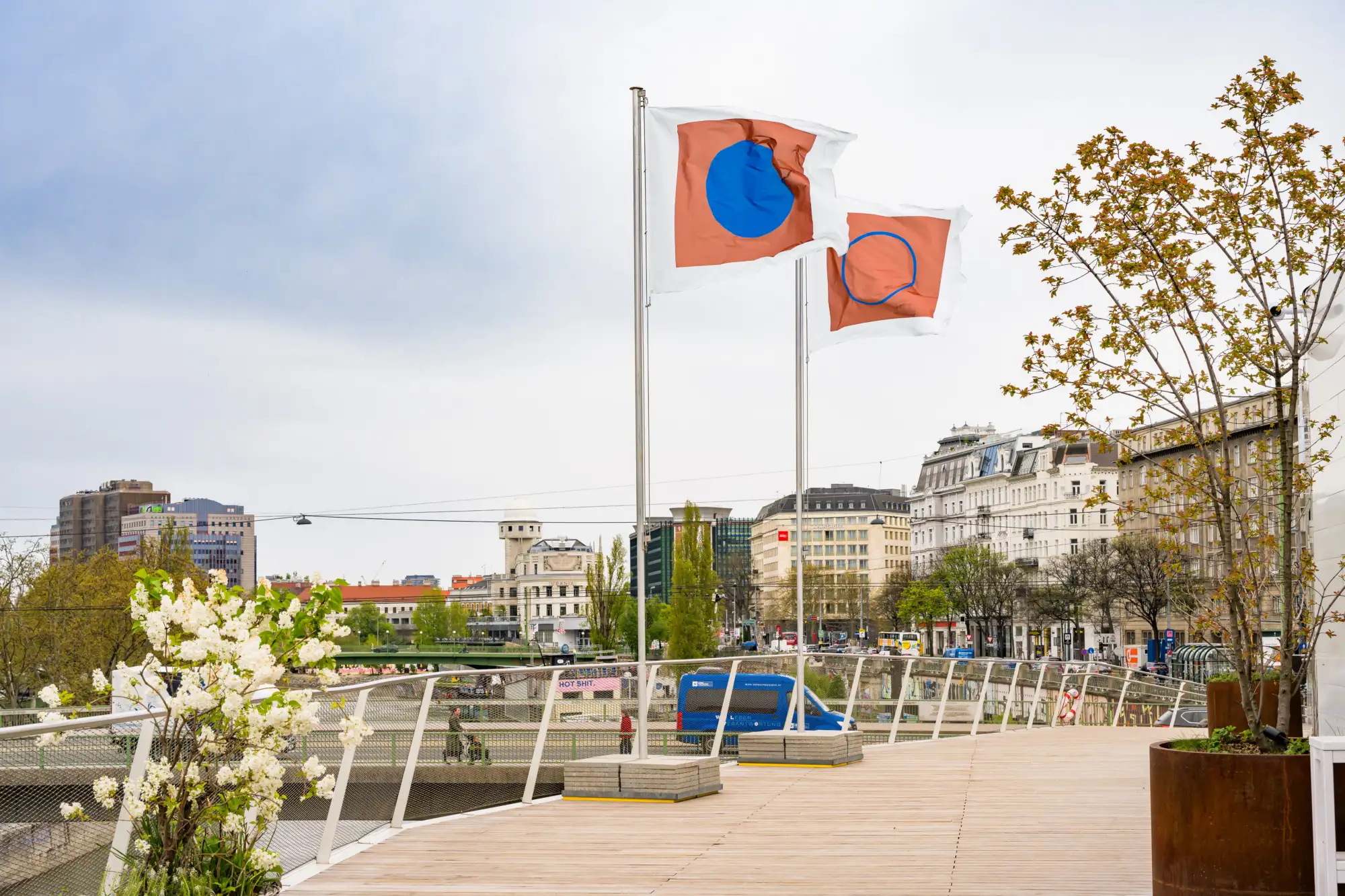
Romuald Hazoumè. ALTER ECO – Fâ
Romuald Hazoumè’s works combine West African traditions with contemporary ecological, social, and socio-political issues. Drawing on everyday life, his objects bear traces of a shared existence. They are not mere representations, but powerful symbols that transcend their origins and continue to resonate within us.
For the Klima Biennale Wien, the artist is exhibiting symbols based on the Fâ, a centuries-old system of knowledge and divination practised by Yorùbá-speaking cultures in West Africa and listed as a UNESCO cultural heritage. These symbols serve as valuable tools for navigating life—rooted in a cosmic order and in a metaphysics of natural forces and ancestral knowledge. On the Aspern bridge and the Stuben bridge, they unfold their universal validity in the desire for reflection and orientation for our community. The spiritual and epistemological dimension of these flags, which are a part of the artist’s Fâ series, gives them a meaning that extends far beyond their original context, making them a globally connectable practice of experience and thought.
ALTER ECO was curated by Alois Herrmann and Kaspar Mühlemann Hartl. A project by museum in progress in collaboration with Klima Biennale Wien 2026.
ALTER ECO
Aspernbrücke & Franz-Josefs-Kai 2
1010 Wien
Events
Supported by