...ProgramSolutions & StrategiesSolutions & Strategies
Solutions & Strategies
© Foto: Matthias Meinharter
Artists:
Juan Rodrigo Torres Plata, Leonie Marquet, Lisa Lupsina, Sidonie Sagmeister, Karolin Burkhardt, Irene Cian, Swetlana Gerner, Gustav Glück, Sheila Grace, Olivia Gründler, Gian Haak, Heidi, Rafael Hofmann, Liu Jingting, Jaehyung Kim, Yifu Leng, Wenjia Luo, Sanjid Mahmud, Kweku Okokroko, Boyun Park, Yeon Park, Maria Pylypenko, Negin Rezaie, Leda Thanassa, Kieren Tockner, Thomas Vava, Lena Wendlandt, Naomi Semma, Josefine Harmer, Birgit F., Francis Fosu, Alix Drakulic, Christoph Karrer, Nana Sorgo, y/liquid (Carmen Rosenkranz, peta Klotzberg), Šimon Varaus, Mark Bou Abdo, Linnea Maria Jørgensen, Rosa Märzendorfer, Mark Napadenski, Sagar Sarkar, Oren Yehoshua (Dj yeriho), Adèle Morel, Carl Theodor Seegers, Sebastian Haaf, Stella Maria Schwaiger, Haesol Han, Nene Wildenberg, Kollektiv Bande (Elisa Schober & Hannah Parth), Hannah Linden, Duannaiyu Wang, Joanna Zoe, Neta Asher Goshen, Veronika Mozberg, Tatiana Vishnyakova, Lukas Sterzenbach, Dauergast, Hanne Jannasch, Isabell Alexandra Meldner, Rasmus Otto Rutsch, Beatrix Johnstone, Gala Alica, Lara Friesz, Mika Roumeliotis, Max Koloman Oswald, Simon Neumüller, Marcus Wagner, Leandra Erdödy, Jonathan Dellago, Dahye Hyun, Josefin Vestberg, Aza Aufgewekt, Theo Bartenberger, Nico Schleicher, Laura Farmwald, Marie Kaňákova, Elza Grono, Gianna Magdalena Semmelhaak, Gwiyeon Han, Cornelis Wuisman Jørgensen, Ana Dos Santos, Helene Kunze, Jana Köstler, Benjamin Ben Amotz, Lukas Matzke, Jan Hadler, Linda Nutz, Bastian Engel, Gabriel, Afiya, Melinda
30.04. –
03.05.26
Artistic Perspectives
© Foto: Anna Knödl
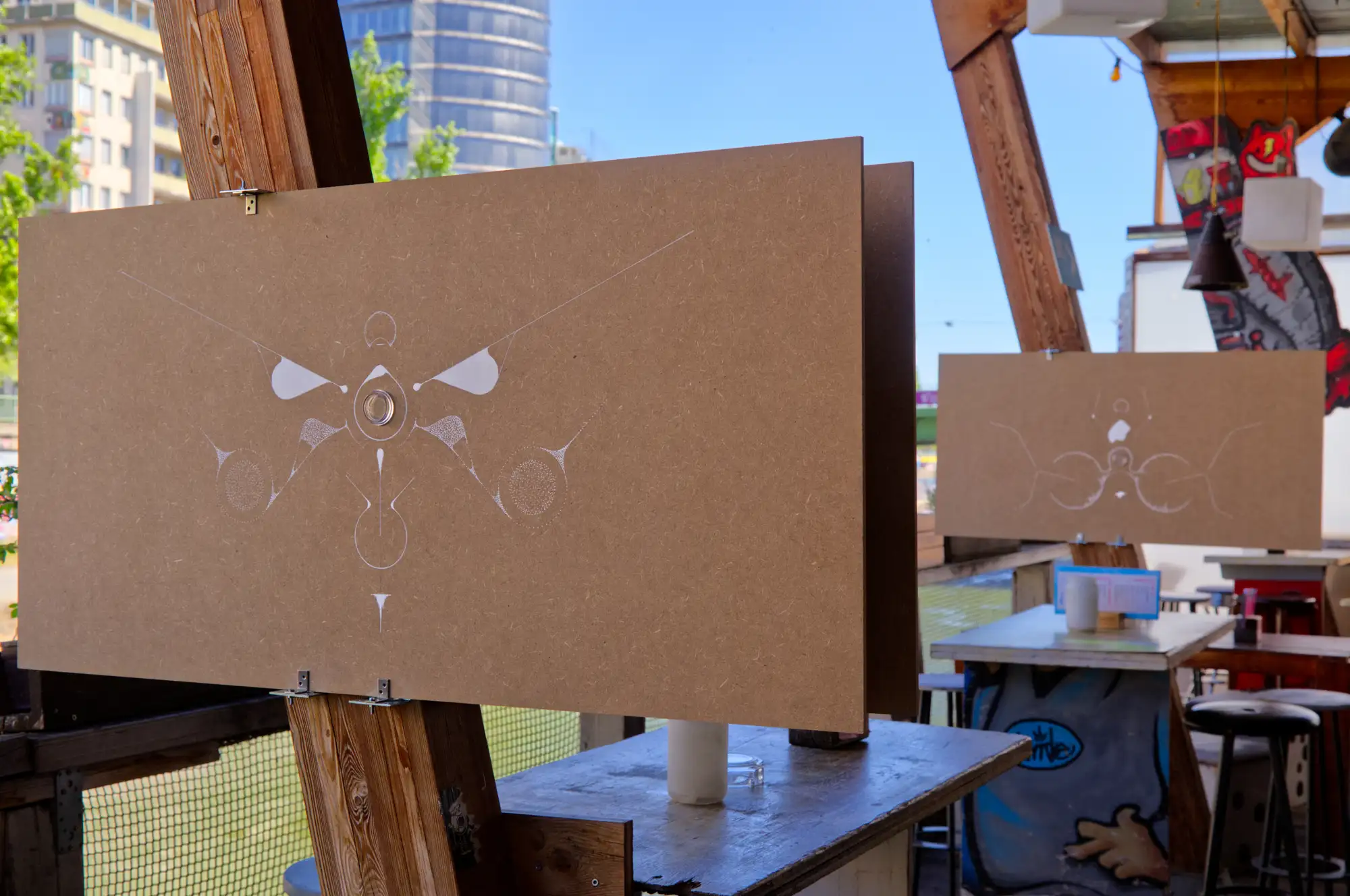
Juan Rodrigo Torres Plata. Alebrije
Alebrijes, inspired by traditional Mexican imagery, appear here as contemporary representations of the Nahual — a shape-shifting being believed to transform into animals and to guide and protect humans in the physical world. They remain deeply rooted in the spiritual symbolism of Mexican culture.
In this image, they are presented as protective presences, evoking a sense of connection to an ancient knowledge that has been largely forgotten.
Acrylic on MDF, 2026
Badeschiff Wien
Wolfgang-Schmitz-Promenade 4
1010 Wien
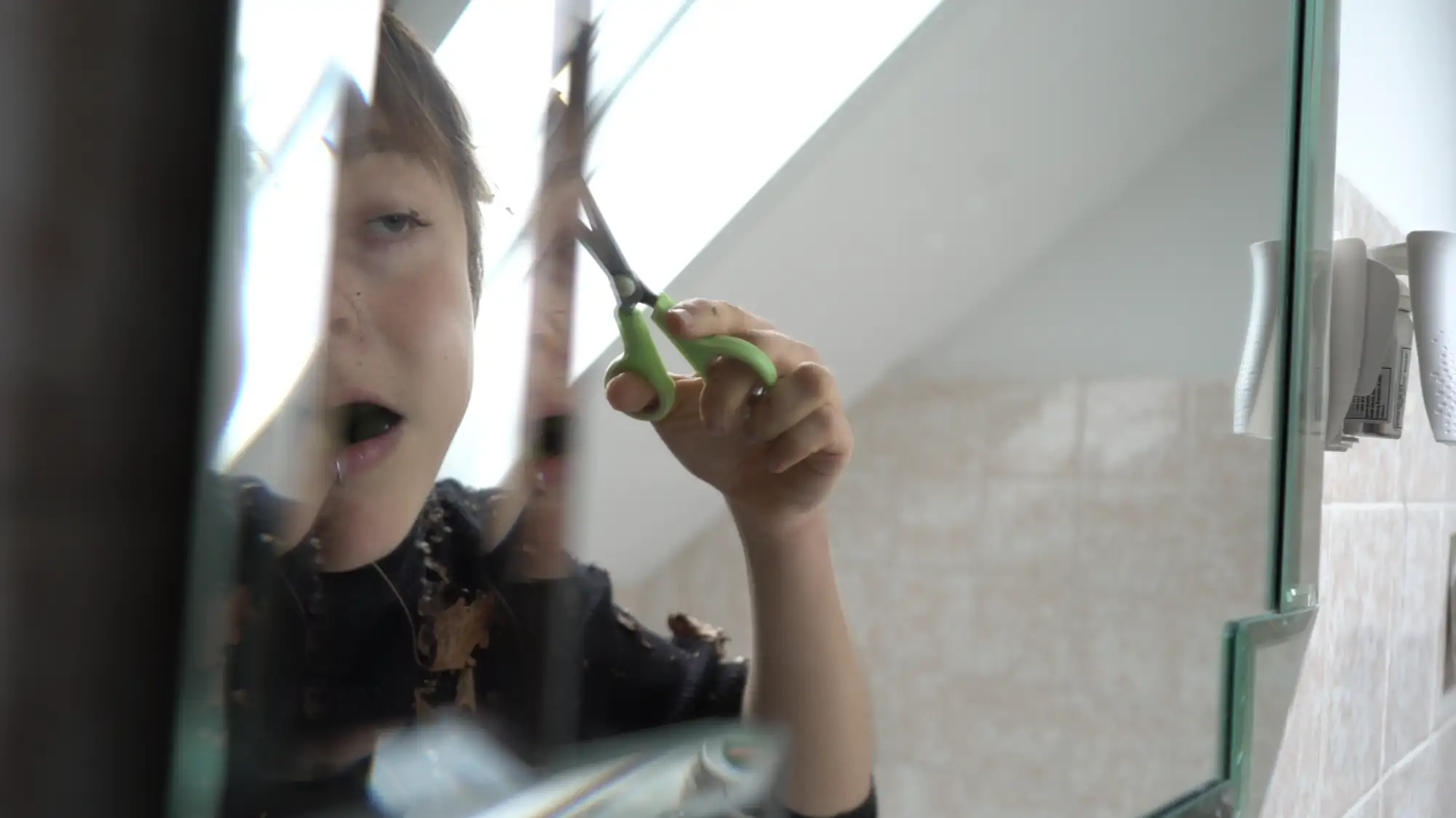
Naomi Semma. morgens
In morgens, we immerse ourselves in the world of a protagonist. We encounter her behind closed doors. These are the brief moments of the day when we are not yet exposed to the world. When we would prefer to hide away, but also have the opportunity to act without being subject to societal norms.
Video, 2025
Music/Composition: Hannah Dorotheé Schmidt
Actress: Luana Gräbe
Special thanks to: Carsten Fuhrmann
Badeschiff Wien
Wolfgang-Schmitz-Promenade 4
1010 Wien
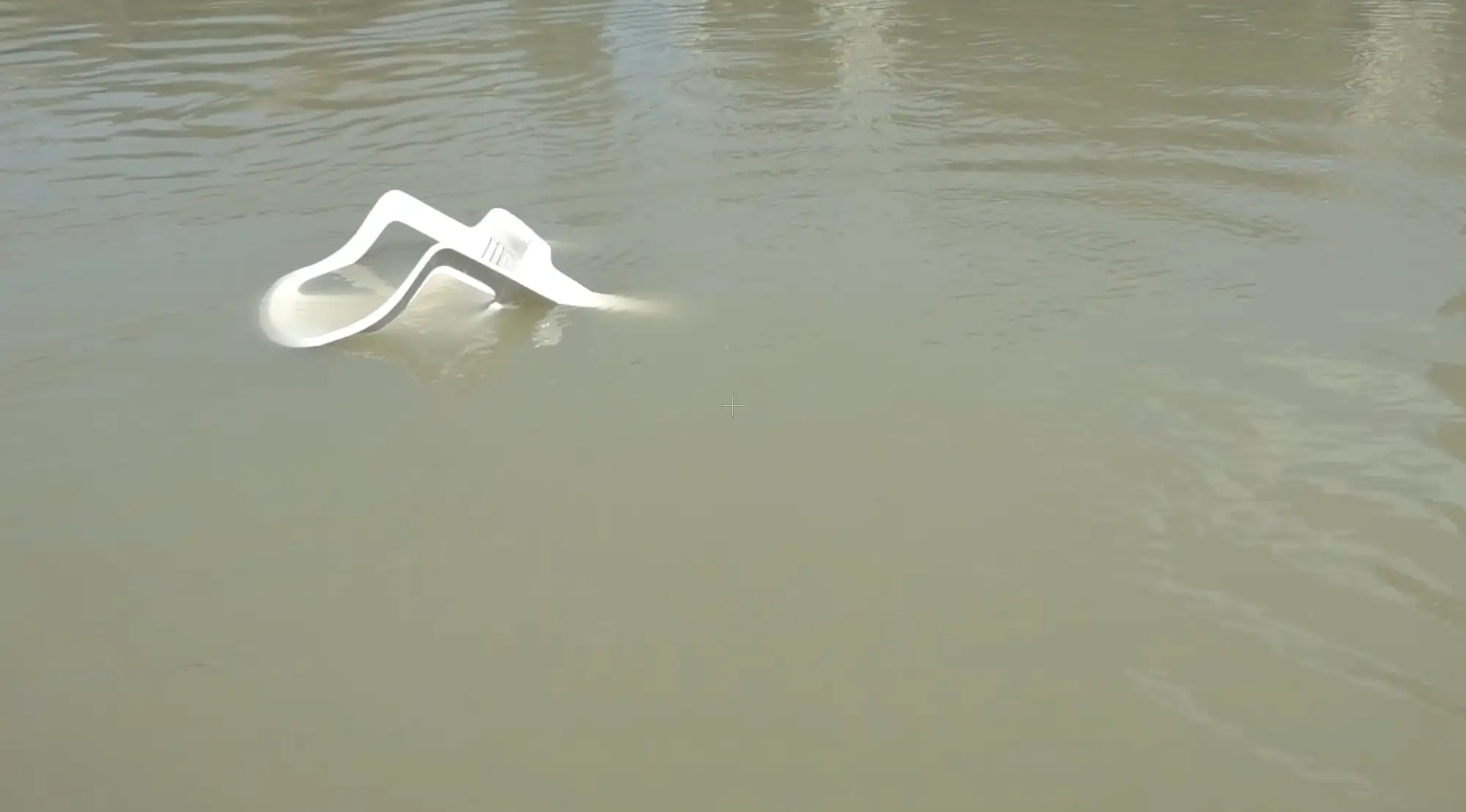
Hanne Jannasch & Isabell Alexandra Meldner. Wir sitzen alle im selben Boot
Originally, the video was created as part of the project “Sitting Somewhere,” which deals with "monobloc chairs" that have been mass-produced and distributed worldwide since the 1970s. Due to its diverse and often contradictory connotations, the chair has become a frequent reference in the art world. Its appearance became almost a cliché. In its recontextualization on the Badeschiff as part of the Klimabiennale, the video becomes an intervention.
Video (00:10min), loop, 2022/2026
Badeschiff Wien
Wolfgang-Schmitz-Promenade 4
1010 Wien
© Foto: Anna Knödl
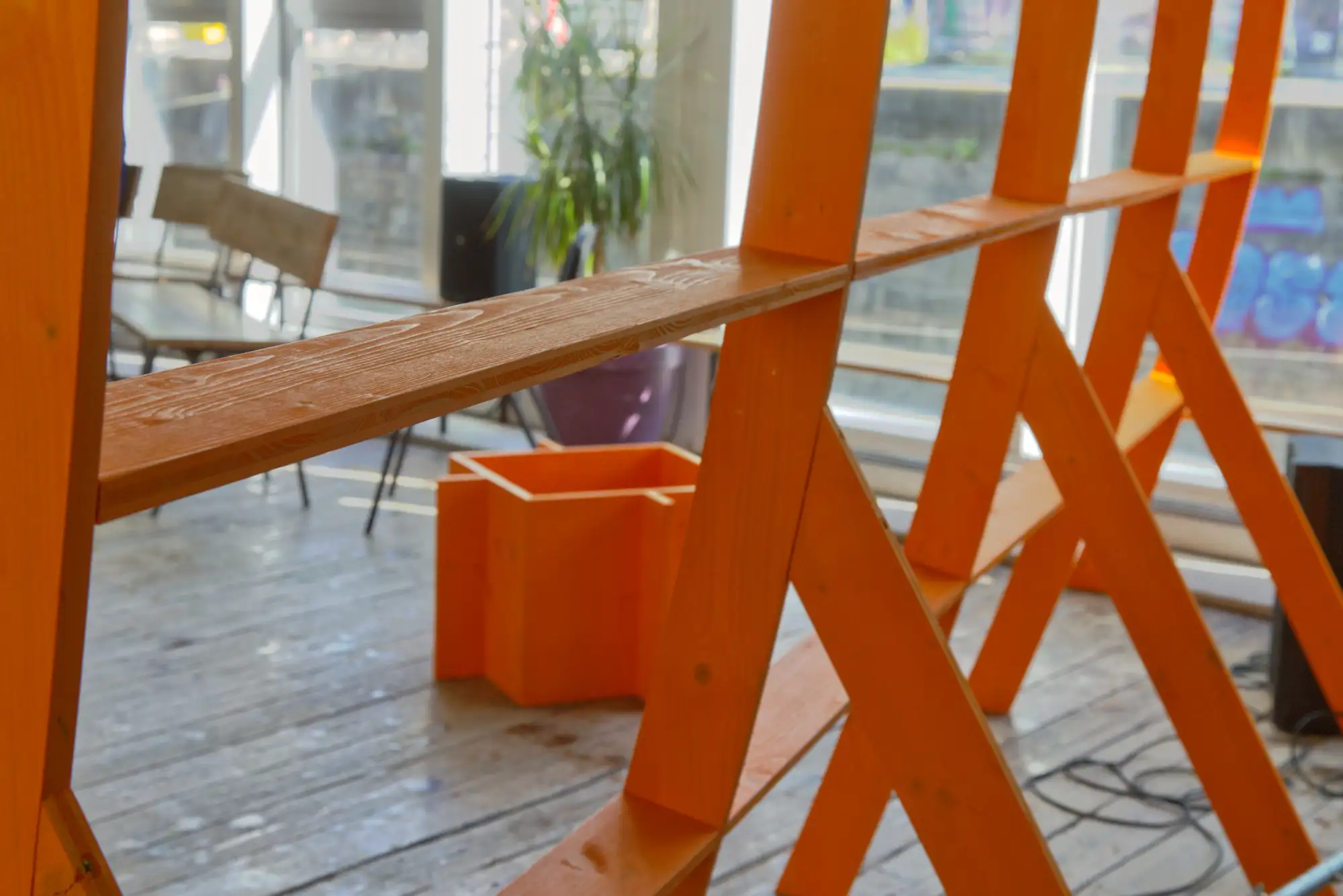
Theo Bartenberger & Nico Schleicher. Transit
Roads, railways and runways - means of human transport break through and traverse natural habitats. What happens if a tunnel is constructed through the middle of a nature reserve? What changes would result from implementing such large-scale projects? And what existing qualities are lost in the process? As we strive for ever more efficient travel and the acceleration that comes with it, sensory impressions increasingly elude our perception.
Installation, 2026
Badeschiff Wien
Wolfgang-Schmitz-Promenade 4
1010 Wien

© Foto: Anna Knödl
Josefin Vestberg. Empurpled creator
The relationship between plus and minus is always constant. It manifests itself in the loss of habitats through resource extraction or in the decimation of an individual whose body ensures the reproduction of a society. Within the grid pattern of the industrially manufactured tiles, plus and minus signs appear in the form of an expanding or moribund star. The plus and minus, the increase or decrease of the quantity of life, are also symbols used in pregnancy tests.
Mosaic tiles, wood, grout, water from the Donau canal, 2026
Badeschiff Wien
Wolfgang-Schmitz-Promenade 4
1010 Wien
© Foto: Anna Knödl
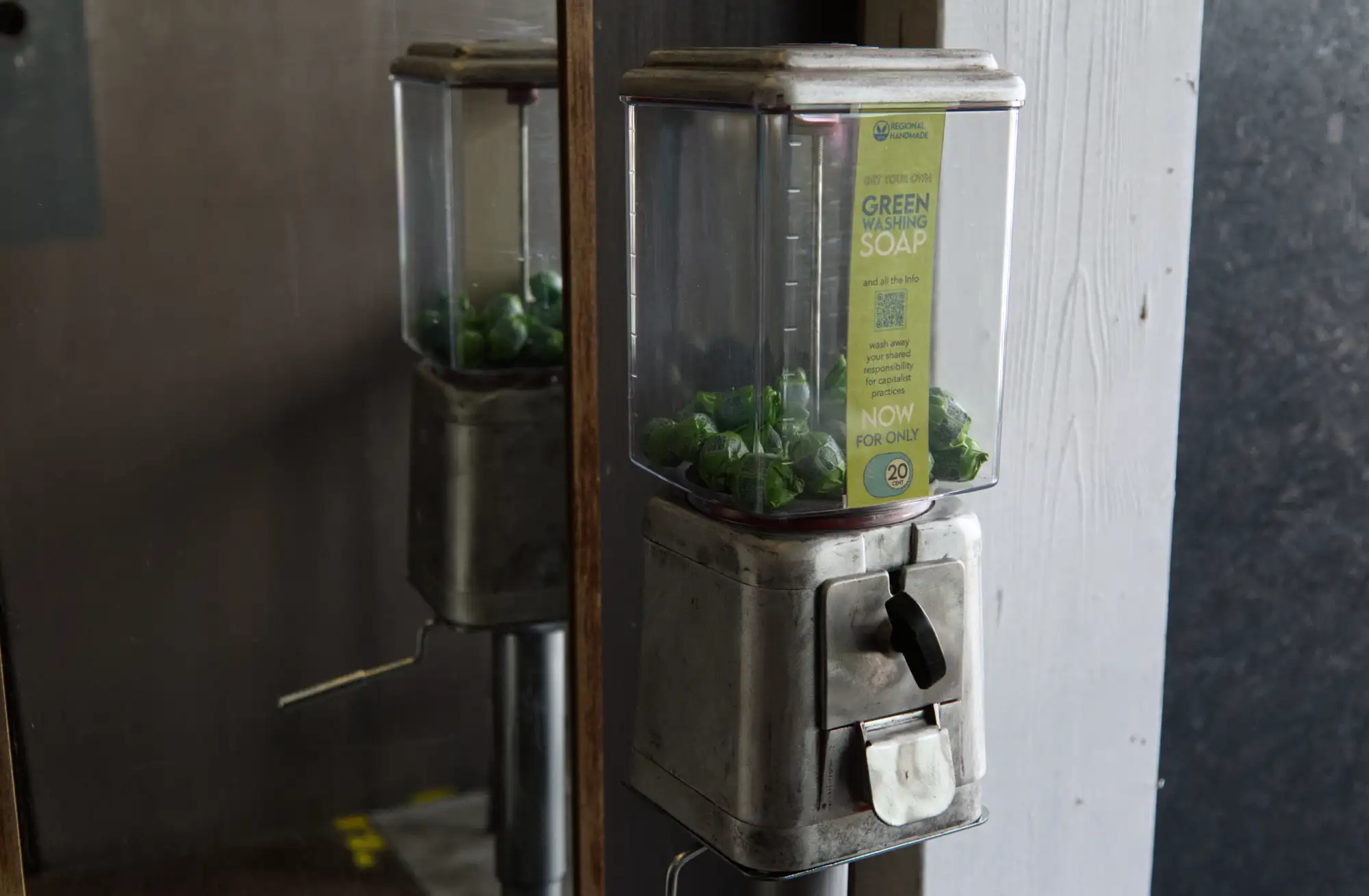
Nene Wildenberg. Greenwashing Soap
Greenwashing Soap is a product that turns morality and a sense of responsibility into a commodity. With this soap, you can wash away your shared responsibility for capitalist practices. Buy your piece of sustainability and play your part. The production chain is transparent, but not immediately obvious—it’s your own interest and reflection on your consumption habits—critical inquiry provides answers.
Installation, 2025/2026
Badeschiff Wien
Wolfgang-Schmitz-Promenade 4
1010 Wien
© Foto: Anna Knödl
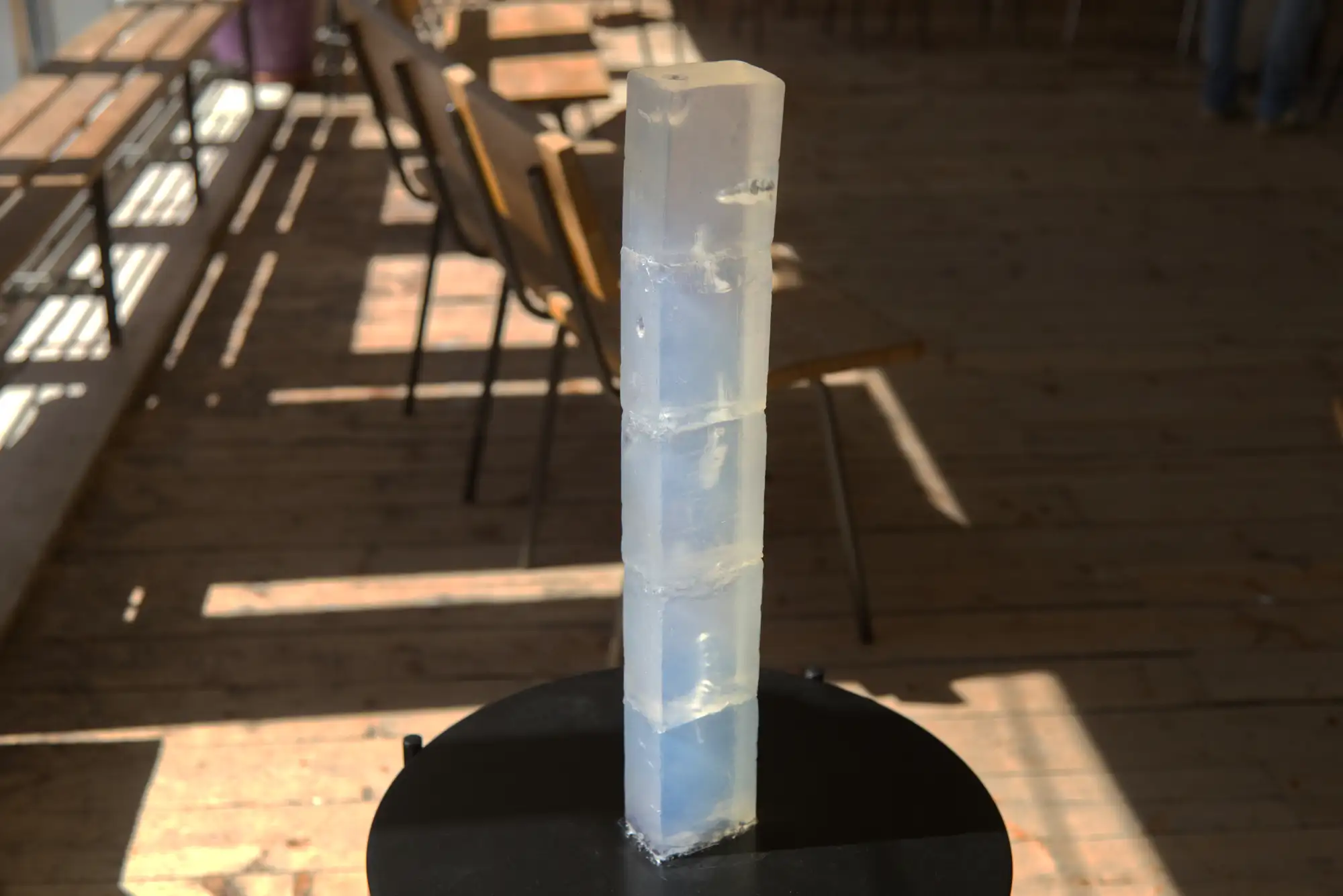
Duannaiyu Wang. The Sun Is Small but Hot
Sunlight is focused through a Fresnel lens and slowly moves across the soap. With time and heat, the surface softens, melts, and changes form.
Activated through performance, this work uses light, heat, and the physical phenomenon of energy transformation as material to capture and translate fleeting, elusive moments in our world — moments that are barely perceptible and evoke a subtle, mysterious silence beyond the ordinary.
Fresnel Lens, Glycerin Soap, 2026
Badeschiff Wien
Wolfgang-Schmitz-Promenade 4
1010 Wien
© Foto: Anna Knödl
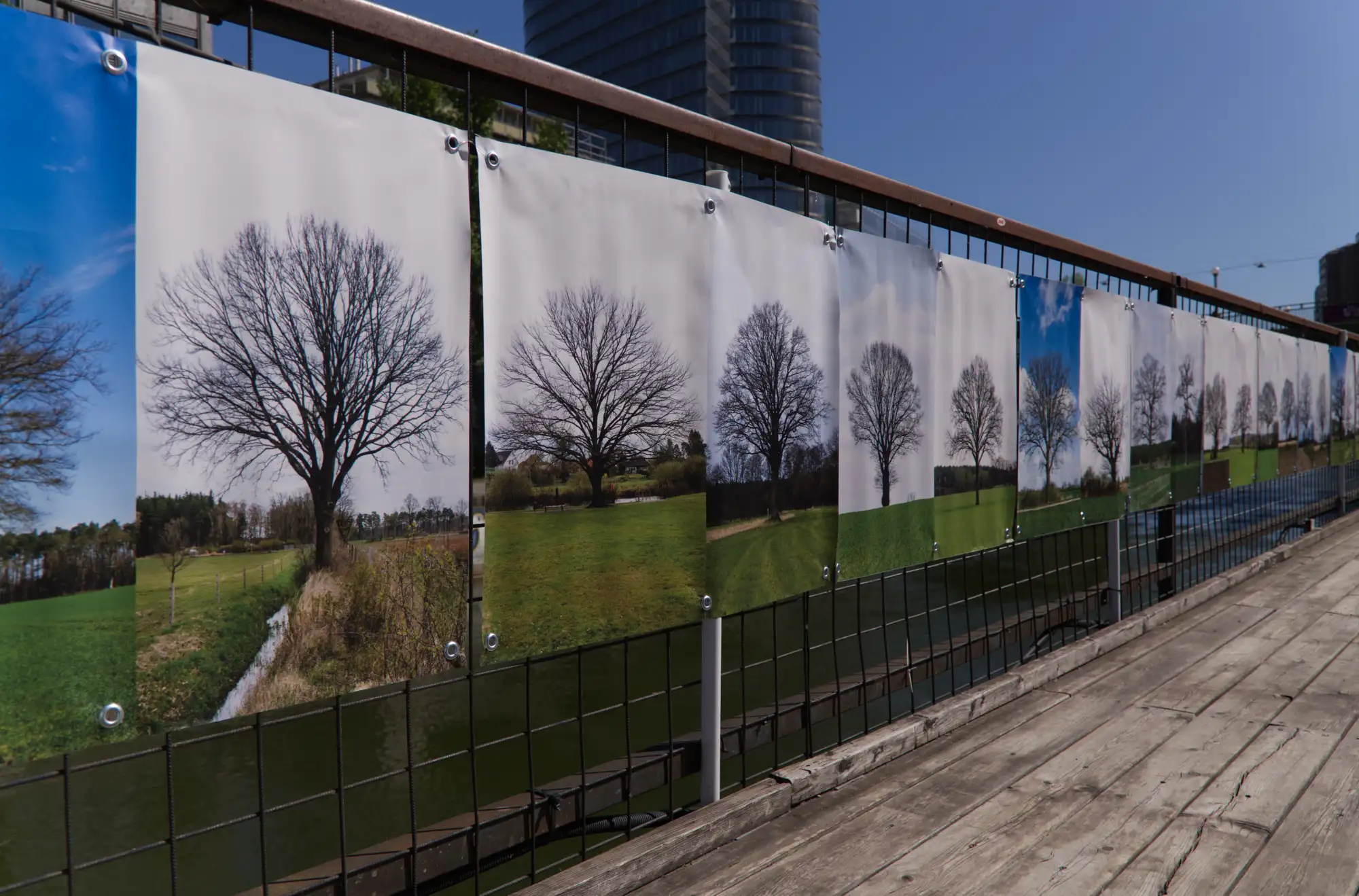
Rasmus Otto Rutsch. Wachstum
A country’s political climate and its impact on the consciousness of its inhabitants create an all-pervading atmosphere. In addition to the psychological effects this has, it also changes the chemical structure of the living beings within it. The trees depicted in “Growth” illustrate the typical growth deformities that have resulted in East and West Germany due to the political climate.
Digital print on PVC, 2026
Badeschiff Wien
Wolfgang-Schmitz-Promenade 4
1010 Wien
© Foto: Anna Knödl
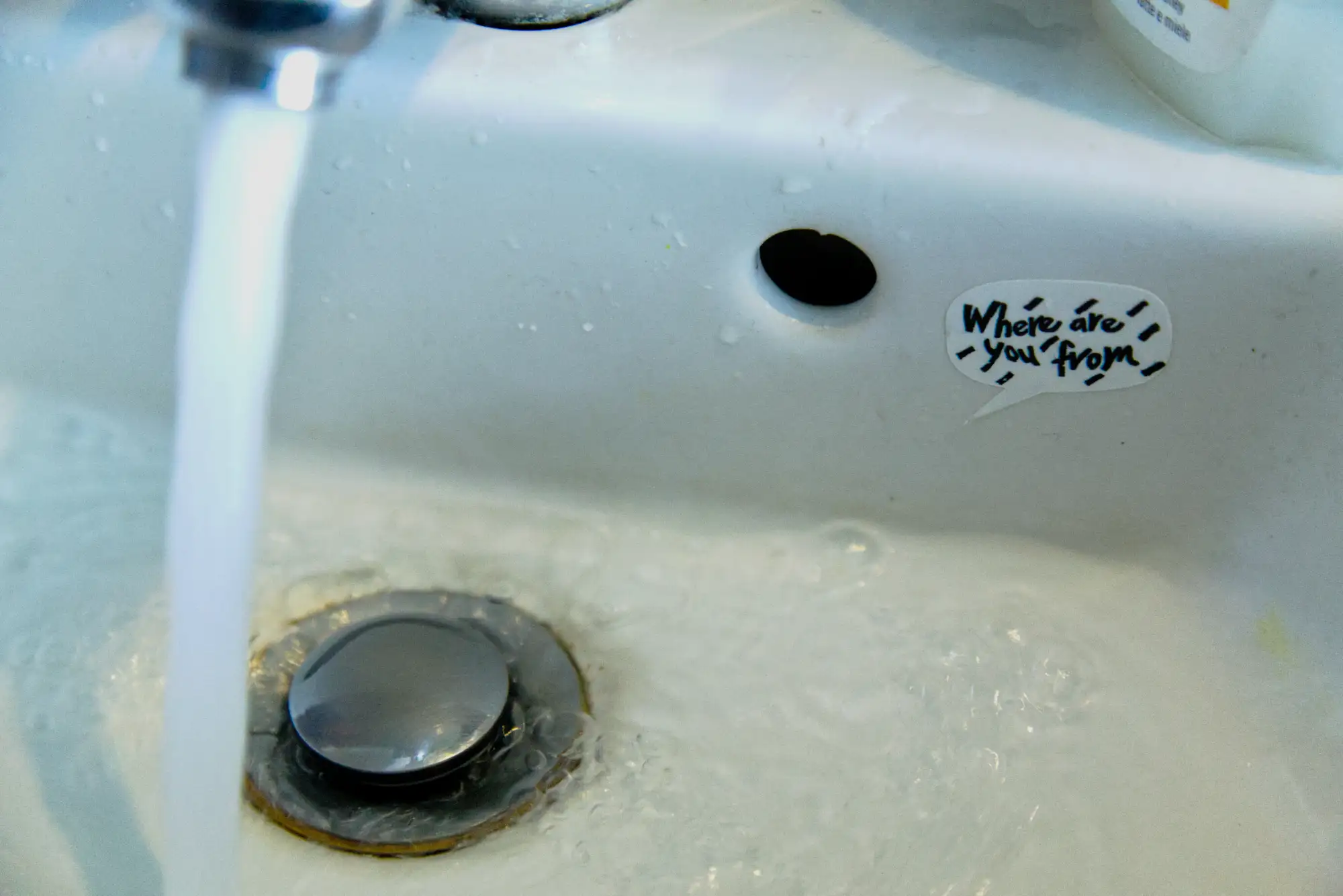
Dahye Hyun. Immigrant water
Participants submit images of water and are invited to guess their origin.
This repeated act brings attention to the question “where are you from,” often asked without hesitation, and invites a reconsideration of how it functions.
Through the repetition of this act, the ways in which such questions position someone as belonging or not begin to blur and lose their meaning.
Fixed ideas of origin and identity are likewise unsettled.
Take a sticker, take a photo, and submit your guess.
Thanks to all participants and to those who move between places.
Participatory art / Web platform, stickers, prompts, 2026
Badeschiff Wien
Wolfgang-Schmitz-Promenade 4
1010 Wien
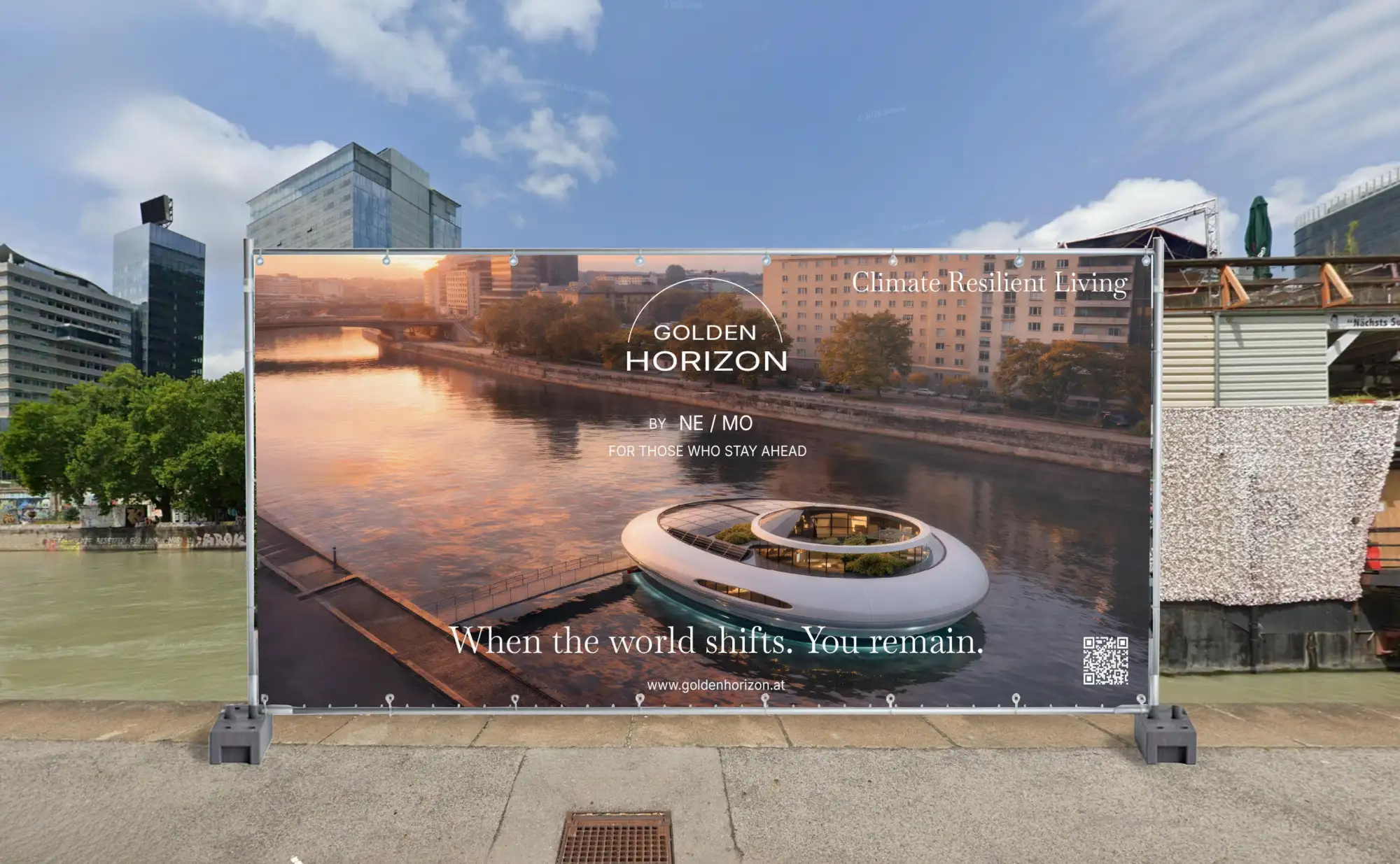
Camilla Lausch, Laura Farmwald. NE/MO presents Golden Horizon - Designed for those who stay ahead.
The investment company NE/MO promotes their newest asset Golden Horizon, an exclusive survival-oriented real estate project.
The autonomous facilities provide off-grid energy generation, water purification, food production, secure communications, and a fully automated defense system.
Designed for and located in the Danube Canal, the facilities are climate-independent and withstand flooding, extreme weather conditions, and supply shortages.
Golden Horizon - redefining climate-resilient real estate.
Textil, Construction Fence, Video, 2026
Badeschiff Wien
Wolfgang-Schmitz-Promenade 4
1010 Wien
© Foto: Anna Knödl
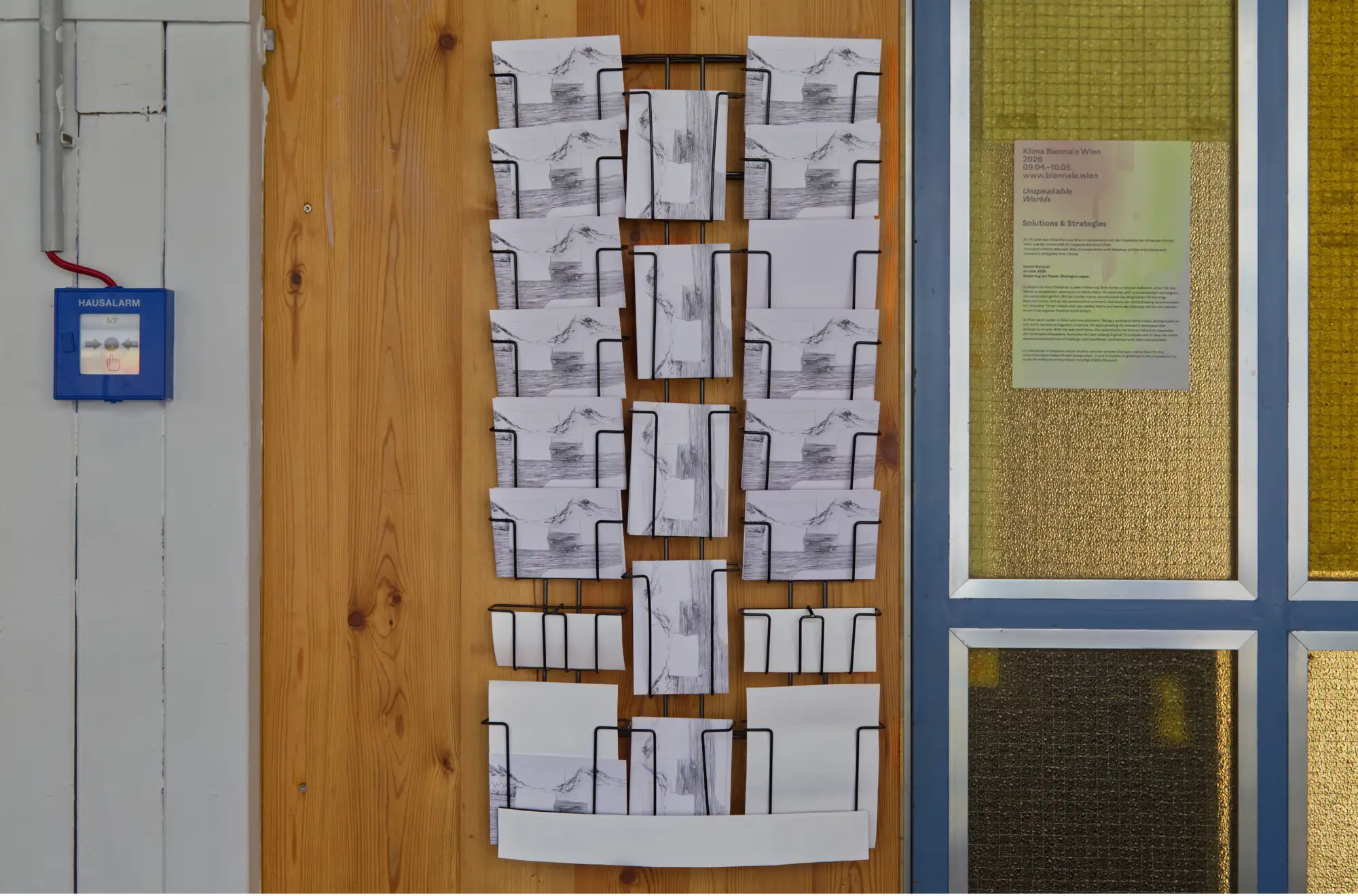
Leonie Marquet. et-vidé
At first, each holder is filled with one postcard. Taking a postcard home means seizing a part of this work, but also a fragment of nature. It’s appropriating for oneself a landscape that belongs to no one.
With the last card taken, the opportunity for future visitors to remember the landscape disappears. And when the last iceberg is gone? It compels one to face the white expanse and emptiness of icebergs, and manifestly, confronted with their own position.
Etching on paper, 2026
Badeschiff Wien
Wolfgang-Schmitz-Promenade 4
1010 Wien

© Foto: Anna Knödl
Lisa Lupsina & Sidonie Sagmeister. Femur (Lösbar)
In this site-specific installation, the intimate act of washing intertwines with ecological reality. Anatomical thigh bones made of soap create a radical dissonance between morbid revulsion and a beguiling scent. They expose the illusion of “cleansing” and echo Donna Haraway’s call to “stay restless.” The soap lathers, the bone dissolves. Those who wash themselves dissolve their own substance. Humans inevitably become compost.
soap, floral inclusions, pine wood, 2026
Badeschiff Wien
Wolfgang-Schmitz-Promenade 4
1010 Wien
© Foto: Anna Knödl
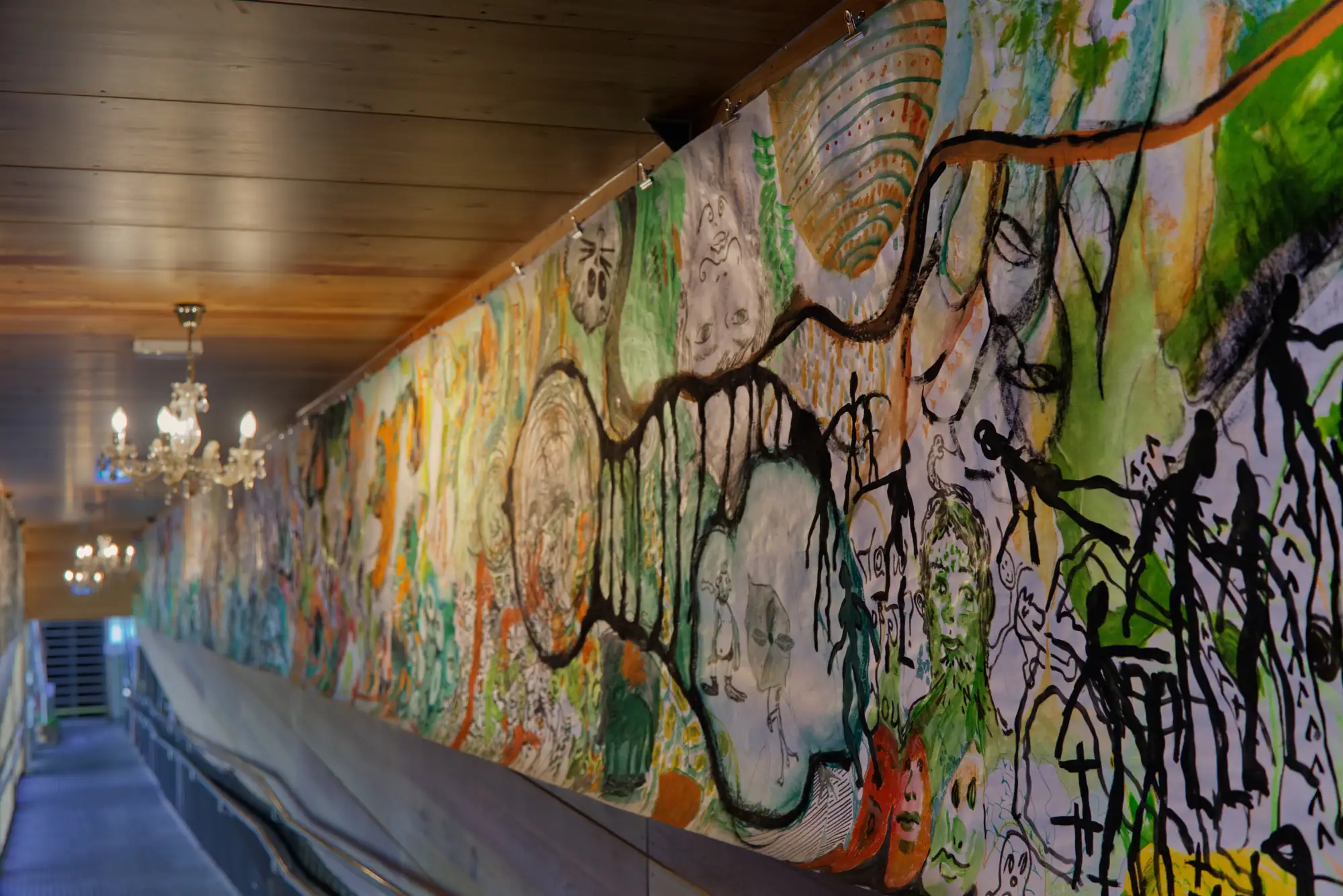
Paper Snake
“Paper Snake” is a collective drawing project by 23 students of the Akademie der bildenden Künste Wien, created during shared sessions in December 2025. Over this period, two paper works of 25 meters each were produced.
The title refers to texture, layering, and shedding—drawing from the skin of a snake. These principles shape both the visual structure and the process of making.
Through the superimposition of individual marks, a shared image emerges, foregrounding collective authorship and multiplicity.
By Karolin Burkhardt, Irene Cian, Swetlana Gerner, Gustav Glück, Sheila Grace, Olivia Gründler, Gian Haak, Heidi, Rafael Hofmann, Liu Jingting, Jaehyung Kim, Yifu Leng, Wenjia Luo, Sanjid Mahmud, Kweku Okokroko, Boyun Park, Yeon Park, Maria Pylypenko, Negin Rezaie, Leda Thanassa, Kieren Tockner, Thomas Vava, & Lena Wendlandt.
Paper, coal, pencil, paint, markers, pen, pastel, ink, collage, mixed media, 2025
Badeschiff Wien
Wolfgang-Schmitz-Promenade 4
1010 Wien
© Foto: Anna Knödl
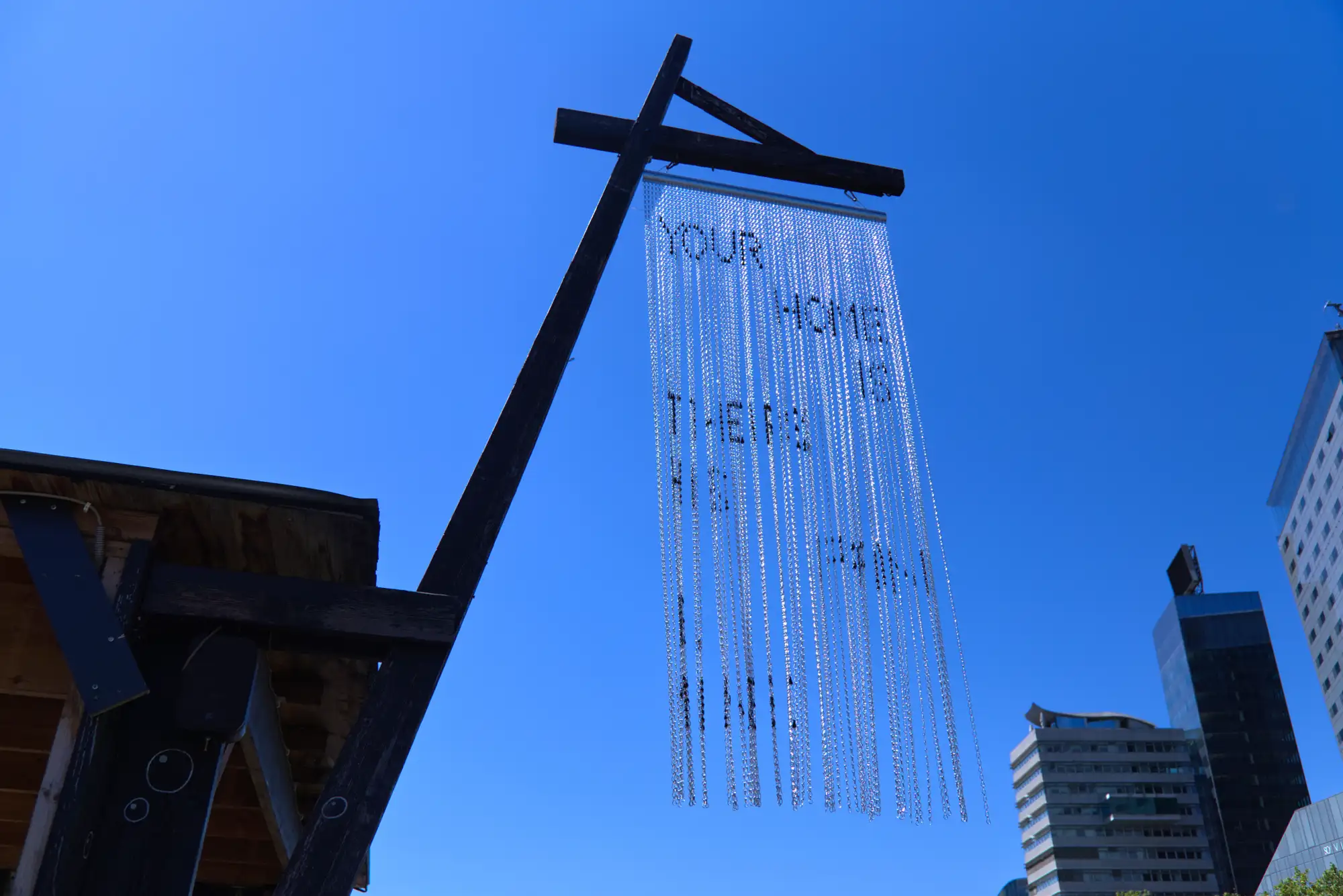
Josefine Harmer. untitled
Aluminium, 2026
Badeschiff Wien
Wolfgang-Schmitz-Promenade 4
1010 Wien
© Foto: Anna Knödl
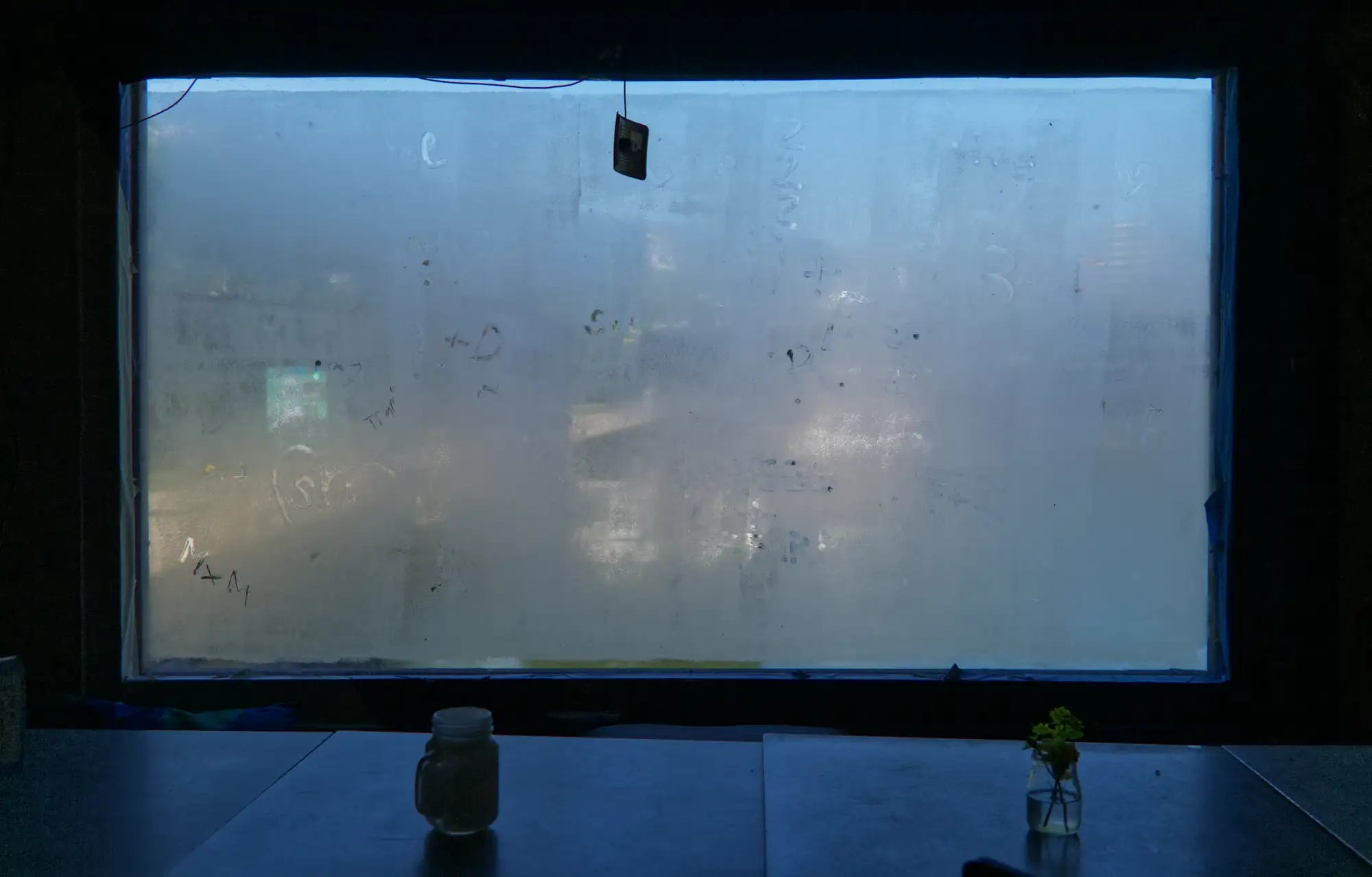
Birgit F. F+L, B+F, L+B
The gestures of lovers, which linger and then fade away, just like love itself. Makes the view foggy. Our vision is blurred; when we take action, we might be able to see more clearly.
Intervention; love gestures on glass, 2026
Badeschiff Wien
Wolfgang-Schmitz-Promenade 4
1010 Wien
© Foto: Anna Knödl
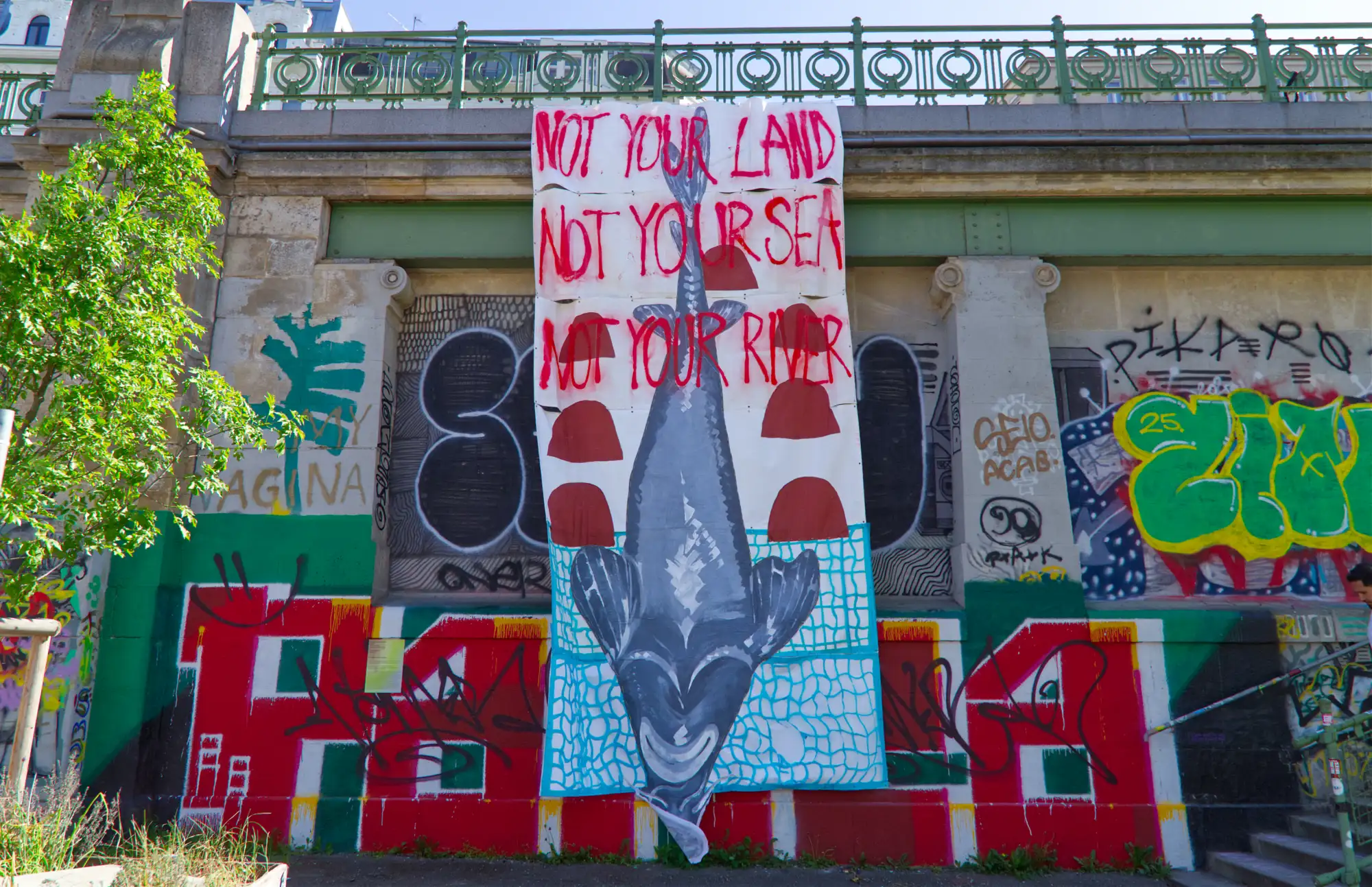
Heidi, Kweku Okokroko, Francis Fosu, Alix Drakulic & Kieren Tockner. Resource Fullness
They call land, animals and other humans, resources to make us feel less guilty for their actions of exploitation. And they depend on distance. Distance between those who profit and those who bear the cost.
The climate crisis was not created by nature; it was produced by a system that rewards extraction and calls it progress. A system that leads to the deterioration and destruction of all that it considers a resource.
Our work ‘’Resource Fullness’’ uses the motifs of the beluga sturgeon, the fishing net, yam mounds and red lettering to make clear an artistic position against environmental destruction and to question what connections exists between consumption in one place and environmental damage in another.
recycled material (banner, fabric, parachute, rope), acrylic paint, 2026
Badeschiff Wien
Wolfgang-Schmitz-Promenade 4
1010 Wien
Christoph Karrer. Fischleich
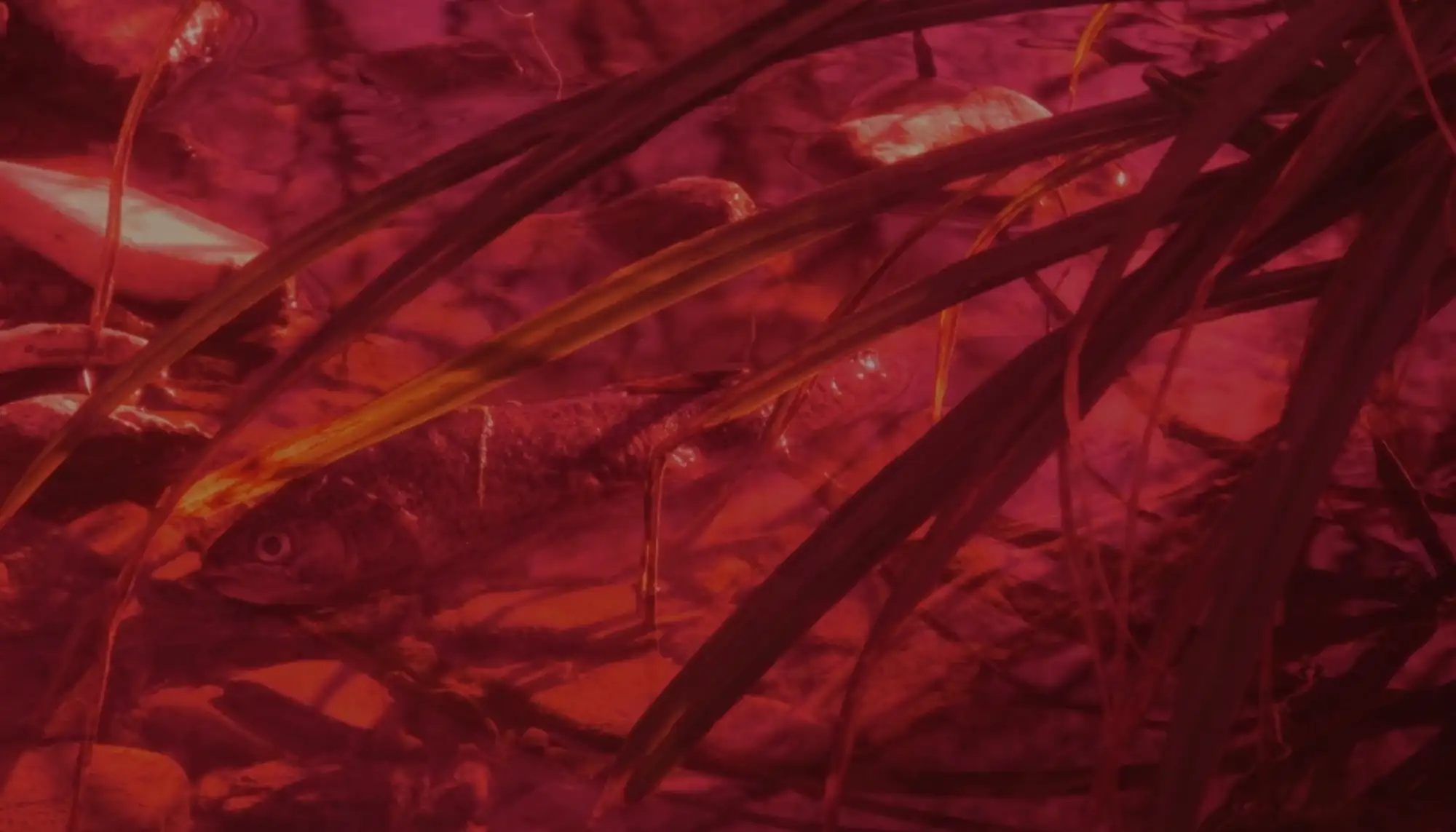
Alienation happens quietly. Adopted patterns shape our thinking without us noticing them. Killing, once a more visible part of obtaining food, is increasingly hidden and repressed. This invisibility protects against discomfort. Yet those who look more closely, who seek the origin, encounter what has been hidden. In the sense of 'He who searches for what he should not, finds what he does not want,' is understood as an invitation to engage with life, suffering, and one's own role.
Video, 2026
Badeschiff Wien
Wolfgang-Schmitz-Promenade 4
1010 Wien
© Foto: Anna Knödl
Nana Sorgo. Bassclub 1-5 (serie)
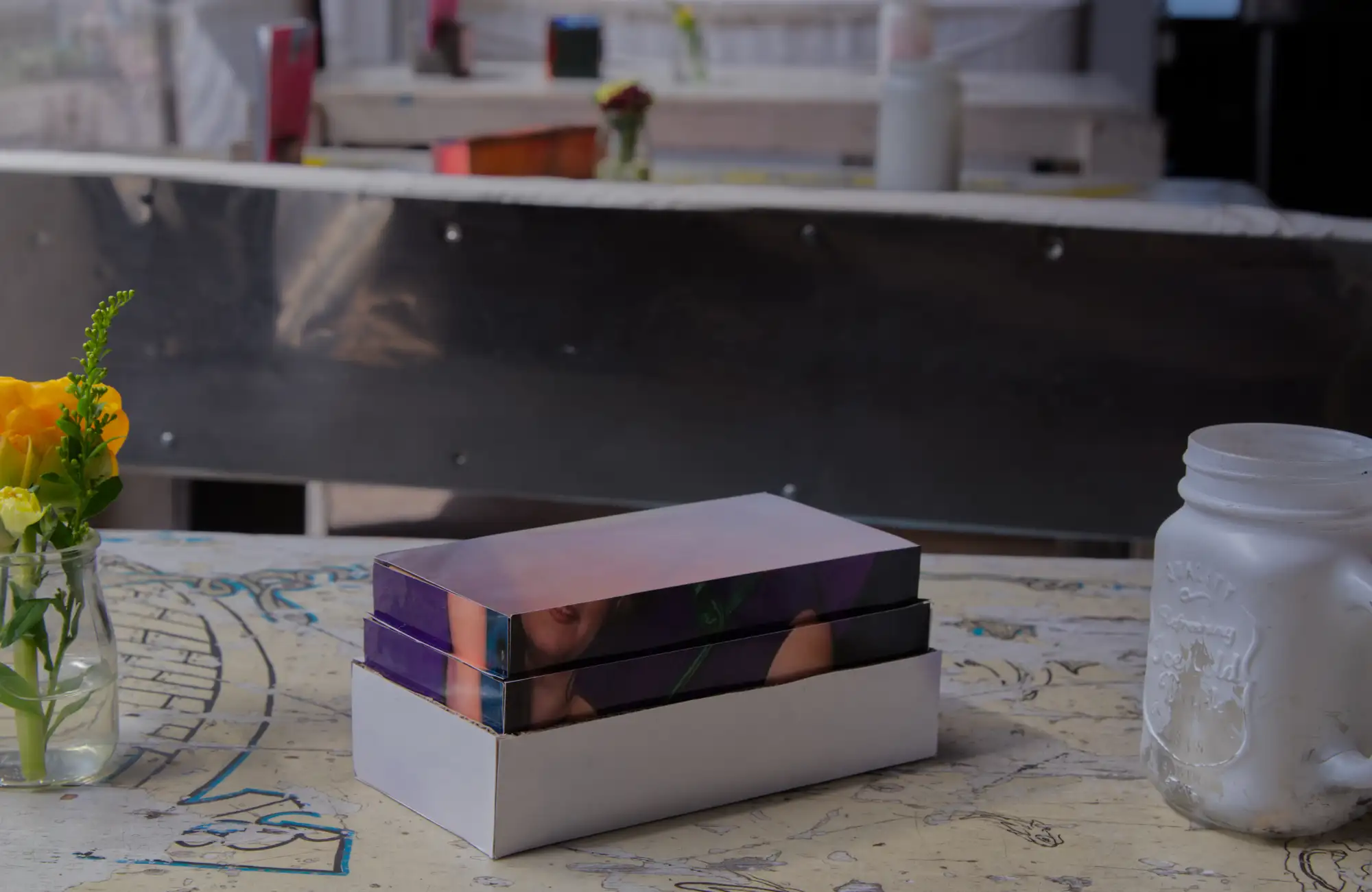
The collages condense 15 years of party culture at Badeschiff into layered visual compositions of overlapping event photographs.
Badeschiff Wien
Wolfgang-Schmitz-Promenade 4
1010 Wien

© Foto: Anna Knödl
Šimon Varaus. The only game I can remember
This video re-edits a broadcast of the Czech Republic vs. Netherlands match from UEFA Euro 2004 by removing all moments in which the game is actively played. What remains are pauses: players waiting, repositioning, preparing for the ball to return.
Presented on a television in a pub, the work blends into a familiar setting. At first glance, it resembles a normal match. Only over time does it reveal that the game never actually happens.
The piece shifts attention from action to anticipation, exposing the unnoticed structures that hold the spectacle together.
Video, 45min, no sound, 2026
Badeschiff Wien
Wolfgang-Schmitz-Promenade 4
1010 Wien
Mark Bou Abdo, Linnea Maria Jørgensen, Rosa Märzendorfer, Mark Napadenski, Maria Pylypenko & Sagar Sarkar. Successful Flood: the Nile River
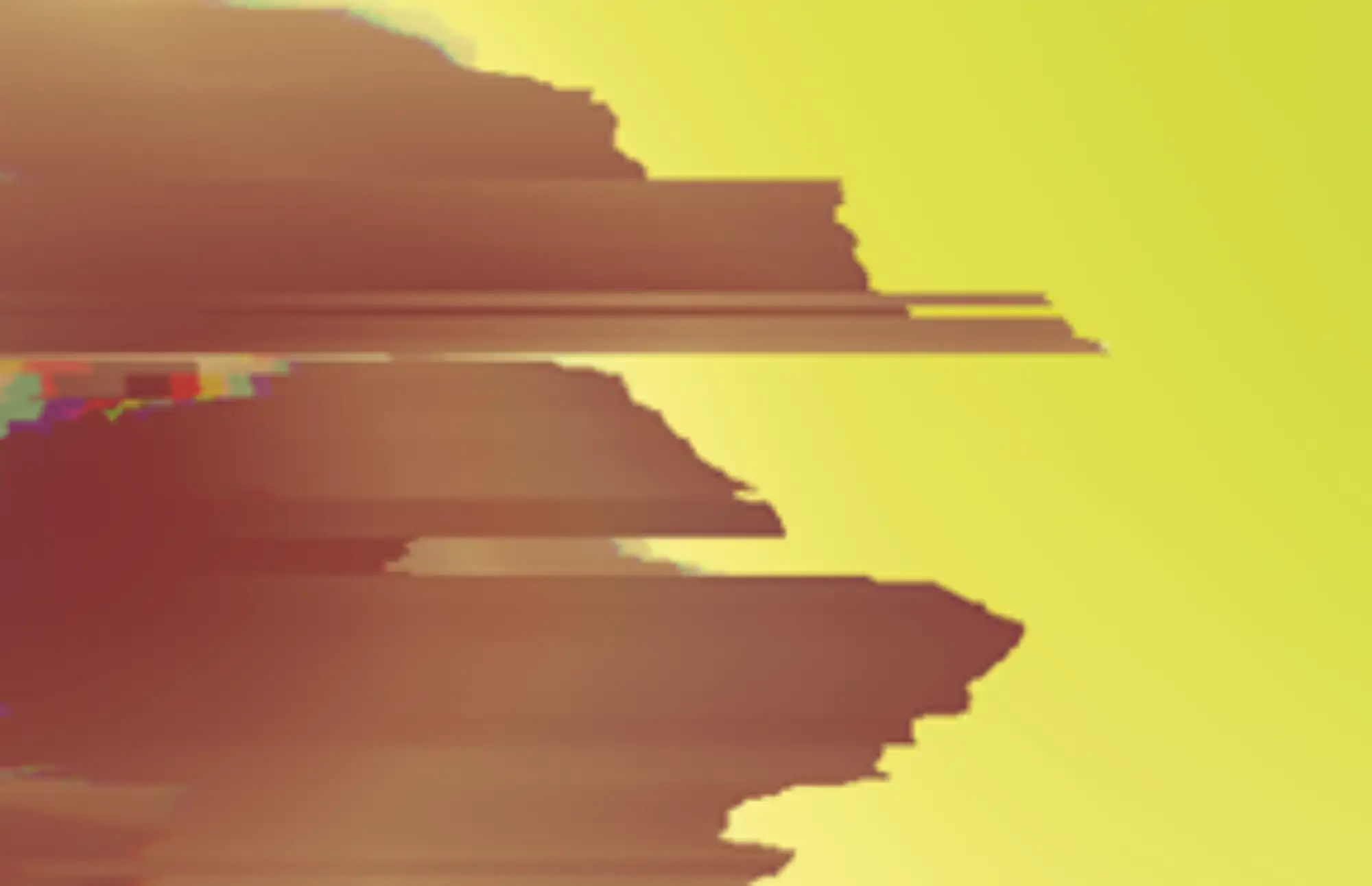
The project emerged from an artistic-scientific collaboration between students from the Institute of Forest Ecology (BOKU Vienna) and the Academy of Fine Arts Vienna within the workshop “Claiming Positive Narrations.” Six students explored the “successful flood” of the Nile in Sudan, focusing on flood-based farming systems.The research culminated in a performative action: drawing on a large research paper and its immersion into the Danube, situating the knowledge within another river system and confronting local perceptions of flooding as risk with its role as a resource.
Video documentation of an artistic-scientific performance, 2025
Badeschiff Wien
Wolfgang-Schmitz-Promenade 4
1010 Wien
© Foto: Anna Knödl
Carl Theodor Seegers, Sebastian Haaf. barrel chimney.
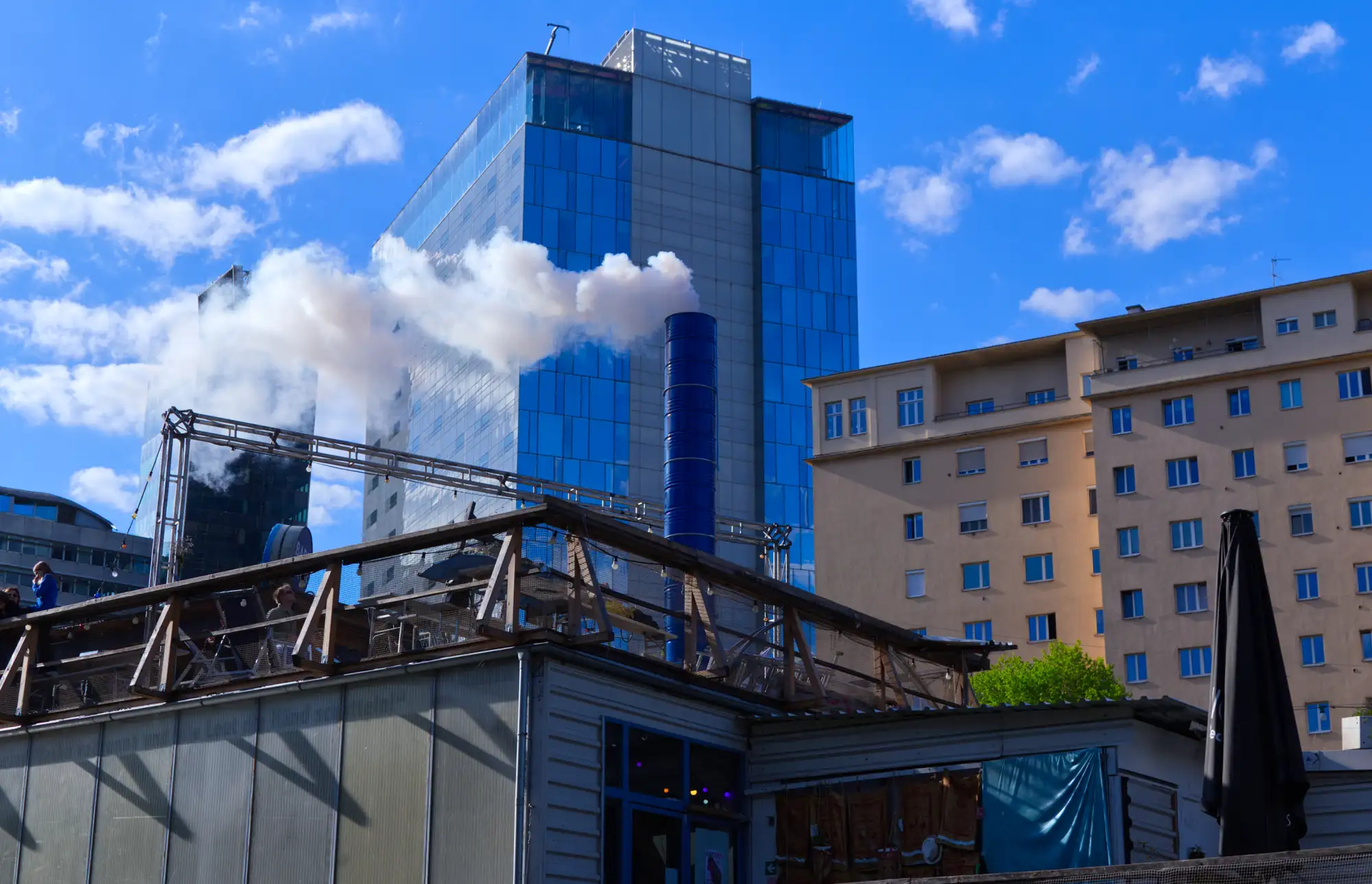
A chimney made of stacked steel barrels stands on the upper deck of the Badeschiff. As a symbol of industry, it points to emissions that affect our environment and are part of our daily lives. At regular intervals, smoke emerges from the opening, reinforcing this effect.
Installation, steel barrels, 2026
Badeschiff Wien
Wolfgang-Schmitz-Promenade 4
1010 Wien

© Foto: Anna Knödl
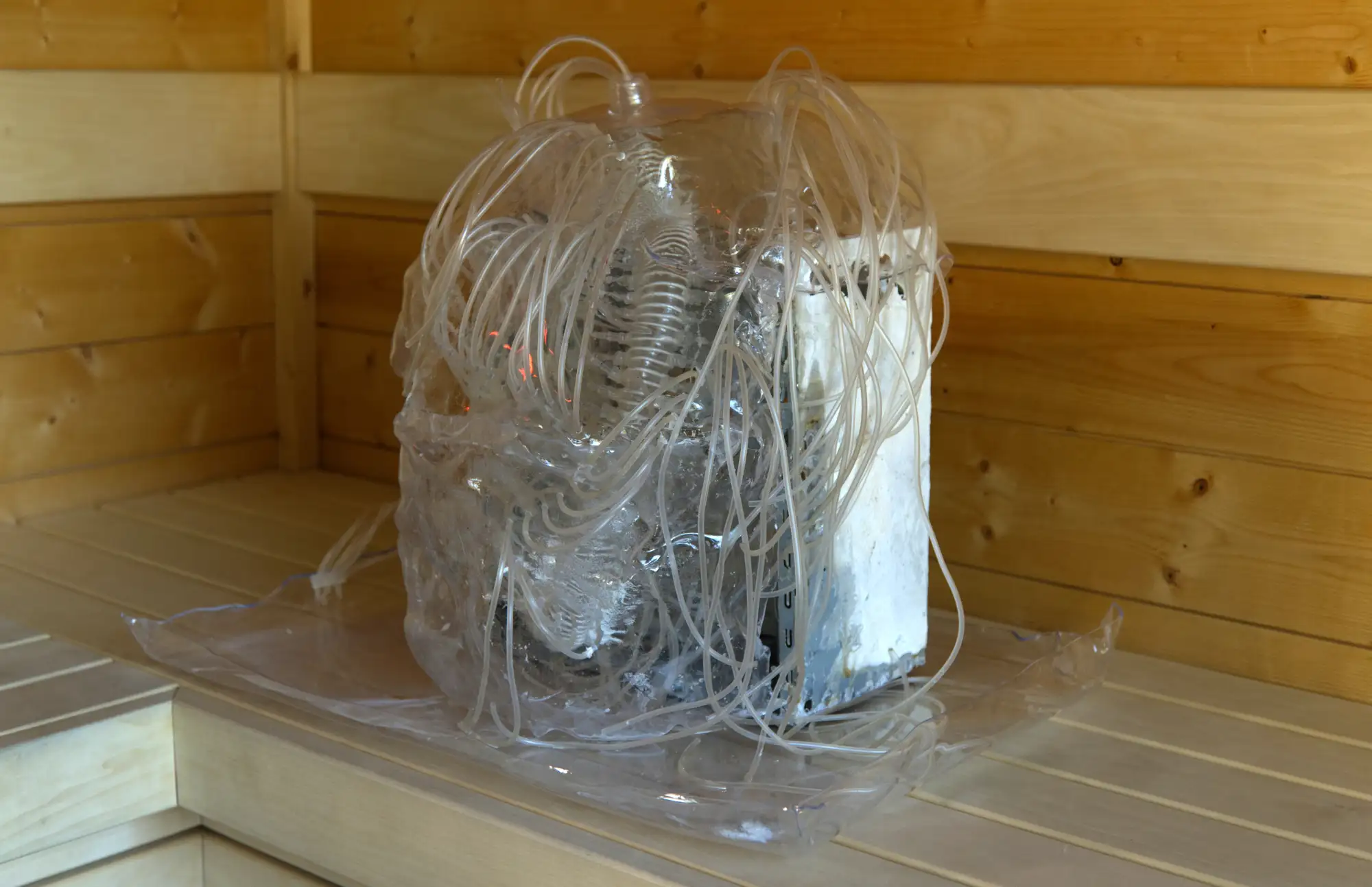
Stella Maria Schwaiger. Kaviarhaufen (Löffel abgegeben)
Ceramics are a constant presence in our daily lives - we eat and drink from them, and wash our bodies in them.
Particular emphasis is placed on the placement of the sculpture and the paradox that is anchored in multiple ways.
The momentarily frozen, suddenly transformed into ceramic, normally edible luxury item, which sits atypically still next to the moving artificial pool surface, which moves rhythmically with the natural water beneath it.
Ceramics, 2026
Badeschiff Wien
Wolfgang-Schmitz-Promenade 4
1010 Wien
© Foto: Anna Knödl
Haesol Han. mu-a (無我)
This work explores a body free from self, consciousness, and will. It exists and transforms within cycles of moisture, embedded in the material flows of the world. For this body peace arises not from the mind, but from existing as a body without consciousness. The work questions whether such a body can exist without mental constraints, and in doing so, engages with transhumanist discourse only to invert it, reflecting on a state stripped of consciousness and information. Freedom from mental constraint is explored rather than from material limits.
sculpture with video, 2026
Badeschiff Wien
Wolfgang-Schmitz-Promenade 4
1010 Wien
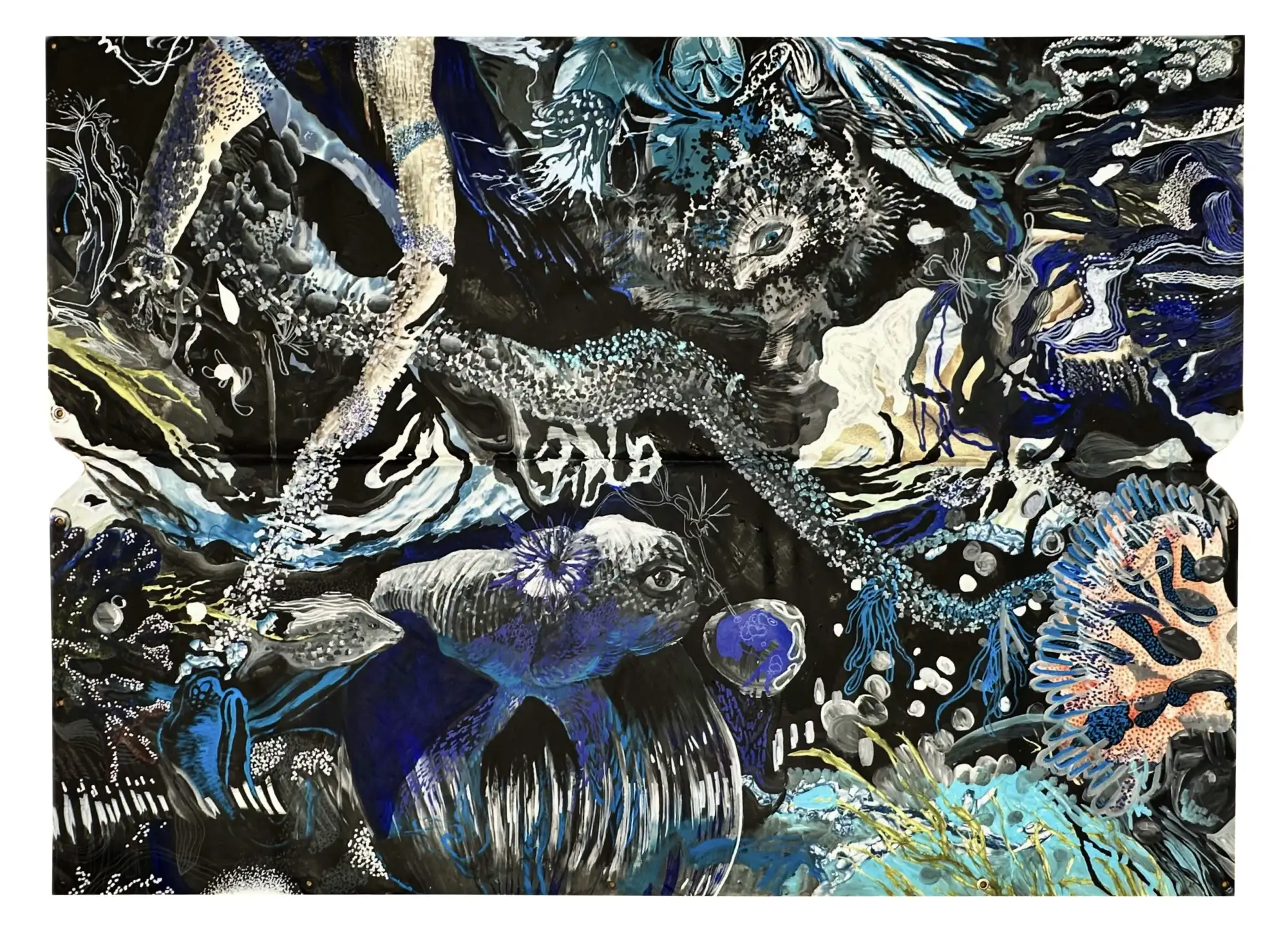
Boyun Park, Maria Pylypenko, Rafael Hofmann. Aquarium
120 Sekunden reichen aus, damit ein Mensch unter Wasser ertrinkt. Und doch versuchen wir immer wieder, das zu kontrollieren, was uns nicht gehört - wir sperren, domestizieren und kolonisieren Welten, die eigentlich jenseits unserer Reichweite liegen: Aquarien, Ozeanarien, das Haus des Meeres oder die kleinen Fischbecken in Büros und Geschäften. Drei Künstler schufen ein gemeinsames visuelles Ökosystem. Fische, Formen und Strukturen tauchen auf und verschwinden. Farben und Spuren formen eine dichte, wandelnde Unterwasserwelt.
Recyceltes PVC-Banner, Acryl, Marker / Recycled PVC banner, acrylic, markers, 2026
Badeschiff Wien
Wolfgang-Schmitz-Promenade 4
1010 Wien
© Foto: Hannah Parth & Elisa Schober
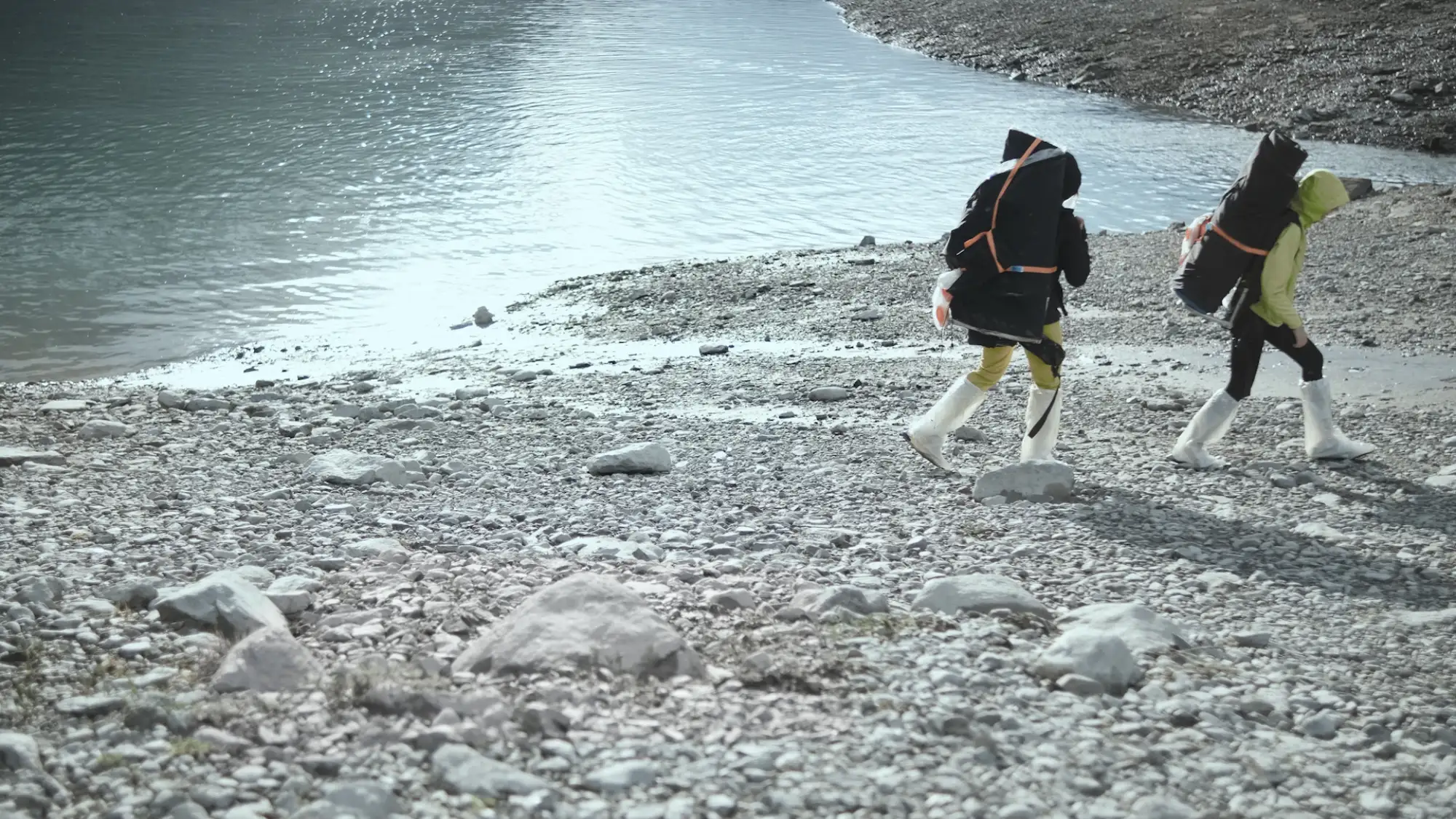
Kollektiv Bande (Elisa Schober & Hannah Parth)
The RCP8.5 emissions scenario, developed by the IPCC, forms the basis of Kollektiv Bande's dystopian future scenario, which is defined by steadily rising water levels and the resulting "survival strategies." In their speculative narrative, sea levels rise dramatically, compelling a reevaluation of current ways of life. As a duo, the artists have addressed the challenges involved, as well as explored the potential for new habitats in environments dominated by water.
Video, 2024
Badeschiff Wien
Wolfgang-Schmitz-Promenade 4
1010 Wien
© Foto: Anna Knödl
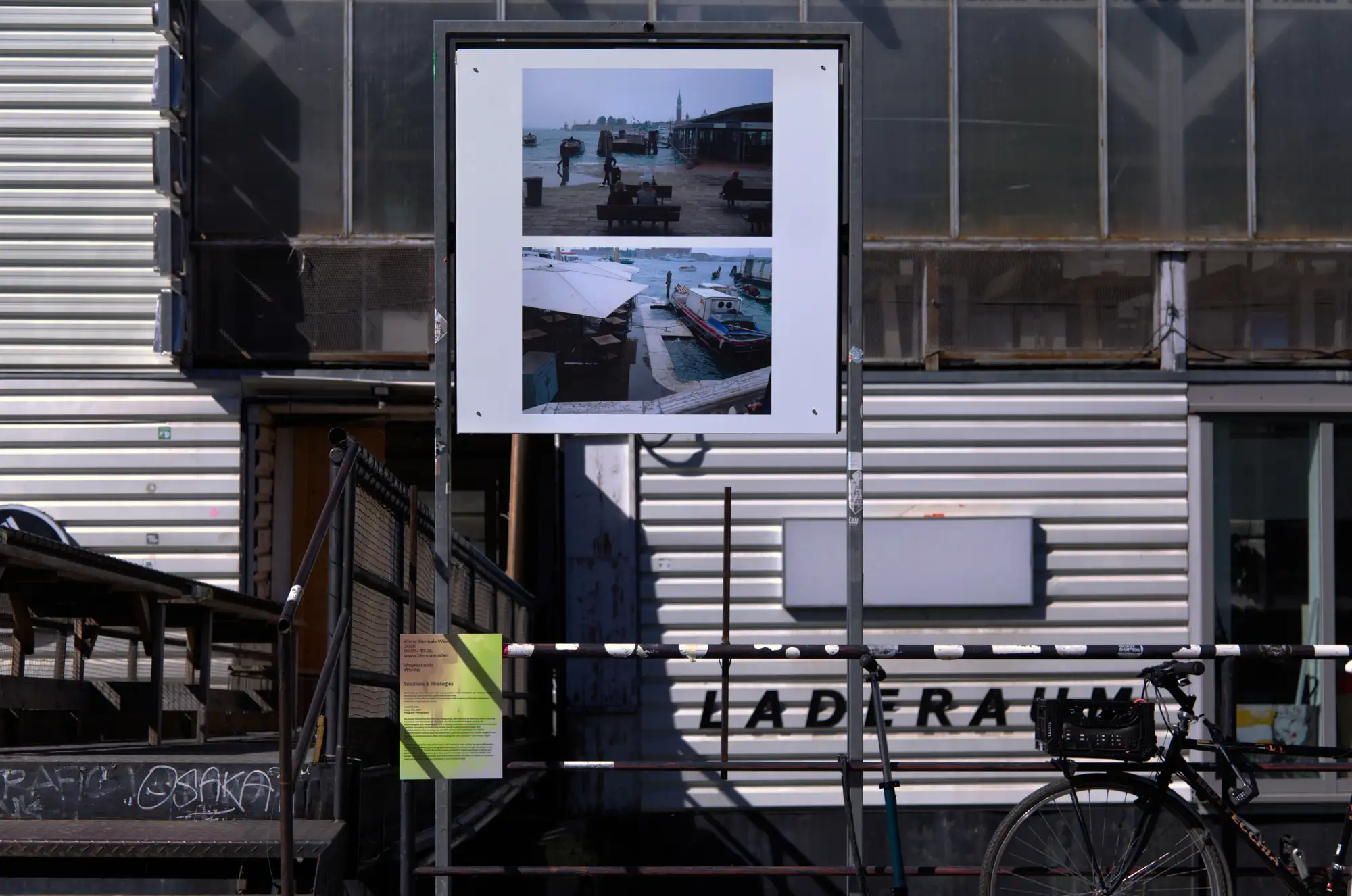
Hannah Linden. Acqua alta
The two photographies are called "Acqua alta" and were taken during the Venice Biennale in 2024. They are addressing the rising sea levels caused by climate change. The water level is called Acqua alta in Venice. It strongly varies and leads to floods especially in autumn and winter. The average sea levels have increased by about 32 cm since 1872. The MOSE- dam System increasingly protects the city, but studies predict that parts of Venice will be under water permanently because of subsidence and climate change.
Photography, 2026
Badeschiff Wien
Wolfgang-Schmitz-Promenade 4
1010 Wien
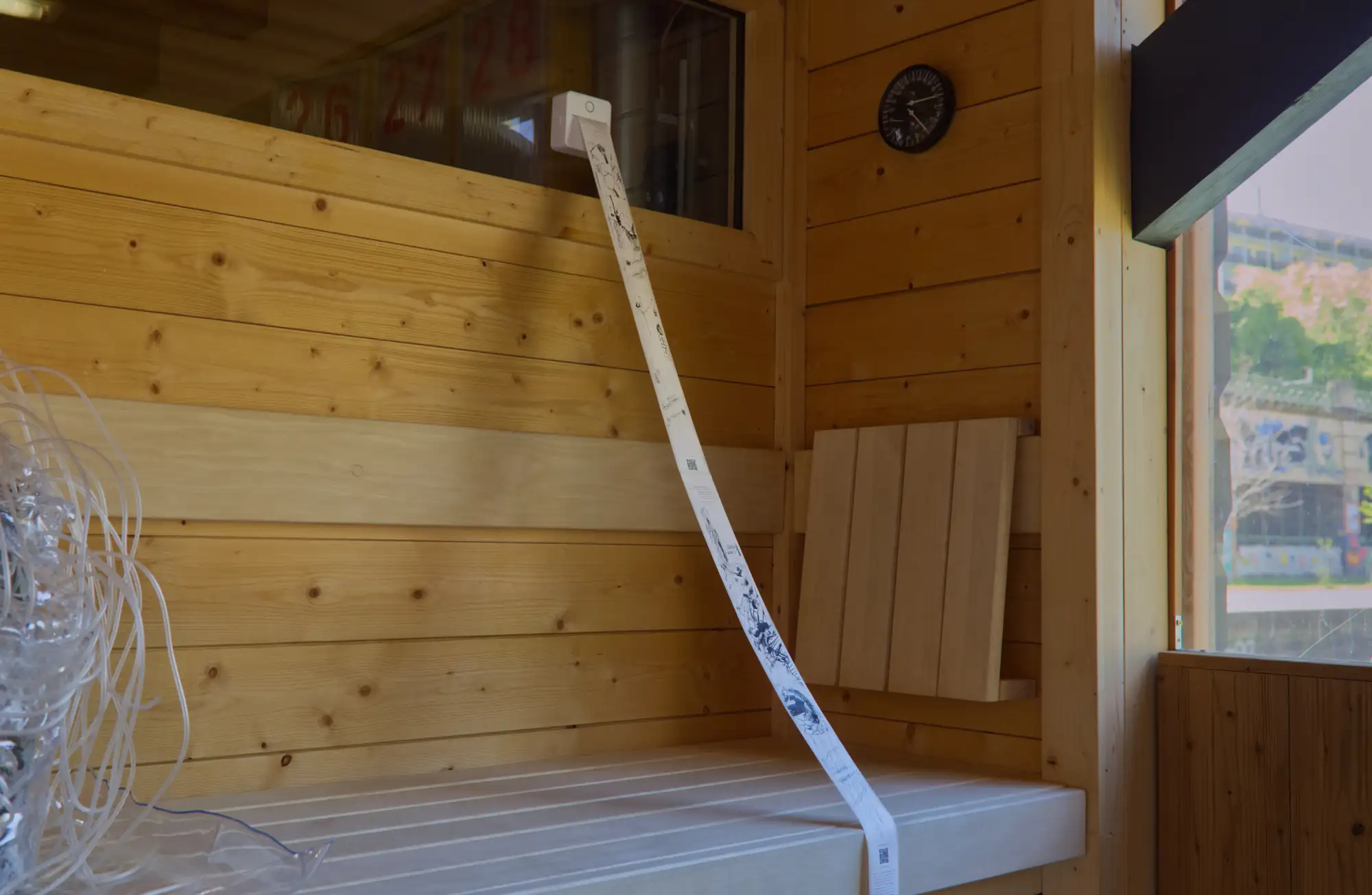
© Foto: Anna Knödl
Joanna Zoe. forecastweather.gr
Checking the weather app is a daily habit for many. The thermal printer highlights the fact that this banal action can vary significantly even within a European perspective. The drawings are inspired by videos from the Greek weather platform forecastweather.gr, which regularly publishes submissions from personal perspectives on the current weather conditions. Insights into a daily snapshot of extreme weather situations, which are particularly concentrated in the Mediterranean.
thermal printer, thermal paper, 2026
Badeschiff Wien
Wolfgang-Schmitz-Promenade 4
1010 Wien
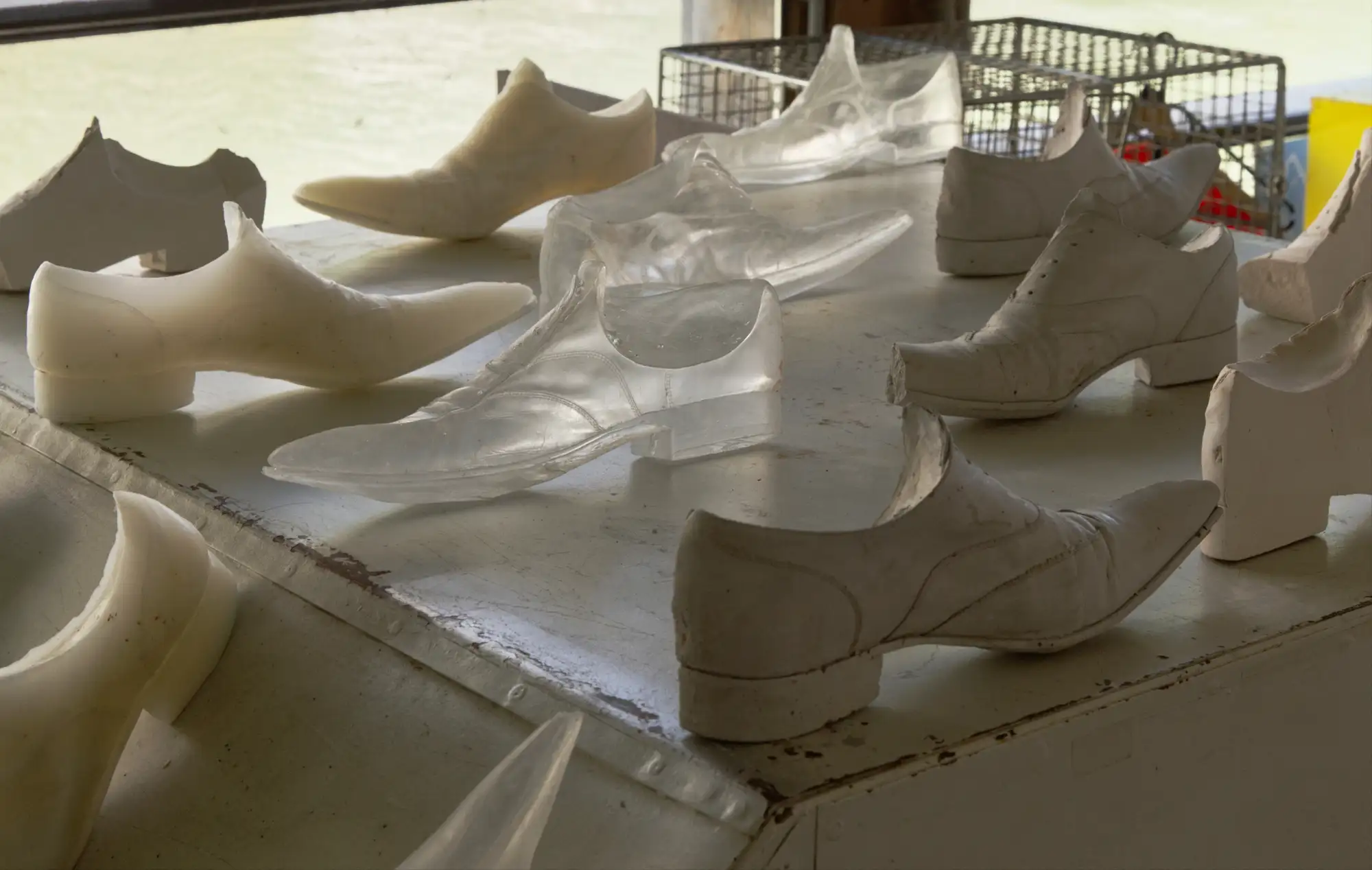
© Foto: Anna Knödl
Neta Asher Goshen. Aquarium #2
Engaging with standardization and material hierarchies, the work looks at how systems—of thought as well as industry—produce variation within sameness, identical but not equal.
Using materials tied to various modes of production, the work reflects on the constructed distinction between “natural” and “synthetic”. Objects appear as fragmented evidence, held in protective conditions.
A romantic condition of mediated access frames itself. Visibility and desirability are structured through separation, or splitting. How tragic.
OSB board, pine plywood, steel, aluminum, plaster, cement, resin, wax, 2026
Badeschiff Wien
Wolfgang-Schmitz-Promenade 4
1010 Wien
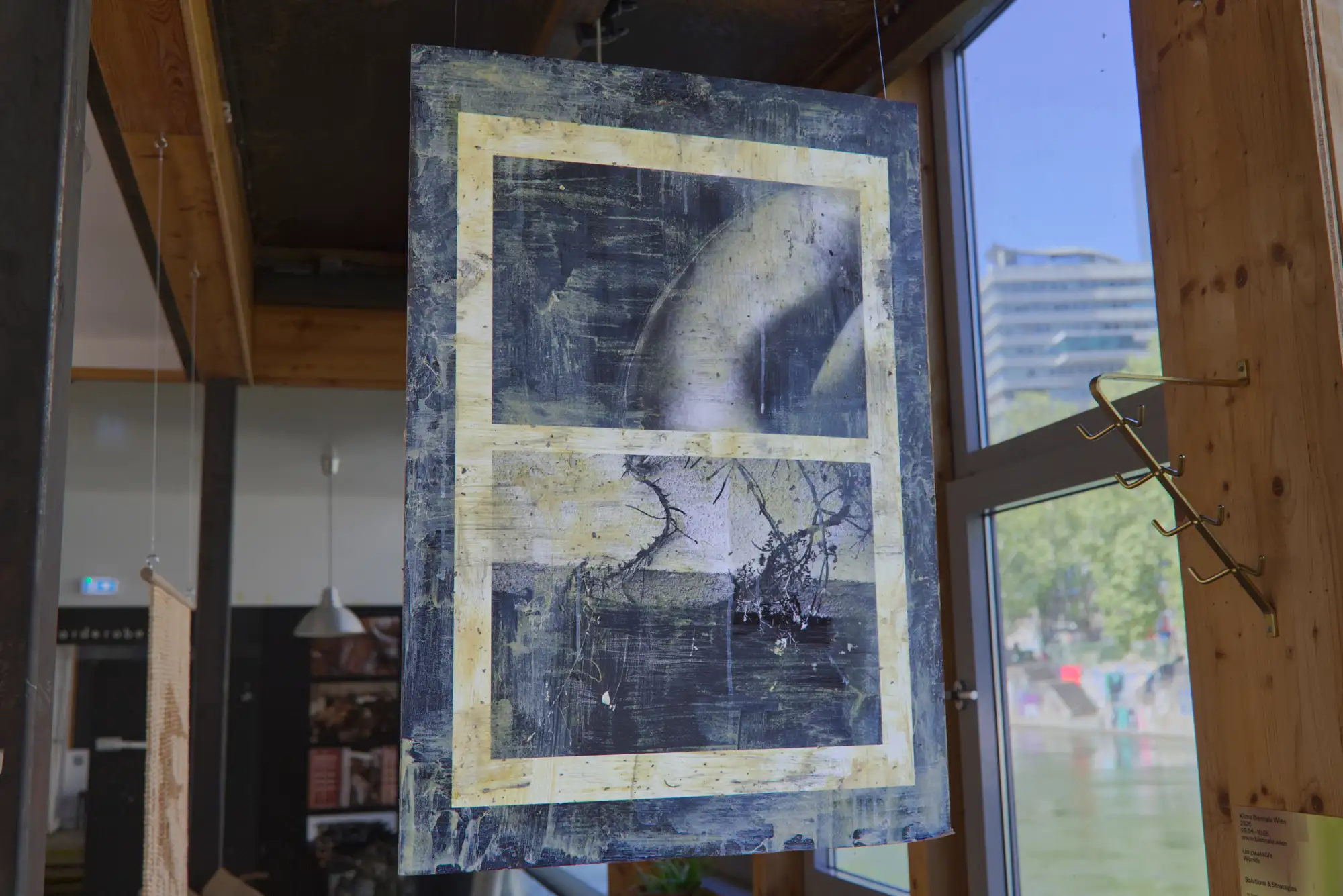
© Foto: Anna Knödl
Veronika Mozberg. Esiema
Esiema - an Estonian word meaning foremother, ancestress, or female progenitor - evokes the ancestral feminine as a living archive of ecological memory. Rooted in Estonian cultural landscapes, she embodies the inseparability of body and land; where human existence is not apart from nature, but entangled within it.
In the context of the climate crisis, these fragmented bodies merging with natural forms reflect both origin and vulnerability. The dissolution of boundaries between skin and soil becomes a reminder: environmental change is not distant - it is inscribed onto the body itself.
Photo printing on paper, 2025
Badeschiff Wien
Wolfgang-Schmitz-Promenade 4
1010 Wien
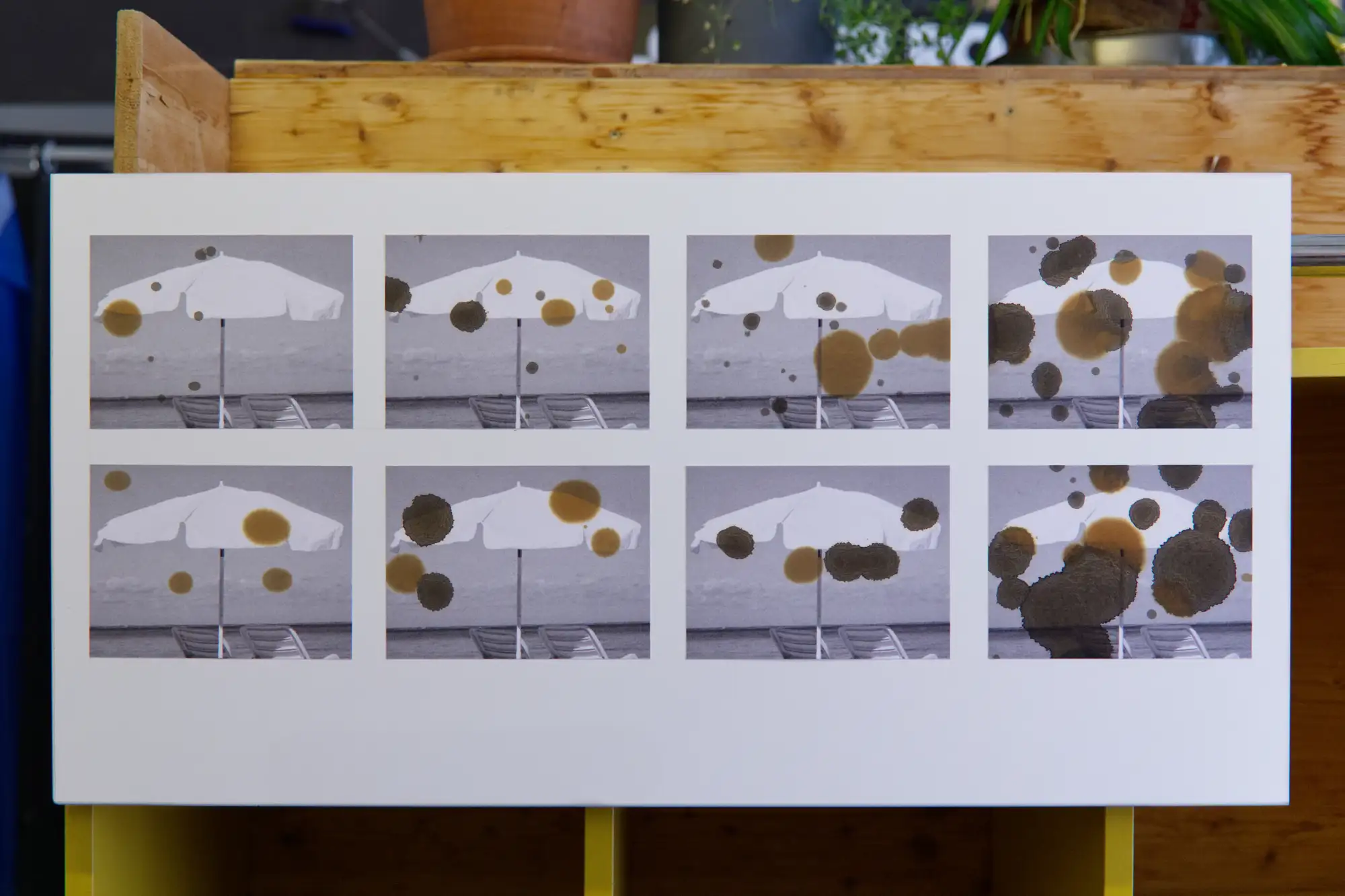
© Foto: Anna Knödl
Tatiana Vishnyakova. ohne Titel
Paper, used motor oil, 2026
Badeschiff Wien
Wolfgang-Schmitz-Promenade 4
1010 Wien
© Foto: Anna Knödl
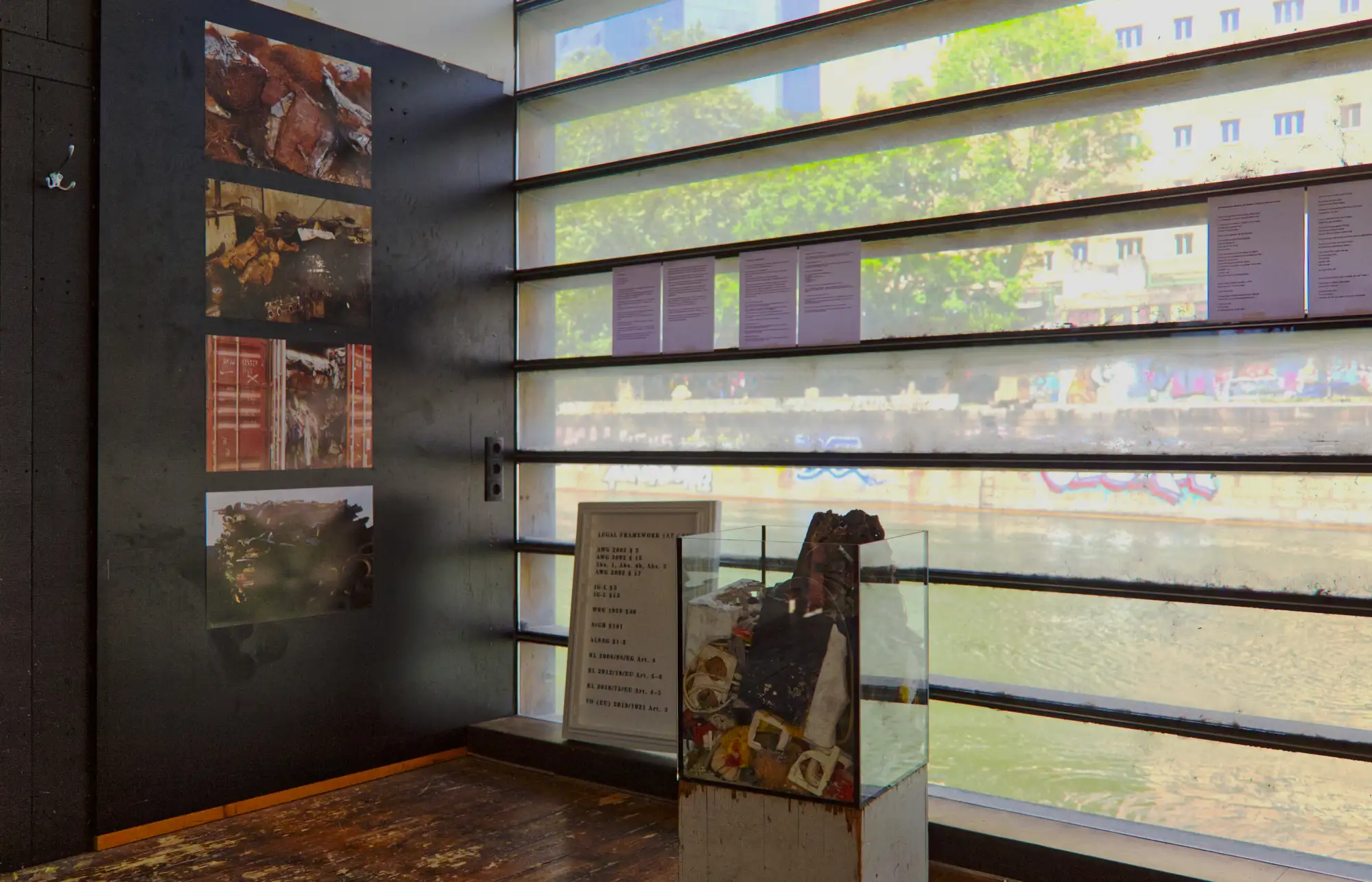
Lukas Sterzenbach. Scrap Cycles
Das Projekt setzt sich mit der Verarbeitung von Elektroschrott auf Deponien in Ghana auseinander, der hauptsächlich aus Europa, Nordamerika und China stammt. Durch die Spuren des Verbrennens und Zerlegens wird ein System sichtbar, das in globale Kreisläufe des Konsums eingebunden ist und ökologische Verantwortung verlagert, während resiliente lokale Praktiken der Wiederverwendung Wert neu ordnen und Materialien zurück in diese Kreisläufe führen.
With thanks to the New Futures Collective, the Initiative of Change USA and the EVC for their support and collaboration in the research-process in Ghana.
Installation, Photography, Waste, 2026
Badeschiff Wien
Wolfgang-Schmitz-Promenade 4
1010 Wien
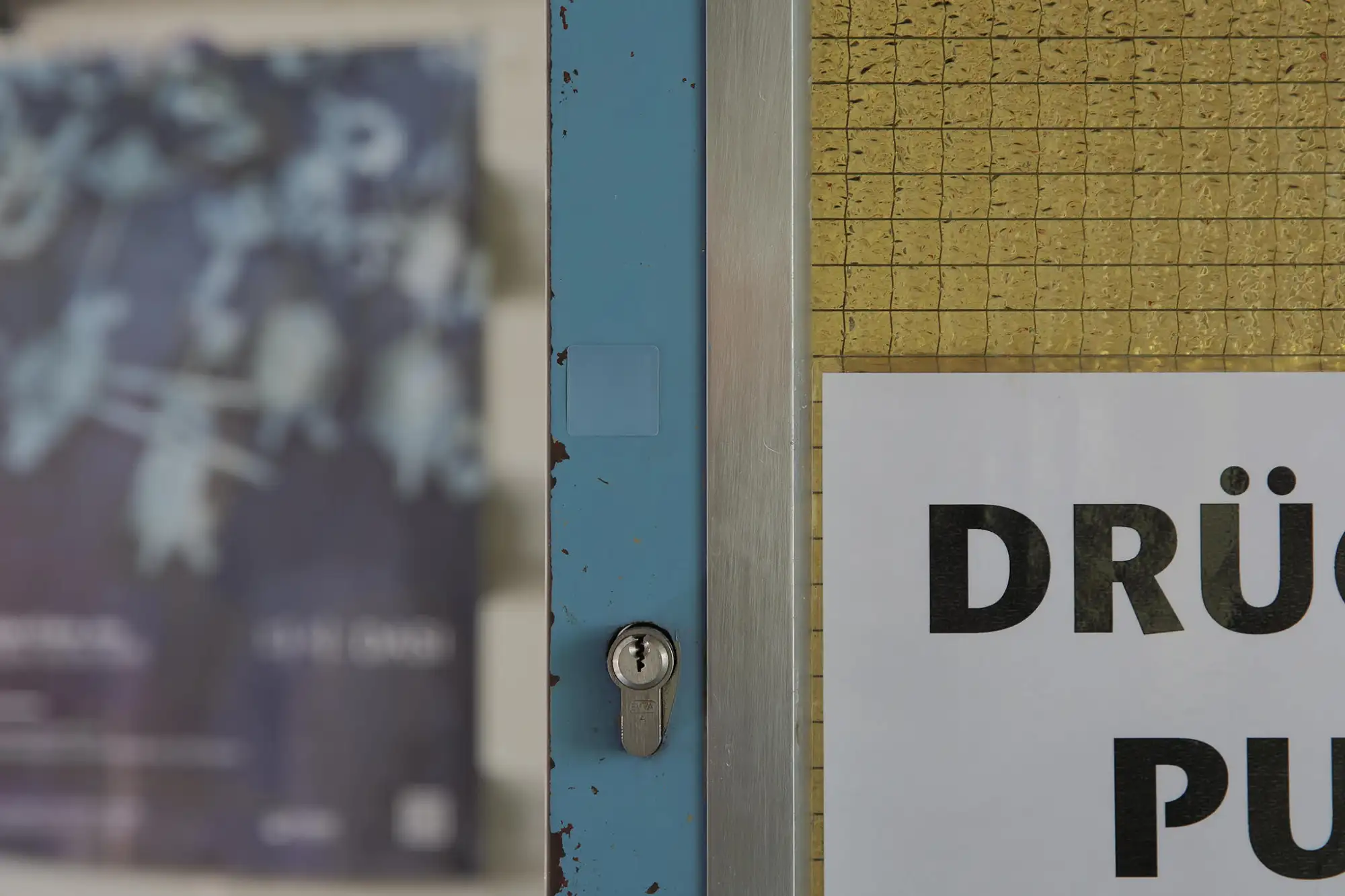
Beatrix Johnstone. Pasties
A slanted rectangle on a yellow metal door. A circle on a wooden table, painted white. A smaller circle on a corrugated wall, also white. A rectangle on a metal handrail. Another rectangle—or is it a square?—with a ridged edge on a wooden wall. A square with rounded corners on a blue doorframe.
Badeschiff Wien
Wolfgang-Schmitz-Promenade 4
1010 Wien
© Foto: Mika Roumeliotis
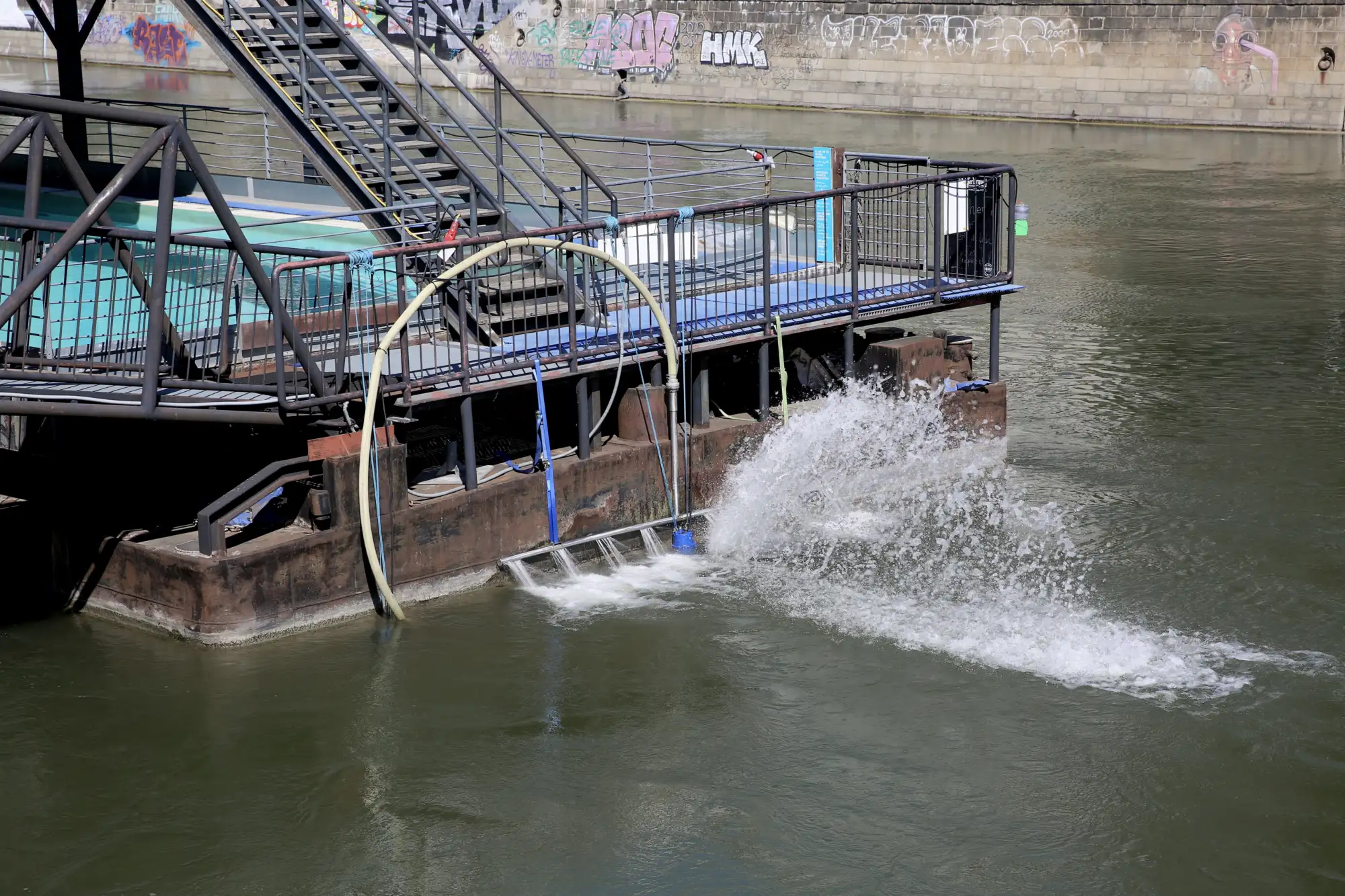
Gala Alica, Lara Friesz, Mika Roumeliotis. Weisswasser
The work Weisswasser engages directly with the Donaukanal water, using it as both a material and a surface to create on. Water becomes sculptural here – a transformable, moving material whose surface is changed to create an ephemeral sculpture. With the help of a water pump, the Danube water is pumped out of the canal and pushed back outward into the canal, temporarily creating a disruption on the water's surface.
Activated only occasionally during the exhibition, the work uses what is already present on site. Visible from the nearby bridge and canal walkway, it addresses passers-by and aims to create a brief disturbance or moment of confusion, before everyday life slips back to normal.
Badeschiff Wien
Wolfgang-Schmitz-Promenade 4
1010 Wien

© Foto: Anna Knödl
Max Koloman Oswald. Eisbärn müssen nie weinen
the work explores the commodification of the polar bear as a stylized icon of the climate catastrophe, questioning the accompanying reduction of complex interrelations to consumable imagery.
Badeschiff Wien
Wolfgang-Schmitz-Promenade 4
1010 Wien
© Foto: Anna Knödl
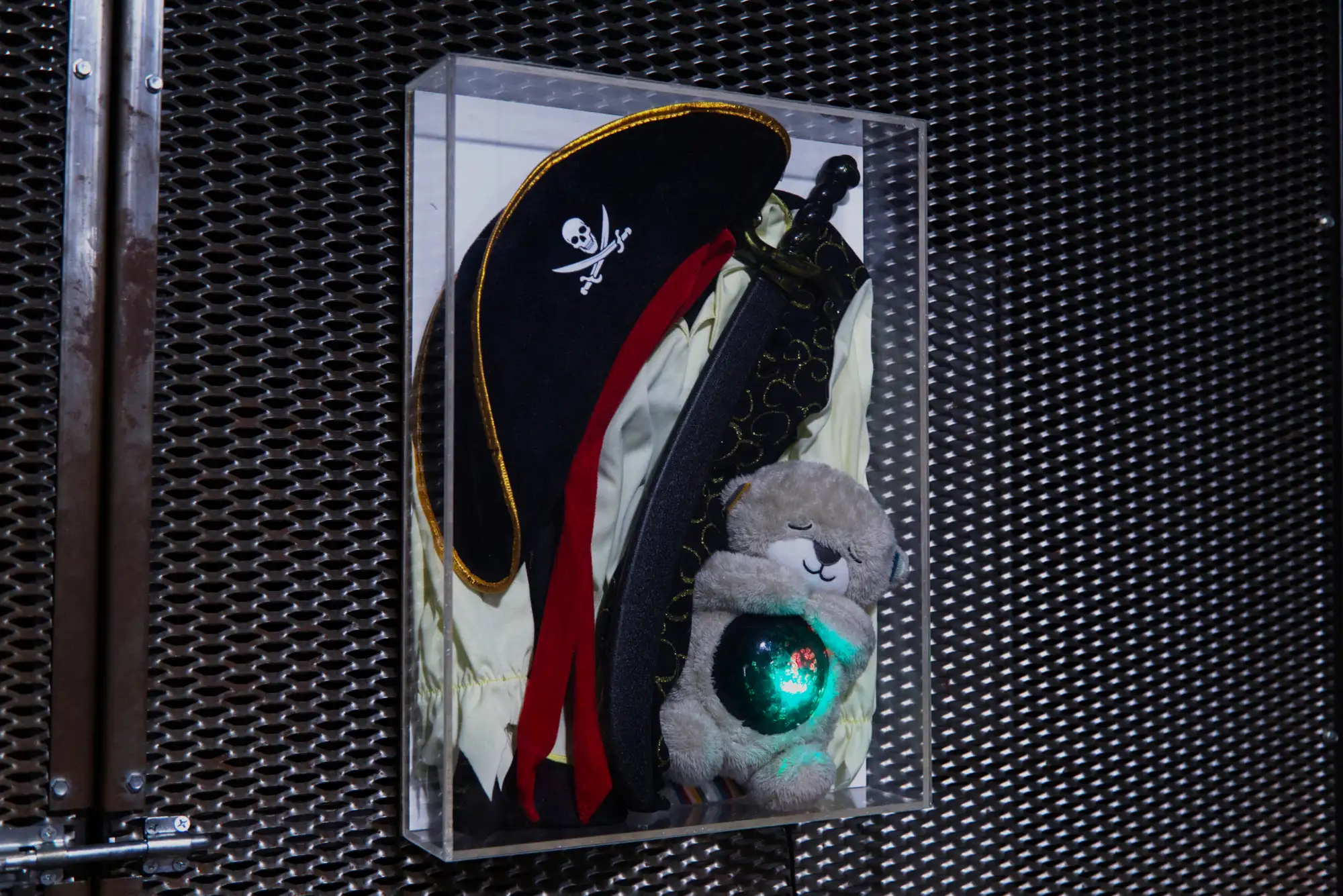
Marcus Wagner. Apocalypse & Apocalypse II
The assemblage “Apocalypse” makes use of several collected second-hand items from Willhaben to formulate a sense of the current state of humanity.
The depicted scene, which places a plastic Playmobil pirate ship at its center, is presumably less to be understood as a clear critique or stance on consumption (although it implies this), but rather as an attempt to visualize the atmosphere of a lost dream. A toy from our childhood is used here as a kind of decoy, luring us further into the illusion that we can continue as before. A deeply rooted, bitter sense of burden follows the joyful sight of adventurous and carefree play from days gone by.
Badeschiff Wien
Wolfgang-Schmitz-Promenade 4
1010 Wien
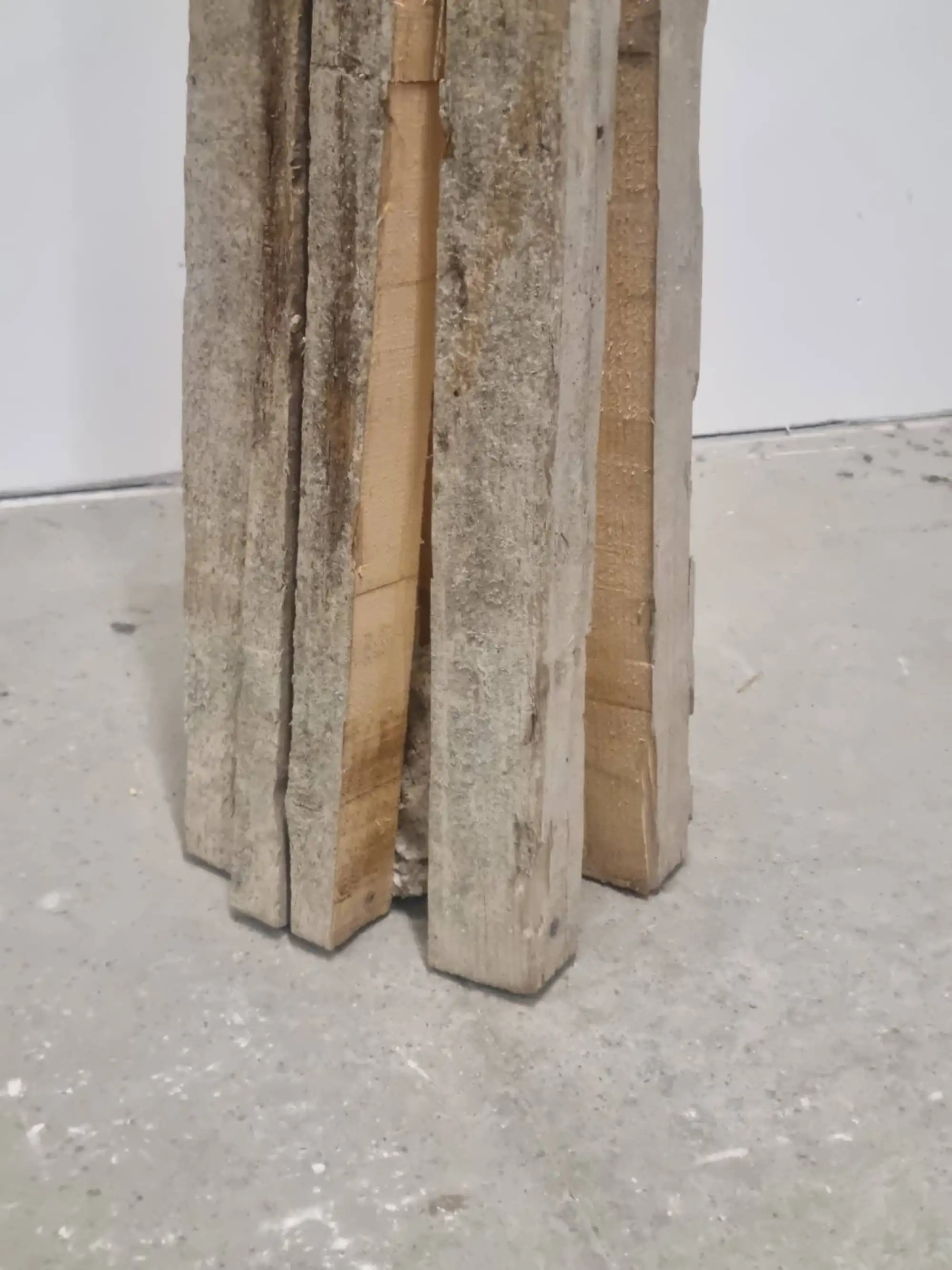
Leandra Erdödy & Jonathan Dellago. And when they weighed anchor?
//To be read in a scratchy, saltwater-corroded voice//
Behold here, a finest specimen, first split, then driven, then hanged, yes, truly a masterpiece...groan...Ah yes, now on with the story:
And when they weighed anchor, their journey began, the wind sang with the fullest longing for distant lands, the waves broke against the ship's sides from all sides. Seawater lapped onto the deck, enveloping the toiling legs, who practiced the dance of the steering wheel...
Badeschiff Wien
Wolfgang-Schmitz-Promenade 4
1010 Wien
© Foto: Anna Knödl
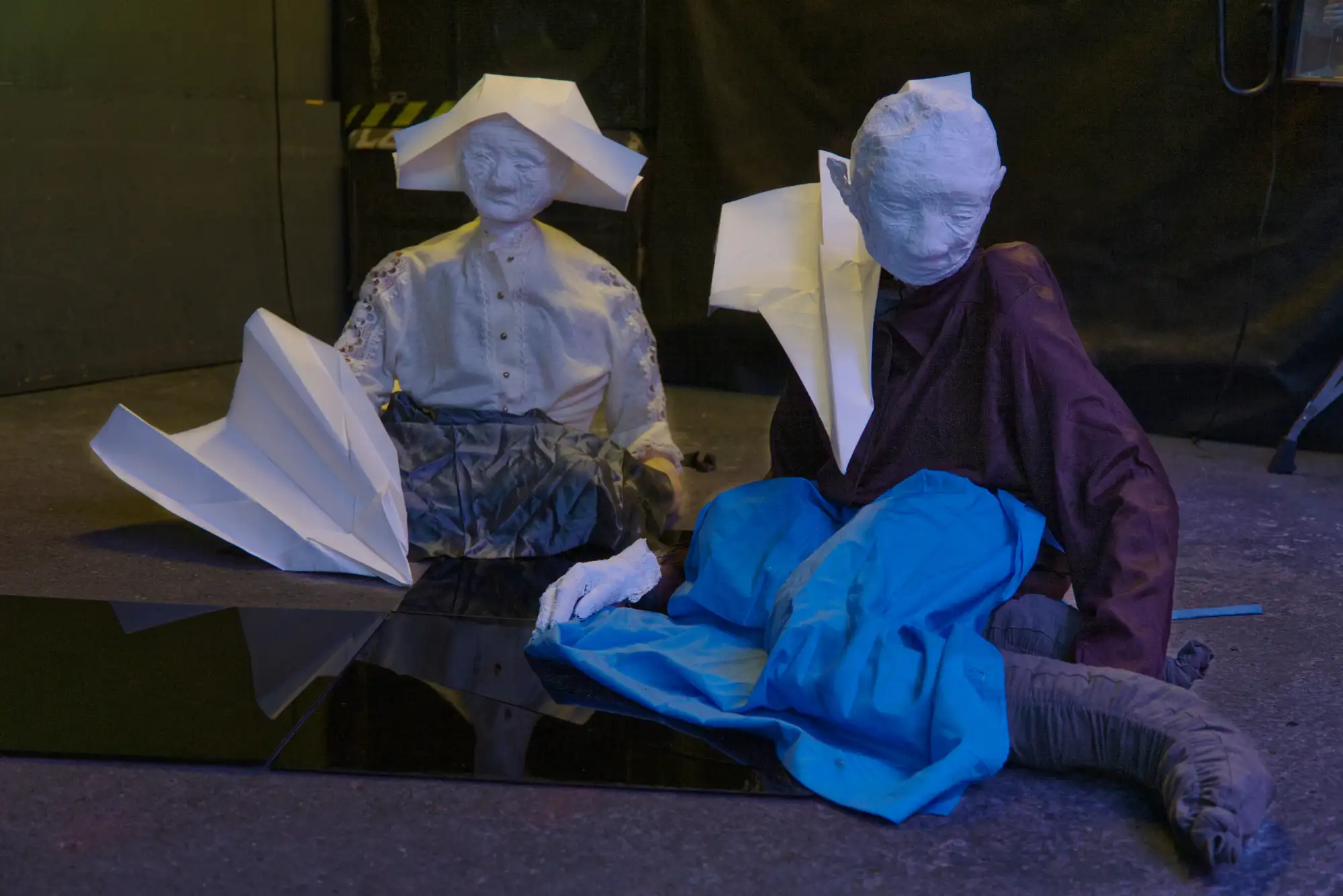
Aza Aufgewekt. Life Effort
The installation Life Effort explores feelings of paralysis emerging from cognitive overload. Today, more information than ever is instantly available, creating to a flood of information that can be hardly fully processed. For many this constant urgency leads to a loss of ability to decide and act. What should provoke response instead dissolves into numbness. The work invites viewers to inhabit this state of excess and asks how agency can be reclaimed in a state of overwhelm.
Thank you to my mom, Heide Aufgewekt, for supporting me!
Badeschiff Wien
Wolfgang-Schmitz-Promenade 4
1010 Wien

© Foto: Anna Knödl
Marie Kaňákova. water loop
This installation uses the familiar aesthetic of bar bottles to explore closed-loop systems. Water circulates within glass bodies, serving as a reminder of the preciousness and constant movement of this vital resource. By placing these fountains in the Badeschiff's bar areas, social space is linked with ecological questions: How do we treat our fundamental resources while we consume? A technical ballet of glass and light highlighting the necessity of sustainable cycles.
Badeschiff Wien
Wolfgang-Schmitz-Promenade 4
1010 Wien
© Foto: Anna Knödl
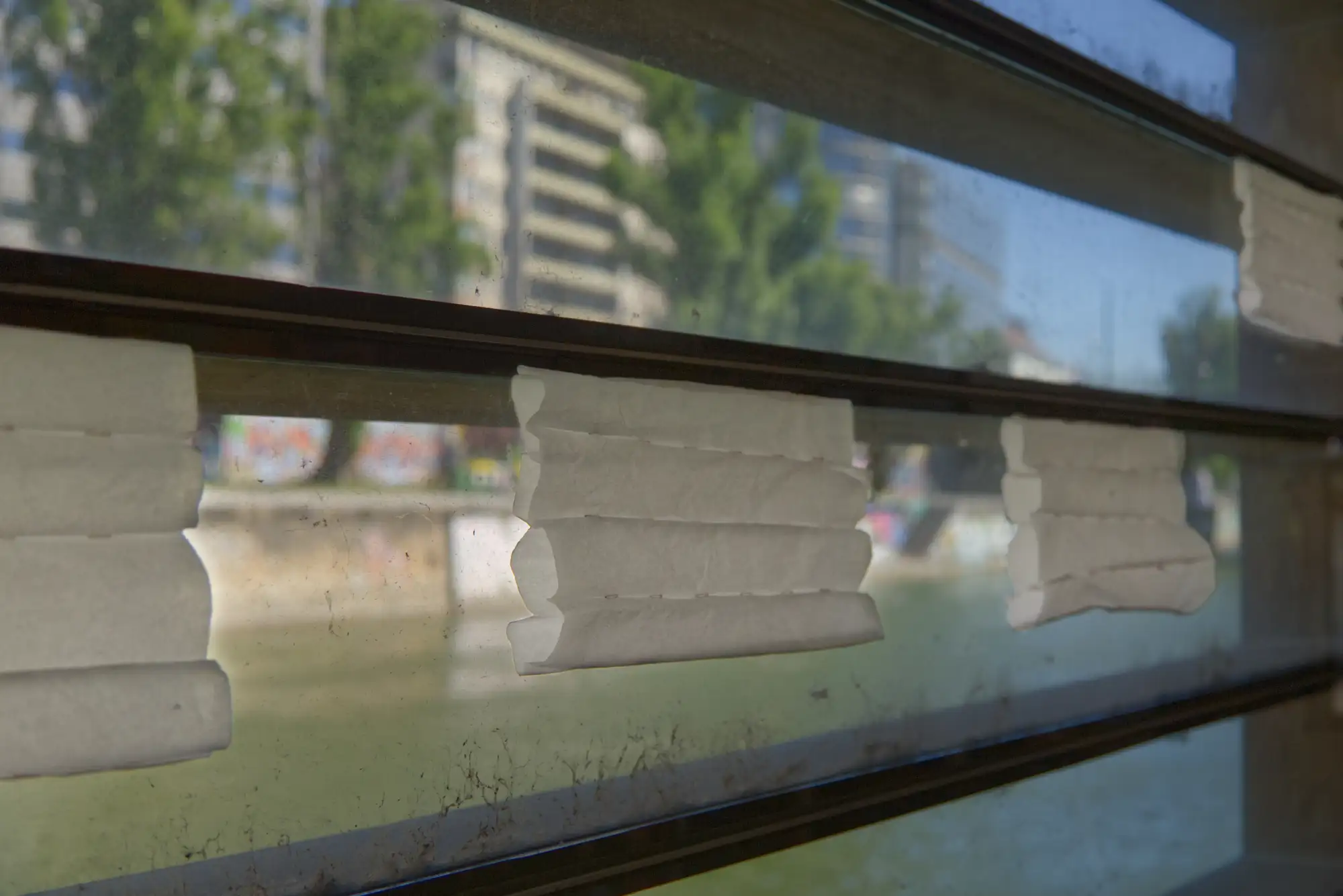
Elza Grono. Leakage / Linkage
The work explores where the outside and inside meet to form an
interdependence. Where there is control of what is let in and what is let out. The intricacies of support and functionality in a space/system sustained by its own resources.
Badeschiff Wien
Wolfgang-Schmitz-Promenade 4
1010 Wien
© Foto: Anna Knödl
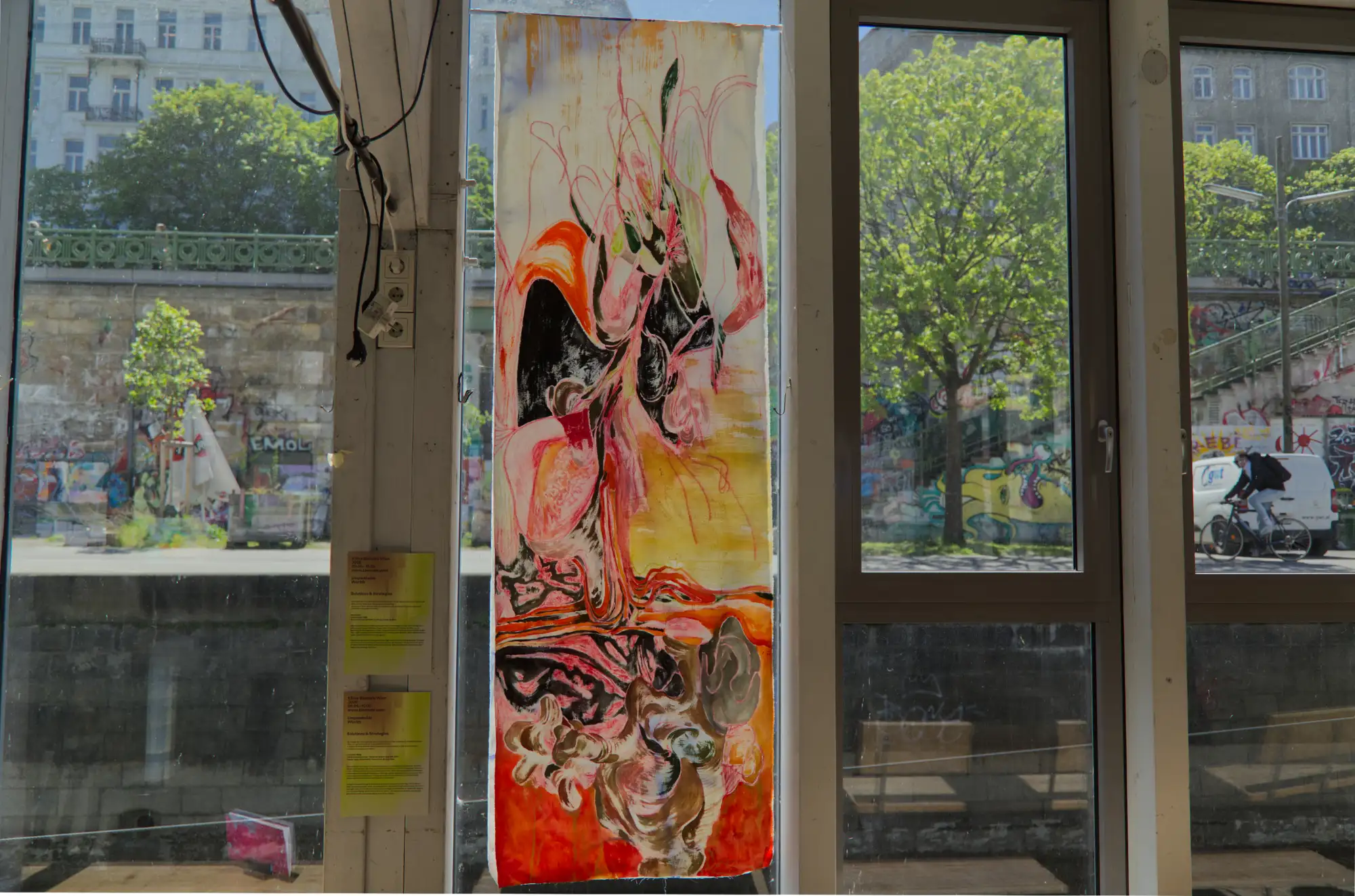
Boyun Park. Uncontrolled
Water flows downward, trees grow toward light, and wind moves along pressure. This work reflects on nature’s tendency toward balance through movement. The layered drips, stains, and gestures follow a logic of gravity and response, allowing material to find its own path rather than imposing fixed form.
Badeschiff Wien
Wolfgang-Schmitz-Promenade 4
1010 Wien

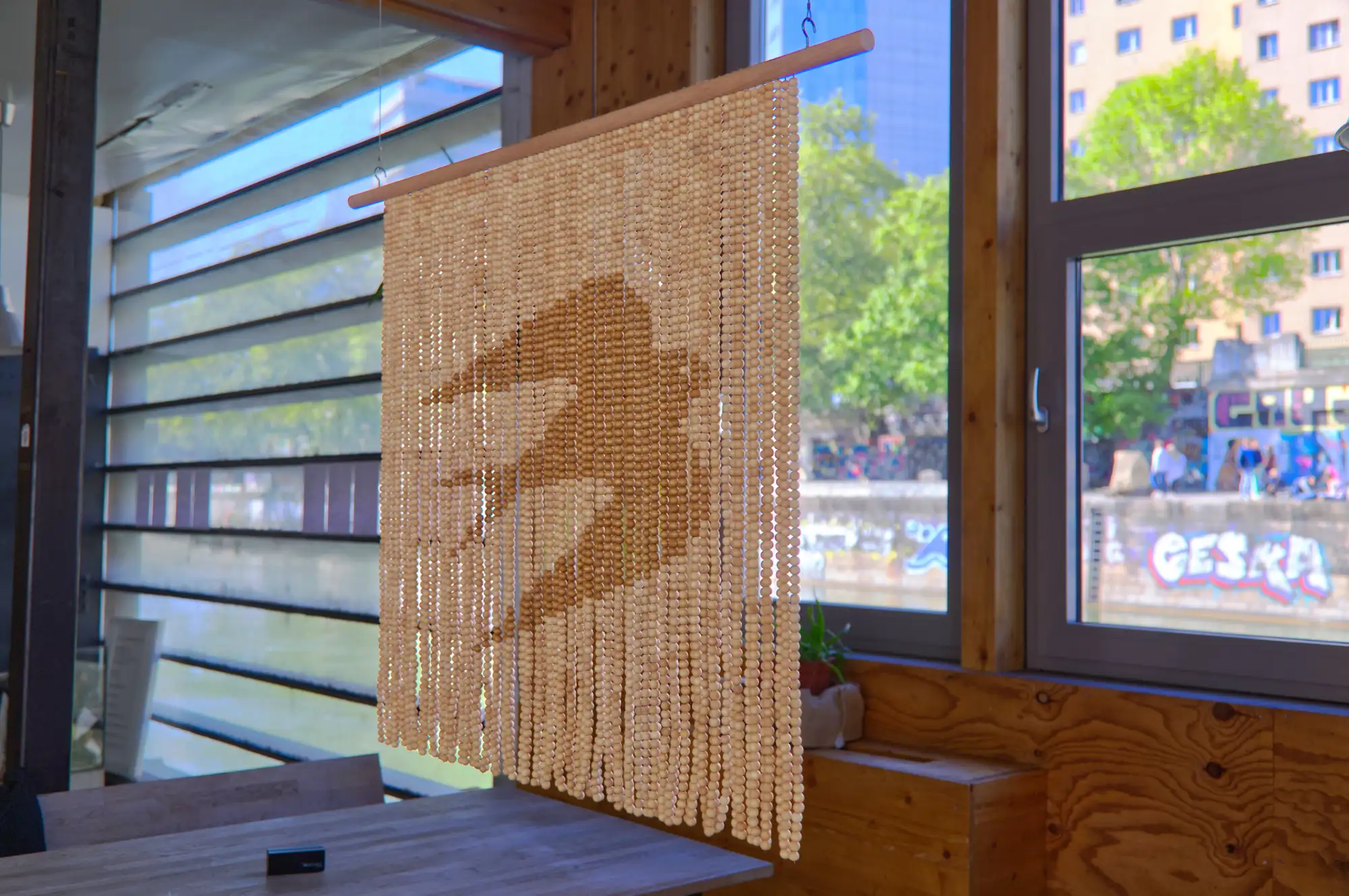
Gianna Magdalena Semmelhaak. circulation in frame
The work understands the Mediterranean as a space shaped by political, economic, and military processes and raises questions of responsibility within the context of global inequalities. The situation in the Mediterranean is shaped by the relationship between forced displacement, geopolitical interests, and economic structures. European border policies organize access to mobility according to principles of selection and exclusion. State actors and institutions such as coast guards and Frontex combine border control with practices of monitoring, deterrence, and selective intervention. Civil sea rescue organizations operate within this field of tension between humanitarian assistance and politically regulated restrictions on access.
In this context, the situation in the Mediterranean is not only a humanitarian crisis, but an expression of global inequalities in which access and protection are unevenly distributed.
Badeschiff Wien
Wolfgang-Schmitz-Promenade 4
1010 Wien
© Foto: Anna Knödl
Gwiyeon Han. Untitled
Some things only become visible when we look closely. What is happening around us right now? This change is still underway, yet we rarely notice it. Have we grown so accustomed to it that we’ve become indifferent? Or do we turn a blind eye, afraid to face the truth? Take a moment to confront the frozen scream at your feet. In what form has this quiet change, long ignored, arrived at our doorstep? How desperately have the things we failed to notice been clinging to survival?
Badeschiff Wien
Wolfgang-Schmitz-Promenade 4
1010 Wien
Kieren, Aza, Gianna, Gabriel, Afiya, Melinda. Q
This project emerged from an artistic–scientific collaboration between students of the University of Natural Resources and Life Sciences, Vienna and the Academy of Fine Arts Vienna.
The group engaged with Quilombola communities in Brazil—descendants of formerly enslaved people who continue to struggle for land rights, autonomy, and the preservation of their ways of life.
Drawing on research into historical contexts, territorial struggles, collective forms of organization, and ecological practices of subsistence, the project brings together text-based work, drawing, film, and sound.
The resulting work approaches questions of community, resistance, and sustainable relationships to land and resources through an artistic lens.
Badeschiff Wien
Wolfgang-Schmitz-Promenade 4
1010 Wien
© Foto: Anna Knödl
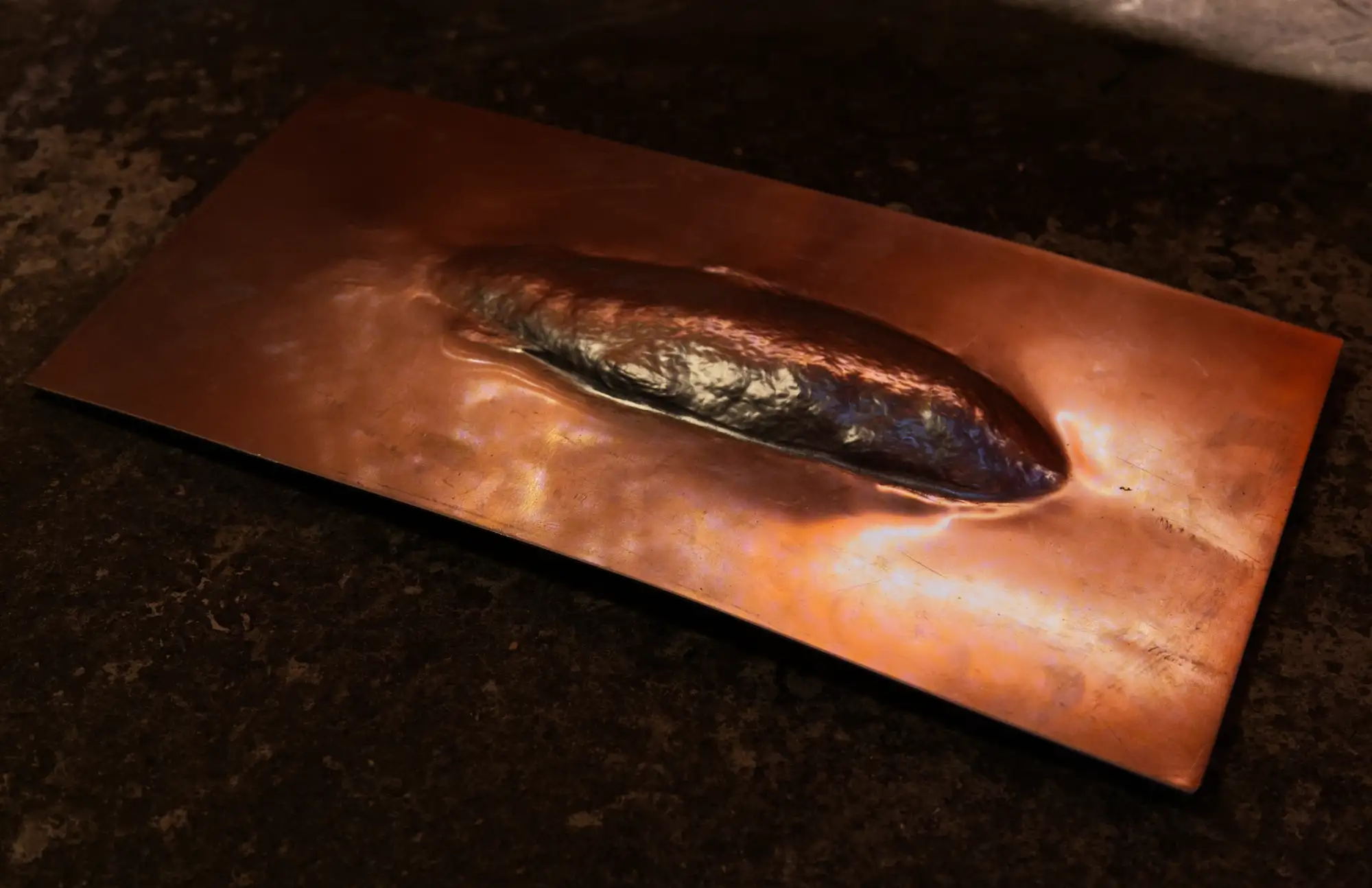
Benjamin Ben Amotz. Function unknown
The object was recovered in 2019 during routine drainage work along the Leitha river, near the Austrian-Hungarian border. It is estimated to date to the mid-17th century, attributed to a small community inhabiting the river valley during a period of prolonged regional displacement. The craftwork combines aluminium, brass, and copper in a manner that suggests both practical salvage and deliberate ritual intent. The community is otherwise undocumented. The object was preserved by the specific mineral composition of the riverbed sediment. Its current loan is facilitated by the Regional Museum of Burgenland.
Badeschiff Wien
Wolfgang-Schmitz-Promenade 4
1010 Wien
© Foto: Anna Knödl
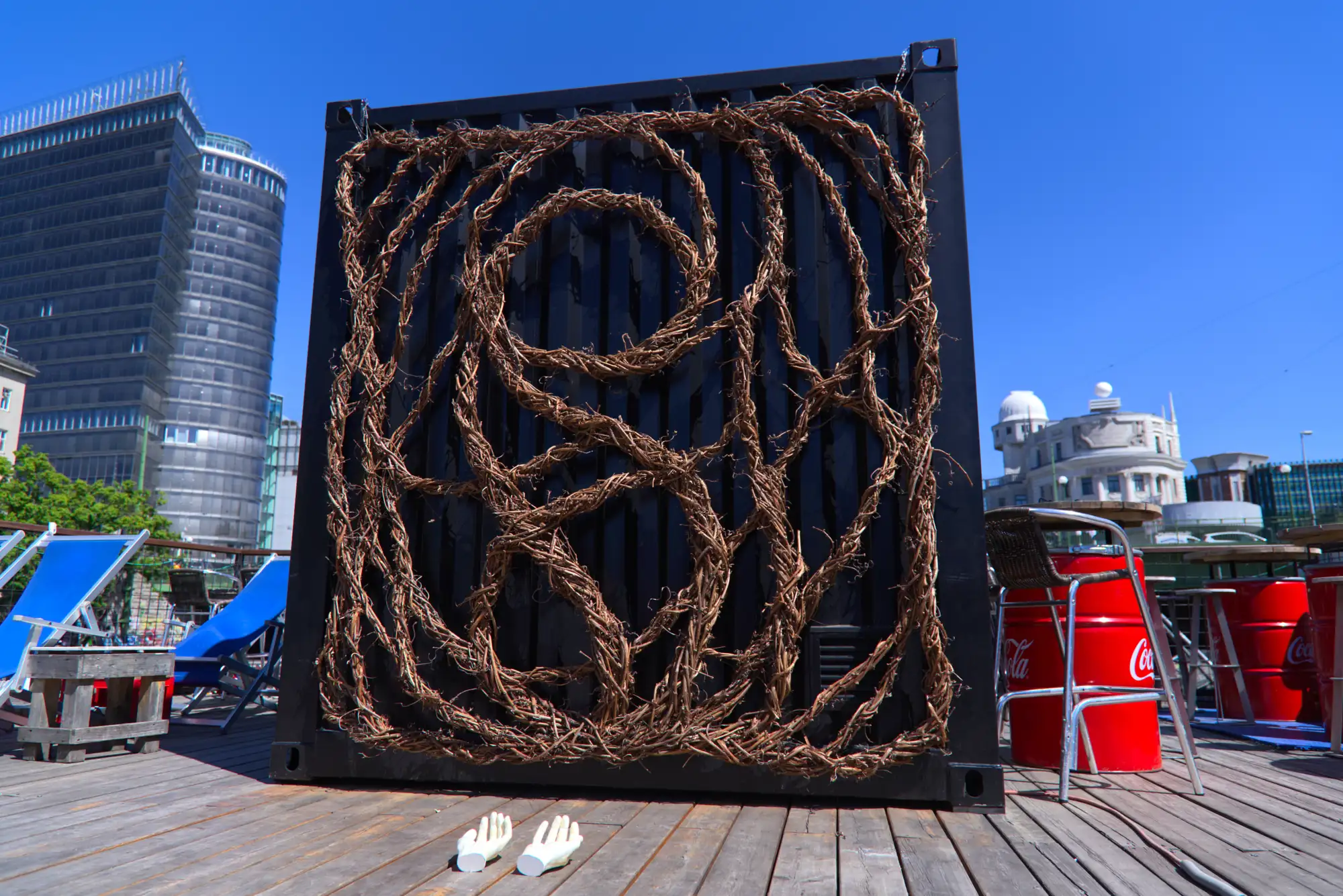
Lukas Matzke. Weaving (Nr.3)
The work “Weaving (No. 03)” is about the appreciation and worship of a living being, while at the same time addressing domestication and dominance when we view this being as mere material.
To produce and to process also means to accept and enact a certain position of supremacy. At the same time, however, we should never forget our dependencies and should be grateful to the resources for their unwittingly sacrificial role.
The material is a victim of our processing, and without restraint, we become its squanderers.
We constantly seek to dissolve these dependencies and demand the impossible: life without vitality.
Badeschiff Wien
Wolfgang-Schmitz-Promenade 4
1010 Wien
Opening Hours
Mon-Sun: 12:00 – 01:00 Uhr
Adress
Badeschiff Wien
Wolfgang-Schmitz-Promenade 4
1010 Wien
Events
Supported by